Our Short List of 3


All 3 Picks at a Glance
| Product | Specs | Action |
|---|---|---|
| 1. VIAGL 2 Pack Tractor Bucket Grab Hook, Grade 70 (VG003) — The Straightforward Pair | Check price on Amazon | |
| 2. AUTMATCH Tractor Bucket Grab Hook, 2 Pack — Highest Stated Ratings, With Rubber Pads | Check price on Amazon | |
| 3. REDTEE Tractor Bucket Grab Hook With 5/8 Inch D-Shackle — Hook and Shackle on One Plate | Check price on Amazon |
Key takeaways
- Compare the best bolt-on tractor bucket hooks by chain size, working load limit, backer plate and hardware, from plain Grade 70 grab hooks to hook and shackle combos.
As an Amazon Associate we earn from qualifying purchases.
A loader bucket is a scoop, not a crane, but a pair of properly mounted grab hooks turns it into a far more useful lifting and dragging tool. With hooks bolted to the top edge of the bucket, a chain stays exactly where you put it instead of sliding along a smooth cutting edge, and jobs like pulling fence posts, skidding logs to a splitting area, lifting a mower deck for blade service, or setting a heavy implement onto a stand become controlled instead of improvised.
Bolt-on hooks are the version most compact and utility tractor owners should consider first. Unlike weld-on hooks, they need no welder, no paint stripping, and no heat near hydraulic lines, and they can be removed or moved when you sell the tractor or change buckets. The catch is that a bolted mount is only as good as its plate, its backer, and its hardware, and the listings in this category use load numbers in several different ways. This guide compares four real bolt-on grab hook products, states each maker’s own ratings as ratings rather than as promises, and explains the differences that actually separate them: hook and chain size, working load limit versus breaking strength, plate construction, included hardware, and whether you also get a tie-down point.
Disclosure: This article contains affiliate links. If you buy through a link on this page, we may earn a commission at no extra cost to you. Specifications and ratings are taken from the manufacturer and retailer listings, are not a substitute for your loader manual, and should be confirmed on the product page before ordering.
Quick Comparison
| Product | Chain size | Maker-stated working load limit | Maker-stated breaking strength | Extras |
|---|---|---|---|---|
| VIAGL 2 Pack Tractor Bucket Grab Hook (VG003) | 3/8 inch, Grade 70 | 6,600 lb | 15,400 lb | Backer plates, washers and nylon lock nuts |
| AUTMATCH Tractor Bucket Grab Hook, 2 Pack | 3/8 inch, Grade 70 | 9,000 lb | 18,000 lb | Backer plates, rubber pads, flange bolts and lock nuts |
| REDTEE Tractor Bucket Grab Hook with D-Shackle | 3/8 inch | Not stated as WLL; 10,000 lb maximum load stated | Not stated | Combined 5/8 inch D-shackle tie-down on the same plate |
| Sulythw Tractor Bucket Hooks with D Rings, 2 Pack | 3/8 inch, Grade 70 | Not stated as WLL; 15,000 lb maximum stated | Not stated | 1/2 inch tie-down D rings on the hook plates |
Read the Load Numbers Correctly Before Anything Else
Every hook in this guide is a chain grab hook, and every rating below belongs to the hook product as its maker states it. None of them raises the lifting capacity of your tractor. Your loader’s rated capacity at the bucket, your tractor’s stability with a raised load, and the strength of the bucket steel itself are all separate limits, and the lowest of them governs any lift. A hook rated above your loader’s capacity does not make the loader stronger; it simply means the hook is unlikely to be the weakest link when it is mounted and used correctly.
Working load limit, often shortened to WLL, is the load the maker intends the product to carry in normal use. Breaking strength is the load at which test samples failed, and it is never a working target. Where a listing states only a maximum load or maximum tow figure without calling it a working load limit, this guide says so plainly and does not convert it into one. Keep loads low, travel with the bucket close to the ground, lift evenly from two hooks where the load allows, and never stand under a suspended load, whatever hook you choose.
1. VIAGL 2 Pack Tractor Bucket Grab Hook, Grade 70 (VG003) — The Straightforward Pair
The VIAGL set is the reference design for this whole category, done without extras: two 3/8 inch Grade 70 grab hooks in drop forged steel, each welded to a bolt-on mount with a backer plate, plus the washers and nylon lock nuts needed to install the pair. The finish is described as galvanized and powder coated, a sensible combination for a part that lives outside, gets chained, and has its coating knocked by chain links every time it works.
The maker rates the hook at a working load limit of 6,600 pounds with a breaking strength of up to 15,400 pounds. Those are the clearest, most conservatively presented numbers in this comparison: a defined WLL well below the breaking figure, matched to the 3/8 inch Grade 70 chain the hook is sized for. A grab hook’s narrow throat is designed to cradle a single chain link so the chain cannot slip through, which is exactly what you want when a log shifts mid-drag or a load settles as you lift.
The package contents are worth reading closely because they describe the mounting system: two mount backer plates, two grab hooks, and four washers with nylon lock nuts. The backer plate is not a decorative extra. Bolting a hook through a single thickness of bucket wall concentrates the load on a small area; a backer spreads it, resists the plate pulling through or dimpling the bucket, and keeps the mount from working loose as the bucket flexes. Nylon lock nuts are the right default here because loader buckets vibrate constantly and plain nuts back off.
The listed package dimensions are 5.31 x 3.54 x 3.74 inches, which gives a sense of the mount’s compact footprint along the top of the bucket. That compactness helps on smaller compact tractor buckets where the top edge is crowded by spill guards or level indicators, but it also means you should check that your drill pattern clears any reinforcement ribs on your specific bucket before you commit to a position.
Choose the VIAGL pair if you want the plain, well-specified version of this tool: chain work only, honest ratings, backer plates included, and nothing else competing for space on the plate. Look elsewhere only if you also need a shackle point for straps, or if the higher stated ratings and rubber pads of the AUTMATCH set below suit a heavier chain routine.
2. AUTMATCH Tractor Bucket Grab Hook, 2 Pack — Highest Stated Ratings, With Rubber Pads
AUTMATCH builds the same basic product — two 3/8 inch Grade 70 bolt-on grab hooks with quarter-inch thick backer plates — and then adds the details owners tend to ask for after their first installation. The hooks are described as high-strength drop forged steel, heat treated, robot welded to their plates, and finished by galvanizing and powder coating. The maker states a working load limit of 9,000 pounds and a breaking strength of 18,000 pounds, the highest pair of figures in this guide.
Treat those figures the way you should treat any maker’s figures: as the rating of the hook assembly as tested by its maker, not as a new capacity for your loader, and not as a reason to lift more than your tractor’s manual allows. The practical value of a stronger hook is margin — the hook stays further from its limit during the shock loads that happen when a chain comes tight or a dragged log catches a root.
The hardware package is the most complete here. The listing includes two grab hooks with backer plates, two rubber pads, four Grade 10.9 flange bolts in half-inch size, flat washers, spring lock washers, hex nuts, and metal self-locking nuts. The rubber pads are a small thing that owners appreciate immediately: they sit between plate and bucket, protect the bucket’s paint, and reduce the metal-on-metal fretting that loosens mounts over a season. Multiple finishes are offered, including colors matched to common tractor liveries, which is cosmetic but harmless.
Installation follows the shared pattern for this category: position the hooks, drill the bucket, sandwich the bucket wall between the hook plate and the backer plate, and torque the hardware evenly. With two hooks, mount them in line with the loader arms where possible, because loads introduced near the arms travel into the loader structure instead of twisting the bucket shell. Spacing them roughly above each arm also makes two-chain lifts balance naturally.
Choose AUTMATCH if you want the strongest stated numbers in this group, the most complete hardware kit, and paint protection included. Choose a simpler set if you dislike having spare washer types left over or if your bucket top is too narrow for its plates — measure first, as always.
3. REDTEE Tractor Bucket Grab Hook With 5/8 Inch D-Shackle — Hook and Shackle on One Plate
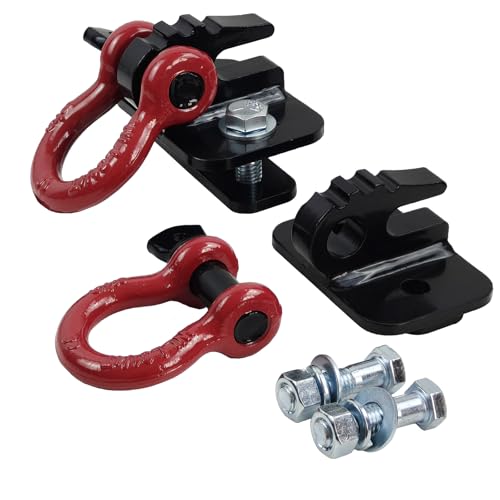
REDTEE takes a different approach: instead of two identical plain hooks, this product combines a 3/8 inch grab hook and a 5/8 inch tie-down D-shackle on a single bolt-on plate. The idea is that bucket work is not all chain work. Sometimes the right connector is a shackle through a strap eye or a rope, and having a closed shackle point next to the grab hook means you are not wrapping straps around a hook throat that was designed for chain links.
The listing describes high-strength steel construction with a black coating and states a maximum load capacity of 10,000 pounds. Note the wording, because this guide preserves it deliberately: a maximum load is stated, rather than a working load limit paired with a breaking strength as the VIAGL and AUTMATCH listings provide. That does not make the product weak, but it does mean you should apply your own larger safety margin, keep loads modest, and treat the loader manual as the controlling document, as you should with every pick here.
Installation is documented in four plain steps: position the hook plate, insert the bolts, fit the bottom steel plate, and secure with nuts and washers, using half-inch bolts through drilled holes. That bottom plate plays the same backer role as on the other mounts, spreading load through the bucket wall. Because hook and shackle share one plate, placement deserves extra thought: mount the unit where both connectors are reachable and where a shackle pin can be inserted and removed without fighting the bucket’s top edge or spill guard.
This is also the newest design in the comparison, with a first available date in 2025 listed for the product, and its single-unit format differs from the two-packs around it. If your work needs a matched pair of lift points, price out two units or choose a two-pack instead. If your typical job is one central chain pull plus a strap to steady the load, the combined plate is genuinely convenient and keeps the bucket top uncluttered.
Choose REDTEE if your loads regularly mix chain and straps and you want both connectors on one mount. Choose a plain two-pack if you mostly lift balanced loads from two hooks, or if you prefer ratings expressed as a working load limit with a separate breaking figure.
4. Sulythw Tractor Bucket Hooks With Tie-Down D Rings, 2 Pack — Grab Hooks Plus D Rings
ASIN: B0DMVK1MHZ
The Sulythw set returns to the two-pack format and adds a tie-down feature to each plate: two 3/8 inch Grade 70 forged steel grab hooks, each paired with a half-inch tie-down D ring, on plates listed at 8 x 4.25 x 0.25 inches, with a stated maximum of 15,000 pounds for the set’s hooks. The orange finish is easy to spot in a dim barn, which sounds trivial until you are trying to find the hook throat by feel while wearing gloves.
The D rings change how the bucket can be used for securing rather than lifting. A ring gives a strap hook or a chain binder a closed attachment point for tying a load into the bucket — brush, a carried implement, or a load of posts — jobs where the cargo rides in the bucket and the connector only has to keep it there. That is a different, gentler duty than suspending weight from the bucket, and it is where combination plates earn their keep. As with the REDTEE listing, the figure given is a maximum rather than a stated working load limit, so keep suspended loads conservative and within the loader’s own rating.
The quarter-inch plate thickness matches the backer-plate class of the other mounts here, and the plate footprint is larger than the VIAGL mount’s, which spreads clamping force but needs more flat, clear space along the bucket top. Check for level rods, spill guard brackets, and any quick-attach hardware that shares that strip of steel before drilling.
Choose Sulythw if you tie loads into the bucket as often as you lift with chain, and you want a ring and a hook at each of two stations. Choose the VIAGL or AUTMATCH pairs if you want ratings stated as working load limits and have no use for rings.
How to Choose Between These Hooks
Start with your chain. All four products are sized for 3/8 inch chain, and a grab hook must match its chain size: a link that is too small rattles in the throat and can slip, while oversized chain will not seat at all. If your chain is quarter-inch or half-inch, none of these is the correct hook, whatever its rating says.
Next, decide whether you need only hooks or hooks plus a tie-down point. Pure chain work favors the plain two-packs. Mixed chain, strap, and securing work favors the REDTEE combination plate or the Sulythw ring plates. There is no benefit to a shackle point you never use, and no substitute for one you need weekly.
Then compare ratings honestly. Prefer listings that state a working load limit separately from breaking strength, and treat any single maximum figure as a ceiling to stay far below. In all cases your loader manual, your tractor’s stability, and the bucket structure set the real limit.
Finally, inspect the mounting kit. A backer plate, lock nuts, and enough flat area on your bucket matter more to long-term satisfaction than any headline number, because a hook that works loose or dents the bucket wall will be removed, not used.
Installation and Safe Use
Position hooks on the top edge of the bucket, aligned with the loader arms where the layout allows, and confirm the drill pattern clears ribs, rods, and guards. Drill cleanly, deburr both sides, sandwich the bucket wall between hook plate and backer plate, use any supplied pads, and torque the hardware in stages, alternating bolts. Re-check torque after the first few hours of work and again after the first heavy pull; bolted joints settle as paint and pads compress.
Rig loads so the chain seats fully in the grab hook throat, lift slowly until the chain is taut before committing, keep the load low and the tractor on the most level ground available, and add rear ballast as your manual directs for loader work. Never use a bucket hook to lift people, never stand under or beside a suspended load’s fall zone, and retire any hook whose throat has opened, whose plate has bent, or whose welds have cracked.
Frequently Asked Questions
Do bolt-on hooks damage the bucket?
They require drilled holes, which is a permanent change, but a mount with a backer plate spreads load and protects the bucket wall far better than improvised chain wrapping, which bends cutting edges and slips. Keep holes away from ribs and edges, and touch up the drilled metal to slow corrosion.
Is welding stronger than bolting on?
A well-executed weld on a suitable bucket can be excellent, and a poor weld can be worse than bolts while also being hard to inspect. Bolt-on mounts are removable, need no welding skill, and their condition can be checked with a wrench, which is why they suit most owners.
How many hooks do I need?
Two hooks give balanced lifting and a spare station for tying loads down, and every two-pack here reflects that. A single combination plate suits owners whose work is one central pull plus a steadying strap.
Can I tow with bucket hooks?
These hooks are made for chain work at loader speeds: dragging, pulling, and lifting within the loader’s rating. They are not a substitute for a proper drawbar or hitch for road towing, and their listings’ towing language should be read in that limited sense.
Verdict
For a plain, clearly rated pair of bolt-on grab hooks, the VIAGL set is the benchmark, and the AUTMATCH set builds on it with higher stated ratings, rubber pads, and the most complete hardware kit. If your work mixes chain with straps, the REDTEE hook and shackle plate or the Sulythw hook and D ring pair put the second connector where you need it. Whichever you choose, match the hook to 3/8 inch chain, respect the loader manual over every number printed on a hook listing, and mount it with its backer plate — that combination is what makes a bolt-on hook a tool instead of a gamble.