We independently review everything we recommend. When you buy through our links, we may earn a commission. As an Amazon Associate we earn from qualifying purchases.
Best Freshwater Trolling Motor: Transom-Mount Picks for Small Boats
Find the best freshwater trolling motor for your boat: transom-mount electric picks with the thrust, shaft length and battery guidance freshwater anglers need.
Find the best freshwater trolling motor for your boat: transom-mount electric picks with the thrust, shaft length and battery guidance freshwater anglers need.
A freshwater trolling motor is the quiet half of a fishing boat. It moves you along a shoreline at trolling speed, holds you against a light wind while you work a point, and does it all without the noise and fumes of the main engine. For the small aluminum boats, jon boats, canoes and inflatables most freshwater anglers actually fish from, the practical format is a transom-mount electric motor with a tiller handle: clamp it on, connect a deep-cycle battery, and fish.
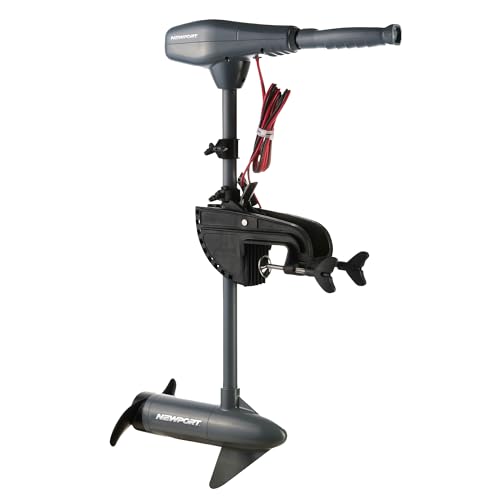
The three picks below are all freshwater transom-mount trolling motors from Newport, a brand that sells this category in a clean ladder of thrust sizes. They share a design and differ mainly in power and shaft length, which makes the real decision simple: match the thrust to your boat’s size and load, then match the shaft to your transom height.
Choosing a Freshwater Trolling Motor
Thrust is rated in pounds, and boat weight decides
Trolling motors are sold by pounds of thrust. The working rule is at least 2 pounds of thrust for every 100 pounds of loaded boat weight — boat, motor, battery, anglers and gear included. A lightly loaded 12-foot jon boat fishes happily on 36 pounds of thrust; a heavier hull, a second angler or regular wind pushes you toward 46 pounds and beyond. Buying one size up costs little in weight and buys real authority when the afternoon breeze builds.
Shaft length must match the transom
The propeller needs to sit submerged with the shaft’s mounting bracket clamped at the transom. Shorter shafts around 24 to 30 inches suit low transoms on canoes, kayaks and small jon boats; taller transoms need the longer shafts in the same model lines. A shaft that is too short ventilates in chop; one that is too long drags and complicates shallow water. Measure from the transom mounting point to the waterline and follow the maker’s sizing guidance.
Speed control and battery reality
These motors draw from a 12-volt deep-cycle battery (or a lithium equivalent), which is sold separately and is half the system: a small battery means a short day regardless of the motor. Tiller motors in this class use stepped speed settings — typically five forward and three reverse — rather than infinitely variable control. Stepped control is simple and durable; the trade-off is less fine speed adjustment at the slowest settings. Runtime depends on how hard you run: trolling slowly sips current, running wide open against wind drains a battery in a fraction of the time.
Freshwater means freshwater
Motors in this guide are freshwater models. Salt water attacks their finishes and internals, and manufacturers sell separate saltwater lines with different coatings and sacrificial protection for that environment. If your fishing splits between fresh and salt, buy the saltwater-rated motor and use it in both, not the other way around.
The NV-Series 36 is the core freshwater pick for small boats: 36 pounds of thrust on a 30-inch shaft, a transom-mount bracket and a tiller handle with five forward and three reverse speeds. That thrust figure suits loaded weights up to roughly 1,800 pounds by the standard sizing rule, which covers the classic 12 to 14-foot aluminum boat with two anglers and tackle. The 30-inch shaft is the versatile middle length for typical jon boat and V-hull transoms.
An LED battery indicator on the motor head helps you judge remaining charge before the paddle comes out. For a first trolling motor on a small freshwater boat, this is the configuration most owners end up with, and parts and propellers for the line are widely stocked.
Newport Kayak Series 36 lb Thrust, 24-Inch Shaft (ASIN: B07454VQ71)
Runner-Up
Newport Kayak Series 36 lb Thrust, 24-Inch Shaft (ASIN: B07454VQ71)
The Kayak Series takes the same 36 pounds of thrust and puts it on a 24-inch shaft sized for the low transoms of kayaks and canoes. The shorter shaft keeps the propeller at the right depth behind a small hull without a long shaft angled awkwardly or dragging in shallow creeks, and the lighter, more compact build suits car-top boats where every pound is carried by hand from the vehicle to the water.
It is the same tiller-controlled, stepped-speed format as the rest of the line, so everything about batteries and care carries over. Anglers adding power to a fishing kayak for hands-free repositioning between casts will find this the correctly proportioned version of the idea.
The 46-pound NV-Series model is the step up for heavier freshwater setups: bigger jon boats, a third person aboard, larger inflatables, or lakes where wind is a daily factor rather than an occasional nuisance. The extra thrust over the 36-pound models shows up exactly where it matters — holding position and making headway when the water gets rough — while the running gear, mount and controls stay in the same simple tiller format.
By the sizing rule it supports loaded weights approaching 2,300 pounds. Owners who fish big water or carry heavy loads should start here rather than asking a 36-pound motor to work at its limit all day, which shortens both the fishing day and the battery’s life.
Transom Mount, Bow Mount and the Rest of the Family
This guide stays with transom-mount tiller motors because they are the freshwater format that fits the widest range of small boats, clamps on in minutes and needs no wiring beyond the battery leads. The wider family is worth understanding so the choice is deliberate. Bow-mount motors mount on the front deck of a bass boat and steer by foot pedal, hand remote or GPS anchor systems that hold the boat on a spot electronically; they are superb fishing tools that make no sense on a 12-foot jon boat. Kayak-specific transom motors like the 24-inch pick here split the difference: transom simplicity in proportions a small hull can carry. Electric outboards — larger transom units with built-in batteries — serve a different, pricier purpose. For a first motor, or a motor that moves between a jon boat, a canoe and a rental hull, the clamp-on tiller format in this guide remains the flexible answer.
How Far Will a Battery Actually Take You
Runtime questions have no single answer because current draw rises steeply with speed setting. As a planning picture: a mid-size deep-cycle battery running a 36-pound motor at a gentle trolling pace can fish most of a day, while the same battery at full throttle against wind may be done in a couple of hours. The practical habits are simple. Troll slowly and use the motor to position rather than to travel; let the main engine or the paddle cover distance. Watch the motor’s battery indicator before it becomes urgent. Carry the battery sized for the longest day you actually fish, not the average one, and recharge it the same evening — deep-cycle batteries live longest when they are never left sitting discharged.
Trolling Motor Care Through the Seasons
These motors are nearly maintenance-free, but nearly is not completely. After fishing, a quick freshwater rinse keeps mud and weed juice off the shaft and mount, even in freshwater use. Monthly in season, pull the propeller — one nut — and clear the fishing line that inevitably wraps behind it; line works into the seal and is the leading cause of water intrusion into the lower unit. Check that the transom clamp pads bite and the bracket screws are snug, since vibration loosens hardware over a season. In winter, store the motor indoors off the boat, store the battery on a maintainer, and the pair will start the spring needing nothing. Sacrificial anodes are a saltwater concern; freshwater motors in this class do not ask for them, which is one more reason the freshwater and saltwater lines stay separate.
Battery and Setup Notes
Pair any of these motors with a 12-volt deep-cycle battery sized to your day: a group 24 or group 27 marine deep-cycle is the common choice, and lithium iron phosphate batteries cut weight dramatically at higher purchase cost. Keep connections clean and tight, fuse the circuit as the motor maker directs, and mount the battery low and centered so its weight trims the boat rather than fighting it. Rinse the motor after muddy water, check the propeller for fishing line wrapped behind it — line cuts seals — and store the battery on a maintainer over winter. A trolling motor asks for very little; the battery asks for slightly more, and repays it in seasons of service.
Frequently Asked Questions
How much thrust does my boat need?
Use at least 2 pounds of thrust per 100 pounds of total loaded weight. A 1,500-pound loaded setup calls for 30 pounds at minimum; choose 36 or 46 pounds for margin against wind and current.
Can I use a freshwater trolling motor in salt water?
No — freshwater models lack the corrosion protection of saltwater lines, and makers void coverage for salt use. Buy a saltwater-rated motor if you fish both.
What battery does a transom-mount motor need?
A 12-volt deep-cycle battery, sized to your runtime needs. Starting batteries are the wrong type; deep-cycle and lithium iron phosphate batteries are built for sustained draw.
Is a tiller motor or a foot-control motor better?
For transom mounting on small boats, tiller control is the standard and keeps hands near the stern where the motor is. Foot-control and remote models exist for bow-mount installations on larger fishing boats.
How do I stop the boat swinging at anchor with a small motor?
A transom motor is a positioning tool, not an anchor: use it to nudge back into place, or pair it with a light anchor for stationary fishing. Point the bow into the wind, run the lowest speed that holds you, and expect to correct in gusts — that rhythm is normal, unhurried small-boat fishing at its most typical.
Can one of these motors push a pontoon boat?
A small, lightly loaded pontoon on a calm lake is within reach of the 46-pound class, but pontoons carry windage far beyond their weight. Regular pontoon use deserves a higher-thrust or pontoon-specific motor; these picks are sized for small fishing hulls.
Disclosure: As an Amazon Associate, this site may earn from qualifying purchases made through links in this article, at no additional cost to you.
W
Wildshot Editorial Team
We compare specs, materials and verified owner reviews before a product earns a spot. Rankings are never paid.
Affiliate disclosure. As an Amazon Associate we earn from qualifying purchases at no extra cost to you. Prices accurate as of the date shown.
Looking for the best vegan mattresses? Compare four Amazon-listed, wool-free mattresses by materials, firmness, thickness, trial, and warranty before you buy.
Find the best lightweight soft and absorbent bath towels for daily showers. Compare plush Turkish cotton sets that dry fast and stay soft wash after wash.
Searching for the best inexpensive garbage disposals? Compare five budget continuous-feed models on power, size, mounting, noise, and warranty before you buy.
Searching for the best blankets for Florida? Compare lightweight, breathable bamboo, cotton, and cooling blankets made for warm, humid nights all year round.
Four thorn proof gardening gloves compared on hide, gauntlet length and palm reinforcement, for pruning roses, clearing blackberries and handling cactus.
Find the best window fans for homes with reversible airflow, thermostats, and quiet twin-blade designs that cool bedrooms and living rooms well every day.
Discover the best floor keyboard rugs for classrooms, playrooms, and home offices, with expert tips on size, material, durability, and keyboard designs.
Discover the best butts humping pillows for laughs and cozy lounging, with soft novelty designs, sizes, covers, and tips for choosing a fun gag gift today.