Key takeaways
- Compare the best generator brands, Honda, Generac, Champion, Westinghouse and WEN, by noise, fuel choice, warranty and one proven model from each line.
Ask a room of generator owners which brand to buy and you will get five different answers, each delivered with total confidence. The truth is that the big names genuinely build different machines. Honda optimises for quiet running and long engine life. Generac leans on surge capacity and its service network. Champion pushes fuel flexibility, Westinghouse packs RV-friendly features into mid-size inverters, and WEN sells honest specifications at the lowest cost of entry. Choosing a brand is really choosing which of those priorities matches your life.


This guide compares five brands through one representative model each, all current Amazon US listings. Every model here is an inverter machine, so the comparison stays fair on power quality, and the differences that remain are the ones that matter: noise figures and how honestly they are published, fuel options, warranty length, dealer support and the outlets on the panel. Read the brand sections for the philosophy, then use the model sections to pin down a specific machine.
As an Amazon Associate, we earn from qualifying purchases.
Quick Picks
| Brand and model | Best for | Key point |
|---|---|---|
| Honda EU2200i | Campers and light users who value quiet running and resale value | The small-inverter benchmark, with published noise figures at two loads |
| Westinghouse iGen4500 | RV owners who want one machine to run the trailer, air conditioner included | 3,700 running watts and a 30-amp RV outlet in an enclosed inverter |
| Champion 4500-Watt Dual Fuel Inverter (200988) | Households that want gasoline and propane options in one unit | Dual fuel with push-button ignition and a carbon monoxide shutoff |
| Generac GP3500iO (7128) | Buyers who want inverter power in a tougher open frame | PowerRush surge help and a three-year residential warranty |
| WEN 56200i | Budget buyers, tailgaters and light backup duty | The lowest-cost route into clean inverter power |
How to Choose
Decide what the brand is actually selling you. Honda sells refinement: its small inverters are the quiet benchmark and hold value for years, but you pay for that polish and get fewer watts per purchase. WEN sells the opposite trade, basic clean power with a shorter warranty and a plainer panel. Champion and Westinghouse compete in the middle, loading mid-size inverters with RV outlets, fuel options and convenience features. Generac brings a standby-generator mindset to portables, with surge technology and a dealer network behind it. None of these positions is wrong; the mistake is buying one brand’s strengths when your use case needed another’s.
Treat noise figures as brand claims, not laboratory truth. Each manufacturer measures sound its own way, at its own distance and load, so cross-brand dBA comparisons are rough at best. Honda is the most transparent of the five, publishing figures at both quarter load and rated load for the EU2200i. Generac publishes no dBA figure at all for the GP3500iO, which tells you noise is not that model’s selling point. As a rule, enclosed inverter models from any of these brands run far quieter than conventional open-frame machines, and the figure that matters is the one at the load you will actually run.
Fuel flexibility is mostly a Champion story here. Four of the five representative models burn gasoline only. The Champion dual fuel unit also runs on propane, which stores indefinitely, burns cleaner and stretches run time considerably, at the cost of lower running watts on propane. If your generator will sit in a garage for months between outages, propane capability is worth real money. If it works every weekend at a campsite or job site, gasoline-only models are simpler and give full output all the time.
Warranty and parts support separate the brands over time. Honda backs the EU2200i with a three-year residential warranty and the deepest dealer network in the business, which matters when a machine needs service a decade from now. Generac matches that three-year residential term on the GP3500iO and has its own wide service footprint. WEN covers the 56200i for two years. Whichever brand you choose, confirm the exact warranty term on the listing for the variant you are buying, because terms can differ between residential and commercial use.
Size by running watts, and check the panel, not the badge. Brands headline surge watts, but your appliances live on running watts. Add up the continuous draw of everything that must run at once, then pick a model with headroom to spare. After that, look at the panel: RV owners need a 30-amp TT-30R outlet, which the Westinghouse, Champion and Generac here provide and the two small models do not. Parallel capability, offered by the Honda, Westinghouse, Generac and WEN in this lineup, lets you link a second identical unit later instead of replacing the machine when your needs grow.
Best Options
Honda EU2200i
Honda is the brand the rest of the industry measures itself against, and the EU2200i is why. It is a small enclosed inverter built around Honda’s GXR120 commercial-grade engine, and its party trick is how little noise it makes doing its work: Honda publishes 48 dBA at quarter load and 57 dBA at rated load, figures most rivals avoid printing at all. Output is modest at 1,800 running watts, which covers lights, electronics, a refrigerator and small appliances in rotation, but not an RV air conditioner on its own.
The ownership experience is the real product. The dealer network is unmatched, parts stay available for years, and used EU-series machines change hands quickly because buyers trust the engine. The trade-offs are equally clear: this is the most expensive way to buy 1,800 watts, it burns gasoline only, ignition is a pull cord, and the Amazon listing covers the 49-state EU2200ITAN variant, so California buyers need to check eligibility before ordering.
Specs
- Enclosed inverter generator; 1,800 running watts and 2,200 surge watts; gasoline; 0.95-gallon fuel tank; run time up to 8.1 hours at quarter load; noise 48 dBA at quarter load and 57 dBA at rated load; 121 cc Honda GXR120 engine; 120V duplex outlet (two receptacles); pull-cord recoil ignition; parallel capable; CO-MINDER carbon monoxide shutoff; weight 46.5 lb; three-year residential warranty
Best for: Campers, tailgaters and homeowners who want the quietest small inverter and the strongest long-term support
Watch out for: The listing is the 49-state variant, so confirm California eligibility; output is too small for an RV air conditioner without a second paralleled unit
Westinghouse iGen4500
Westinghouse has built its portable line around one idea: give RV owners a single enclosed inverter with enough output to run the whole trailer. The iGen4500 delivers 3,700 running watts, which handles a 13,500 BTU rooftop air conditioner alongside the microwave, converter and lights, and it does so at a published 52 dBA that keeps it welcome in campgrounds with noise rules. A 3.4-gallon tank stretches run time to as much as 18 hours at quarter load, so overnight air conditioning does not mean a midnight refuelling trip.
The brand’s dealer and parts network is thinner than Honda’s or Generac’s, and the range leans heavily on a few strong models rather than depth. Westinghouse also sells several iGen4500 variants, including dual fuel and remote-ignition versions under different listings, so the badge on the listing needs a careful read. What you get for that homework is one of the most complete RV feature sets in the class: electric ignition, a proper TT-30R outlet, a data display and parallel ports.
Specs
- Enclosed inverter generator; 3,700 running watts and 4,500 peak watts; gasoline; 3.4-gallon fuel tank; run time up to 18 hours at quarter load; noise 52 dBA; push-button electric ignition; outlets include a 120V 30A TT-30R RV receptacle, a 120V 20A duplex and USB DC output; parallel capable; CARB compliant; weight 98 lb
Best for: RV and travel-trailer owners who want one quiet machine that can run the air conditioner
Watch out for: Several iGen4500 variants exist across listings, including dual fuel versions; confirm the exact variant, ignition type and included accessories on the listing before ordering
Champion 4500-Watt Dual Fuel Inverter (200988)
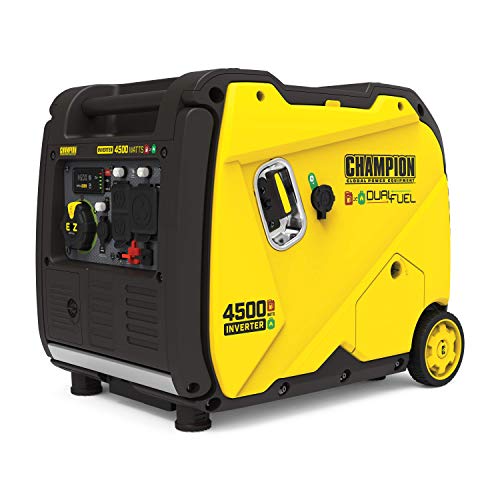
Champion’s identity is versatility at a fair cost, and this dual fuel inverter is the clearest expression of it. Run it on gasoline for the full 3,500 running watts, or connect a propane tank for 3,150 running watts with far longer storage life and run times up to 21 hours. Push-button ignition, an RV-ready TT-30R outlet and Champion’s CO Shield carbon monoxide shutoff round out a panel aimed squarely at trailer owners and outage-prone households.
Champion supports its machines with a large US-based support operation and a model range that runs from tiny inverters to whole-home standby units, so parts and documentation are easy to find. The compromises are noise and weight: at 61 dBA it is the loudest enclosed unit in this comparison, and it is a two-handed lift. Propane mode also gives up output, which matters if your air conditioner already pushes the gasoline figure.
Specs
- Enclosed inverter generator; 4,500 surge watts with 3,500 running watts on gasoline and 3,150 running watts on propane; dual fuel, gasoline or propane (LPG); noise 61 dBA; run time up to 14 hours on gasoline and up to 21 hours on propane; push-button electric ignition; 120V 30A TT-30R RV outlet plus household outlets; CO Shield carbon monoxide auto shutoff; Intelligauge display; parallel capable with a separate kit
Best for: Households and RV owners who want the storage and run-time advantages of propane without giving up gasoline output
Watch out for: Running watts drop on propane, so size your loads against the lower figure; at 61 dBA it is noticeably louder than the Honda and Westinghouse here
Generac GP3500iO (7128)
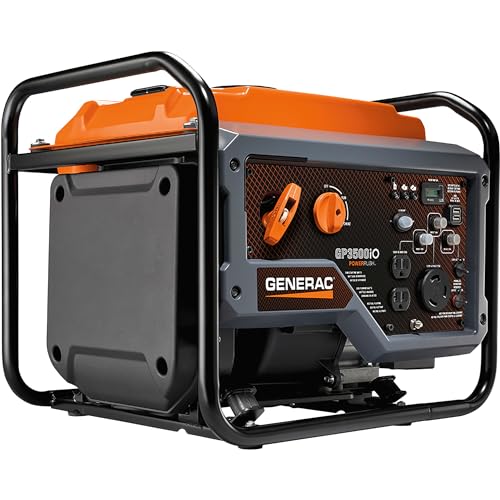
Generac is best known for home standby generators, and the GP3500iO applies that thinking to a portable: an open-frame inverter with 3,000 running watts, built to be serviced easily and to shrug off job-site handling that would crack an enclosed case. Its PowerRush technology delivers extra surge capacity beyond the headline figure to help motor-driven loads get moving, and the panel includes a 30-amp RV outlet and USB ports, with parallel ports for linking a second identical unit.
The open frame is the honest trade. It makes the machine easier to maintain and keeps it lighter than a comparably powerful enclosed unit, but there is no sound-damping shell, and Generac publishes no noise rating for this model, which tells you where it sits in the class. What you get instead is the backing of the biggest standby brand in the market: a three-year limited residential warranty and a service network that most portable-only brands cannot match.
Specs
- Open-frame inverter generator; 3,000 running watts and 3,500 surge watts with PowerRush surge assistance; gasoline; 2.37-gallon fuel tank; run time up to 11 hours at quarter load and 8 hours at half load; 212 cc Generac OHV engine; pull-cord recoil ignition; outlets include a 120V 30A RV receptacle, duplex household outlets and USB; parallel ready; total harmonic distortion under 3 percent; weight 74.3 lb; three-year limited residential warranty
Best for: Buyers who want inverter-clean power in a rugged, easy-to-service frame with strong brand support
Watch out for: Generac publishes no dBA rating for this model and the open frame runs louder than the enclosed inverters here; it parallels only with another GP3500iO
WEN 56200i
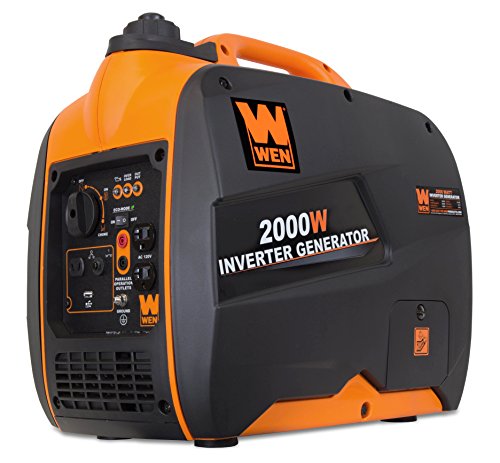
WEN’s proposition is simple: clean inverter power, honestly specified, at the lowest cost in this comparison. The 56200i is a compact enclosed unit with 1,600 running watts, a published 51 dBA noise figure that embarrasses bigger names, and a panel with a duplex outlet, a 12V DC receptacle and a USB port. It will run lights, laptops, a television, fans and a small refrigerator in rotation, and it parallels with a second unit when you need more.
Everything about the ownership proposition is a step down from Honda, deliberately. The warranty is two years instead of three, the support network is thinner, the engine is a small 79.7 cc unit with a pull cord, and there is no RV outlet. For a machine that lives in a truck bed, powers a tailgate or covers occasional short outages, those compromises are rational. For a household relying on it through multi-day outages every year, they are not.
Specs
- Enclosed inverter generator; 1,600 running watts and 2,000 surge watts; gasoline; 79.7 cc WEN OHV 4-stroke engine; noise 51 dBA; run time 6 hours at half load; pull-cord recoil ignition; outlets are one 120V 20A duplex, one 12V DC receptacle and one 5V USB port; parallel capable with a separate cable; EPA III and CARB compliant; two-year warranty
Best for: Budget-conscious campers, tailgaters and light backup use where clean power matters more than capacity
Watch out for: No RV outlet and no electric ignition; the two-year warranty and smaller support network are the price of the savings
Which One Fits
You camp in organised sites with noise rules: the Honda EU2200i, whose published low-load figure is the most trustworthy quiet claim in this group, provided 1,800 running watts covers your loads.
You tour with a travel trailer: the Westinghouse iGen4500 for gasoline simplicity and long run time, or the Champion dual fuel model if you already carry propane and want the storage and run-time benefits that come with it.
You want backup for a house, with service nearby: the Generac GP3500iO, whose warranty term and dealer footprint suit owners who would rather have a machine repaired than replaced.
You need occasional, portable power on a budget: the WEN 56200i, accepting the shorter warranty and smaller output as the cost of entry.
You plan to grow: any of the parallel-capable models here, since doubling up later is cheaper than selling a too-small machine and buying again.
Common Mistakes
Comparing surge watts across brands. Every brand headlines its biggest number. Compare running watts, which is what your appliances actually draw hour after hour.
Treating dBA figures as directly comparable. Brands measure at different loads and distances, and one brand in this guide publishes no figure at all. Use noise numbers to separate enclosed inverters from open frames, not to split hairs between two enclosed models.
Assuming propane gives the same output as gasoline. On the Champion here, propane running watts are lower. Size against the fuel you will actually use in an outage.
Ignoring state variants. Some listings, including the Honda in this guide, cover 49-state models. Check CARB eligibility for your state before ordering, not after delivery.
Buying the brand instead of the panel. A famous badge with no RV outlet will not run your trailer the way you expect. Confirm the TT-30R, parallel ports or DC outputs you need exist on the specific model.
FAQ
Which generator brand is the quietest?
Honda has the strongest documented claim, publishing 48 dBA at quarter load and 57 dBA at rated load for the EU2200i. The WEN and Westinghouse here also publish low figures, but brands measure differently, so treat all of these numbers as approximate and favour enclosed inverters for noise-sensitive use.
Which brand is best for powering an RV?
Westinghouse and Champion both build mid-size inverters around the 30-amp TT-30R outlet an RV needs, with enough running watts for a rooftop air conditioner. The Westinghouse is quieter and runs longer per tank; the Champion adds propane capability. Generac’s GP3500iO also has the RV outlet if you prefer an open frame.
Does a dual fuel generator lose power on propane?
Yes, on the Champion in this guide running watts fall from 3,500 on gasoline to 3,150 on propane. In exchange, propane stores far longer without degrading, burns cleaner and extends run time to as much as 21 hours, which is why many outage-focused buyers accept the trade.
Which brand offers the best warranty and support?
Honda and Generac both back their representative models with three-year residential warranties and the deepest service networks of the five brands. WEN covers its model for two years. Whichever brand you choose, confirm the term on the exact listing, since coverage can differ for commercial use.
Final Verdict
There is no single best generator brand, only a best match. Honda remains the default recommendation for quiet, long-lived small power. Westinghouse builds the most complete RV inverter in this group, Champion owns fuel flexibility, Generac brings standby-grade support and surge technology to an open frame, and WEN makes inverter power affordable. Decide which of those strengths your situation actually needs, confirm the running watts and the panel on the specific model, and the brand decision makes itself.