Our Short List of 3

- Best for: Hybrid shooters who put video first. The open-gate 6K mode captures the full sensor height, which lets you crop to vertical video later without losing the horizontal master. Unlimited recording removes the heat timer that cuts other cameras off mid-take, and the L-Mount alliance opens lenses from Panasonic, Leica, and Sigma. The 14+ stop V-Log range gives colorists room to shape the image in post.
- 24.2MP full-frame sensor; L-Mount; Phase Hybrid autofocus with 779 AF points and subject detection; Active I.S. stabilization for video; 6K 30p open-gate recording with unlimited recording time; 4:2:2 10-bit internal recording; 14+ stop V-Log and V-Gamut capture with Real Time LUT; 9 fps continuous shooting; 3-inch LCD; 2 memory slots; 740 g; electronic viewfinder with 0.78x magnification.
- View on Amazon
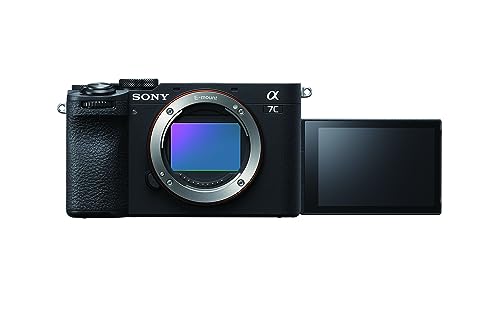
- Best for: Travel and everyday carry. This is the smallest full-frame body in this guide, yet it carries the same 33MP sensor and AI autofocus as larger Sony bodies. The articulating screen suits video and vlogging, the 7-step stabilization steadies handheld stills, and the E-mount catalog keeps the lens kit small if you pair it with compact primes. The built-in flash covers fill light in a pinch.
- 33MP Exmor R full-frame sensor; Sony E-mount; BIONZ XR processor with a dedicated AI processing unit; 759 AF points with Real-time Tracking; 5-axis stabilization quoted at 7.0 steps; 4K 60p video with full pixel readout and S-Cinetone; 10 fps continuous shooting; 3-inch articulating LCD touchscreen; 15.2 oz; ISO 100-51,200; built-in flash; model ILCE7CM2/B.
- View on Amazon

- Best for: Resolution-first work such as landscapes, studio portraits, and commercial images that will be cropped hard or printed large. The AI processing unit recognizes a wide range of subjects and holds focus on eyes and animals, while the 8-step stabilization steadies the high-resolution sensor at slow shutter speeds. The dual slots accept both CFexpress Type A and SD cards, and the 9.44M-dot viewfinder is the sharpest in this guide.
- 61MP Exmor R full-frame sensor; Sony E-mount; BIONZ XR processor with a dedicated AI processing unit; 693 phase-detection AF points covering 79 percent of the frame; 5-axis stabilization quoted at 8 steps; 8K 24p and 4K 60p video with 10-bit 4:2:2; 10 fps continuous shooting with AF and AE tracking, up to 583 compressed RAW frames in one burst; dual CFexpress Type A and SD slots; 4-axis multi-angle LCD; 9.44M-dot electronic viewfinder with 0.9x magnification; 16 oz; model ILCE7RM5/B.
- View on Amazon
All 3 Picks at a Glance
| Product | Specs | Action |
|---|---|---|
| 3. Panasonic Lumix S5 II |
| Check price on Amazon |
| 4. Sony Alpha 7C II (Black) |
| Check price on Amazon |
| 5. Sony Alpha 7R V |
| Check price on Amazon |
Key takeaways
- Mirrorless full-frame cameras only: compare sensor size, lens mounts, IBIS and video specs, then choose from five proven bodies for stills and video work.
A full-frame mirrorless camera pairs a large sensor with a lens mount that has no mirror box in the way, and that combination shapes everything from low-light stills to handheld video. This guide covers mirrorless full-frame cameras only. The word DSLR appears in the search phrase that led you here, but it is a keyword artifact: no DSLR body appears in this guide, and every camera below is a mirrorless body with a full-frame sensor.
Five bodies made the cut, one from each of the main full-frame mirrorless families except for a second and third Sony pick that earn their places on very different strengths. Each listing below is a body-only listing unless noted, so budget for at least one lens alongside the body. Check the linked listing before you buy, since availability changes and a body-only listing can share a page family with kit versions.
Disclosure: As an Amazon Associate, we earn from qualifying purchases.
Quick Picks
- Best all-rounder: Sony Alpha 7 III — a proven 24.2MP body with dual card slots and long battery life.
- Best for low light: Nikon Z5 II — a 24.5MP body with autofocus that holds down to -10 EV and 7.5 stops of stabilization.
- Best for video: Panasonic Lumix S5 II — a 24.2MP hybrid with 6K open-gate recording and unlimited 4:2:2 10-bit capture.
- Best compact body: Sony Alpha 7C II — a 33MP full-frame body in a small frame with 7-step stabilization.
- Best for resolution: Sony Alpha 7R V — a 61MP body with an AI processing unit and 8K video.
| Camera | Sensor | Mount | Stabilization | Video | Burst |
|---|---|---|---|---|---|
| Sony Alpha 7 III | 24.2MP full-frame | Sony E | 5-axis, 5.0 steps | 4K UHD | 10 fps |
| Nikon Z5 II | 24.5MP full-frame BSI | Nikon Z | 5-axis, 7.5 stops | 4K 60p | 30 fps |
| Panasonic Lumix S5 II | 24.2MP full-frame | L-Mount | Sensor-shift, Active I.S. | 6K 30p open gate | 9 fps |
| Sony Alpha 7C II | 33MP full-frame | Sony E | 5-axis, 7.0 steps | 4K 60p | 10 fps |
| Sony Alpha 7R V | 61MP full-frame | Sony E | 5-axis, 8 steps | 8K 24p | 10 fps |
How to Choose
Sensor size and resolution. Full-frame sensors measure about 36 by 24 mm, which is roughly twice the area of an APS-C sensor. That extra area gathers more light at the same exposure settings, which helps in dim rooms and at dusk. Resolution is a separate choice: 24MP files are smaller and easier to store, 33MP adds cropping room, and 61MP captures fine detail for large prints and heavy crops. More megapixels also mean larger files and a faster computer for editing, so match resolution to your output, not to a bigger number for its own sake.
Lens ecosystem. The body is only half the system. Sony E-mount has the widest native and third-party lens catalog, which keeps lens costs down over time. Nikon Z mount has grown fast and pairs with a strong line of compact primes. L-Mount is shared by Panasonic, Leica, and Sigma, so the S5 II can draw on three makers. Before you commit to a body, list the three lenses you will actually buy in the next two years and confirm each one exists in that mount at a focal length and aperture you want.
In-body image stabilization (IBIS). IBIS moves the sensor to counter hand shake, and the figure is quoted in stops. Five stops, as on the Alpha 7 III, is a solid baseline for stills with unstabilized primes. Seven to eight stops, as on the Z5 II, Alpha 7C II, and Alpha 7R V, lets you shoot slower shutter speeds handheld in dim light and smooths walking video. IBIS helps with shake, not with a moving subject, so it never replaces a fast shutter speed for action.
Video specs. If video matters, look past the headline resolution. Check whether 4K is oversampled from a larger sensor readout, whether 10-bit 4:2:2 recording is available in camera, and whether recording time is unlimited or capped by heat. The S5 II records 6K 30p open gate with no recording limit, the Z5 II records 4K 60p with 12-bit N-RAW in camera, and the Alpha 7R V records 8K 24p. Also check the crop: some 4K 60p modes use only part of the sensor, which narrows your lens field of view.
Kit versus body-only. A body-only listing ships without a lens, which is the right call if you already own lenses in that mount or want to choose a better lens than the usual kit zoom. A kit listing bundles a 28-70mm or 24-50mm zoom and can be good value for a first lens, but the bundled zoom is usually a slow variable-aperture lens. The five listings in this guide are body-only listings, so add a lens to your plan before you compare total cost.
Card slots and battery. Two card slots let you write a backup copy of every frame as you shoot, which matters for paid work and for trips you cannot repeat. Three of the five bodies here have two slots. Battery life is quoted in shots per charge under lab conditions; real life is shorter with heavy screen and autofocus use, so a spare battery belongs in the bag for a full day of shooting.
5 Best Options
1. Sony Alpha 7 III
Specs
- 24.2MP back-illuminated full-frame sensor; Sony E-mount; BIONZ X processor with front-end LSI; 693 phase-detection AF points covering about 93 percent of the frame plus 425 contrast-detection points; 5-axis stabilization quoted at 5.0 steps; 4K UHD video from 2.4-times oversampling with HLG; 10 fps continuous shooting with AF and AE tracking; dual SD card slots; NP-FZ100 battery quoted at about 610 shots with the viewfinder and 710 with the LCD; 3-inch tilting LCD with 921,600 dots; mic and headphone terminals; 1.4 lb.
Best for: Shooters who want a proven all-rounder at the lowest entry point in this guide. The 24.2MP sensor keeps files manageable, the autofocus covers almost the whole frame, and the battery lasts longer than most newer bodies. Dual card slots add a safety net for paid shoots, and the E-mount catalog means lenses are easy to find at every focal length.
Watch out for: The tilting screen only flips up and down, so low-angle vertical shots and selfie-style video are awkward. The 4K video tops out at 30p, and the menu system is older than the one on newer Sony bodies. This is also the oldest body here, so confirm the listing is the new body-only version, model ILCE7M3/B, and not a renewed or bundled listing.
2. Nikon Z5 II
Specs
- 24.5MP back-illuminated full-frame sensor; Nikon Z mount; EXPEED 7 processor; 299 AF points with subject detection for 9 subject types including people, birds, dogs, cats, cars, bicycles, motorcycles, trains, and airplanes; autofocus down to -10 EV; 5-axis in-body stabilization quoted at 7.5 stops; 4K 60p video with 12-bit N-RAW recording in camera; 30 fps with the electronic shutter and 14 fps with the mechanical shutter; 3.2-inch articulating LCD with 2,100K dots; dual SD UHS-II slots; ISO 100-64,000, expandable to 50-204,800; 1.54 lb.
Best for: Low-light shooting and anyone who wants the brightest viewfinder in this guide. Autofocus that holds to -10 EV keeps working in near darkness, and the 7.5-stop stabilization pairs with it for handheld shots at slow shutter speeds. The 4K 60p and in-camera N-RAW make it a strong second body for video, and the articulating screen flips out for video and low-angle stills.
Watch out for: The 30 fps burst rate applies to the electronic shutter, where rolling shutter can bend fast-moving subjects; the mechanical shutter tops out at 14 fps. The Z lens catalog is smaller than E-mount, so check that your must-have lenses exist in Z mount before you switch systems. The body is not water resistant, so treat rain with care.
3. Panasonic Lumix S5 II
- Best for: Hybrid shooters who put video first. The open-gate 6K mode captures the full sensor height, which lets you crop to vertical video later without losing the horizontal master. Unlimited recording removes the heat timer that cuts other cameras off mid-take, and the L-Mount alliance opens lenses from Panasonic, Leica, and Sigma. The 14+ stop V-Log range gives colorists room to shape the image in post.
- 24.2MP full-frame sensor; L-Mount; Phase Hybrid autofocus with 779 AF points and subject detection; Active I.S. stabilization for video; 6K 30p open-gate recording with unlimited recording time; 4:2:2 10-bit internal recording; 14+ stop V-Log and V-Gamut capture with Real Time LUT; 9 fps continuous shooting; 3-inch LCD; 2 memory slots; 740 g; electronic viewfinder with 0.78x magnification.
- View on Amazon
Hybrid shooters who put video first. The open-gate 6K mode captures the full sensor height, which lets you crop to vertical video later without losing the horizontal master. Unlimited recording removes the heat timer that cuts other cameras off mid-take, and the L-Mount alliance opens lenses from Panasonic, Leica, and Sigma. The 14+ stop V-Log range gives colorists room to shape the image in post.
At 9 fps it has the slowest burst rate in this guide, so it is the weakest pick for fast action stills. The 4K 60p mode uses a sensor crop, which narrows the field of view of wide lenses. The listing shown here is sold by a third-party seller, Focus Camera LLC, in the crawl we checked, so confirm the seller and the body-only style, model DC-S5M2BODY, on the live page before you buy.
Watch out for: At 9 fps it has the slowest burst rate in this guide, so it is the weakest pick for fast action stills. The 4K 60p mode uses a sensor crop, which narrows the field of view of wide lenses. The listing shown here is sold by a third-party seller, Focus Camera LLC, in the crawl we checked, so confirm the seller and the body-only style, model DC-S5M2BODY, on the live page before you buy.
4. Sony Alpha 7C II (Black)
- Best for: Travel and everyday carry. This is the smallest full-frame body in this guide, yet it carries the same 33MP sensor and AI autofocus as larger Sony bodies. The articulating screen suits video and vlogging, the 7-step stabilization steadies handheld stills, and the E-mount catalog keeps the lens kit small if you pair it with compact primes. The built-in flash covers fill light in a pinch.
- 33MP Exmor R full-frame sensor; Sony E-mount; BIONZ XR processor with a dedicated AI processing unit; 759 AF points with Real-time Tracking; 5-axis stabilization quoted at 7.0 steps; 4K 60p video with full pixel readout and S-Cinetone; 10 fps continuous shooting; 3-inch articulating LCD touchscreen; 15.2 oz; ISO 100-51,200; built-in flash; model ILCE7CM2/B.
- View on Amazon
Travel and everyday carry. This is the smallest full-frame body in this guide, yet it carries the same 33MP sensor and AI autofocus as larger Sony bodies. The articulating screen suits video and vlogging, the 7-step stabilization steadies handheld stills, and the E-mount catalog keeps the lens kit small if you pair it with compact primes. The built-in flash covers fill light in a pinch.
There is a single card slot, so there is no in-camera backup copy of your frames. The small grip can feel cramped with large lenses, and the electronic viewfinder is smaller than the one on the Alpha 7 III. The black body-only listing is model ILCE7CM2/B; a silver version exists under a different listing, so confirm the color and the body-only style on the live page.
Watch out for: There is a single card slot, so there is no in-camera backup copy of your frames. The small grip can feel cramped with large lenses, and the electronic viewfinder is smaller than the one on the Alpha 7 III. The black body-only listing is model ILCE7CM2/B; a silver version exists under a different listing, so confirm the color and the body-only style on the live page.
5. Sony Alpha 7R V
- Best for: Resolution-first work such as landscapes, studio portraits, and commercial images that will be cropped hard or printed large. The AI processing unit recognizes a wide range of subjects and holds focus on eyes and animals, while the 8-step stabilization steadies the high-resolution sensor at slow shutter speeds. The dual slots accept both CFexpress Type A and SD cards, and the 9.44M-dot viewfinder is the sharpest in this guide.
- 61MP Exmor R full-frame sensor; Sony E-mount; BIONZ XR processor with a dedicated AI processing unit; 693 phase-detection AF points covering 79 percent of the frame; 5-axis stabilization quoted at 8 steps; 8K 24p and 4K 60p video with 10-bit 4:2:2; 10 fps continuous shooting with AF and AE tracking, up to 583 compressed RAW frames in one burst; dual CFexpress Type A and SD slots; 4-axis multi-angle LCD; 9.44M-dot electronic viewfinder with 0.9x magnification; 16 oz; model ILCE7RM5/B.
- View on Amazon
Resolution-first work such as landscapes, studio portraits, and commercial images that will be cropped hard or printed large. The AI processing unit recognizes a wide range of subjects and holds focus on eyes and animals, while the 8-step stabilization steadies the high-resolution sensor at slow shutter speeds. The dual slots accept both CFexpress Type A and SD cards, and the 9.44M-dot viewfinder is the sharpest in this guide.
Files are very large: 61MP RAW files and 8K footage demand fast cards, large drives, and a capable editing computer. The 10 fps burst rate is modest next to the Z5 II, and the high pixel density shows noise sooner at very high ISO settings than a 24MP sensor does. Two body-only listings exist for this model; the one linked here is the listing with the ASIN shown below, so match the ASIN on the live page rather than the title alone.
Watch out for: Files are very large: 61MP RAW files and 8K footage demand fast cards, large drives, and a capable editing computer. The 10 fps burst rate is modest next to the Z5 II, and the high pixel density shows noise sooner at very high ISO settings than a 24MP sensor does. Two body-only listings exist for this model; the one linked here is the listing with the ASIN shown below, so match the ASIN on the live page rather than the title alone.
Which One Fits
Pick the Alpha 7 III if you want the most proven body for the least money and you shoot a mix of stills and video. Its battery life, dual slots, and deep lens catalog make it the safe default for a first full-frame body.
Pick the Z5 II if you shoot in dim light, at events, or at weddings. The -10 EV autofocus and 7.5-stop stabilization are the strongest low-light combination in this guide, and the 4K 60p with in-camera N-RAW covers video without a second body.
Pick the Lumix S5 II if video leads and stills follow. Open-gate 6K, unlimited recording, and 10-bit 4:2:2 in camera are video features the other bodies do not match at this level, and the L-Mount alliance keeps lens options open.
Pick the Alpha 7C II if size is the deciding factor. It is the body to carry all day, on travel, and for street shooting, with 33MP and AI autofocus in a frame that fits a small bag with a compact prime attached.
Pick the Alpha 7R V if resolution is the job. Landscapes, studio work, and heavy cropping justify the large files and the higher cost, while the AI autofocus and 8-step stabilization keep the big sensor usable handheld.
Common Mistakes
Buying the body before the lenses. A full-frame body with a poor lens gives poorer images than a cheaper body with a good lens. Choose your first two lenses in the same mount before you choose the body, and confirm both exist at focal lengths you will use.
Judging a camera by megapixels alone. A 61MP sensor captures more detail, but it also magnifies camera shake, demands faster shutter speeds, and fills cards and drives faster. A 24MP sensor is the better call for events, travel, and anyone who delivers images online.
Ignoring the video crop. Some 4K 60p modes use only part of the sensor, which turns a 24mm lens into a much narrower view. Check the crop for the exact video mode you plan to use, and test it with your widest lens before a paid shoot.
Skipping the second card slot question. If you shoot weddings, once-in-a-lifetime trips, or paid client work, a single-slot body is a risk you should take knowingly. Either pick a dual-slot body or carry a strict backup routine with frequent card swaps and copies.
Forgetting the total cost. Body-only listings need a lens, a spare battery, cards, and often a faster computer for high-resolution files. Add those to the body cost before you compare two bodies, or the cheaper body can end up costing more.
FAQ
Do I need a full-frame camera to take good photos?
No. A full-frame sensor gathers more light and gives shallower depth of field at the same aperture, which helps in dim light and for portraits. Good photos depend far more on the lens, the light, and the photographer than on sensor size. A smaller-sensor camera with a fast lens often beats a full-frame body with a slow kit zoom.
Is a mirrorless camera better than a DSLR?
Mirrorless bodies focus with the sensor itself, which gives autofocus that covers most of the frame and tracks eyes in the viewfinder. They are also smaller, since there is no mirror box, and they show exposure changes live in the viewfinder. DSLR bodies still exist and have optical viewfinders some shooters prefer, but every body in this guide is mirrorless, and the mirrorless lens catalogs are where new lenses now appear.
Should I buy a body-only camera or a kit?
Buy body-only if you already own lenses in that mount or you have a specific lens in mind that beats the kit zoom. Buy a kit if you own no lenses and want a working zoom on day one, and treat the kit zoom as a first lens rather than a final one. The five listings in this guide are body-only, so add at least one lens to your plan.
How many megapixels do I need for large prints?
A 24MP file prints well at common large sizes, and 33MP adds cropping room for prints above that. A 61MP file is for very large prints, heavy crops, and commercial work where the client may crop hard. Match the resolution to your largest real output, and remember that larger files slow down storage, backup, and editing.