We independently review everything we recommend. When you buy through our links, we may earn a commission. As an Amazon Associate we earn from qualifying purchases.
5 Best 50 Amp Generators for RV (November 2026)
Five generators with a genuine 50 amp 14-50R outlet confirmed from maker and listing specs, covering dual fuel, maximum output and one true inverter option for RV power.
Five generators with a genuine 50 amp 14-50R outlet confirmed from maker and listing specs, covering dual fuel, maximum output and one true inverter option for RV power.
A 50 amp RV is a serious electrical load. Two air conditioners, a microwave, a water heater and a converter running together can call for wattage that smaller generators simply cannot deliver, and the whole question comes down to one detail on the control panel: a genuine 50 amp outlet, the 120/240V 14-50R receptacle that a 50 amp shore-power cord plugs into. Plenty of generators are marketed to RV owners while topping out at a 30 amp outlet, which leaves a 50 amp rig running through an adapter and rationing appliances.
Every generator in this guide has a 14-50R 50 amp outlet confirmed from its maker’s or listing’s own specifications. Four are conventional open-frame machines, three of them dual fuel, and one is a true inverter model. Two brands, Westinghouse and DuroMax, make up the group, because they are the brands whose big portables actually carry this outlet. Read the sibling models carefully as you go: in both ranges, near-identical model names hide real differences in fuel and features.
Quick Picks
As an Amazon Associate we earn from qualifying purchases.
Product
Best for
Key spec
Westinghouse WGen9500DF
Dual fuel with remote start
9,500 running watts on gas, 14-50R outlet
DuroMax XP12000EH
A long-running dual-fuel design
9,500 running watts, 14-50R outlet
DuroMax XP13000EH
Maximum output in this group
10,500 running watts on gas
DuroMax XP11000iH
Clean inverter power
9,000 running watts, inverter, 14-50R outlet
Westinghouse WGen9500
Gas-only simplicity
50 amp 14-50R outlet, transfer switch ready
How to Choose
Confirm the 50 amp outlet first
This is the filter that decides the whole list. A 50 amp RV service needs a 120/240V 14-50R receptacle on the generator. A TT-30R or an L14-30R is a 30 amp outlet, whatever the advertising around the generator says, and a unit whose largest outlet is 30 amp cannot feed a 50 amp rig at full capacity. Every pick below was included because its specification names the 14-50R. When you compare any other model, find the outlet list in the maker’s own spec sheet and look for those exact characters before you look at anything else.
Match running watts to the rig
Peak watts start motors; running watts carry the load hour after hour, so running watts are the number to shop by. A 50 amp, 240V service can in principle call for up to 12,000 watts, which is why the generators in this class cluster between 9,000 and 10,500 running watts: enough for two air conditioners and the normal background load of a large fifth wheel or motorhome, with the understanding that everything at once, all the time, is more than any portable can promise. Add up your own big loads honestly and leave headroom for the surge when a compressor starts.
Decide on fuel before you decide on a model
Three of these picks are dual fuel, able to run on gasoline or propane. Propane stores indefinitely, burns cleaner and is often already on board an RV in quantity, but output drops on propane: where the listings state both figures, the propane running watts are lower than the gasoline figures, and that gap is printed in the product sections below. Gasoline gives full output and easy refuelling on the road. One pick here, the Westinghouse WGen9500, is gasoline only, which is a legitimate choice if you value simplicity and never plan to plumb a propane line to the generator.
Inverter and conventional power are not the same thing
Four of these machines are conventional generators, and their output carries the higher harmonic distortion typical of the type. The Westinghouse WGen9500DF, for example, is specified at under 23 percent total harmonic distortion, which is fine for air conditioners, heaters and battery chargers but is not the clean output that sensitive electronics are happiest with. Exactly one pick, the DuroMax XP11000iH, is an inverter generator, and the clean-power advantage belongs to that pick alone. If the generator will routinely power laptops, TVs and modern RV electronics directly, that distinction should drive your choice.
Be honest about size and placement
None of these is a small machine. They are open-frame generators in the 457 to 500 cc class, built to sit outside the RV and be heard doing it, and the largest of them, the XP13000EH, is a genuinely heavy unit to move around a campsite. Think about where it will live in transit, how it gets to the ground, and how far from the rig it will sit, before the wattage figures talk you into more generator than you want to handle.
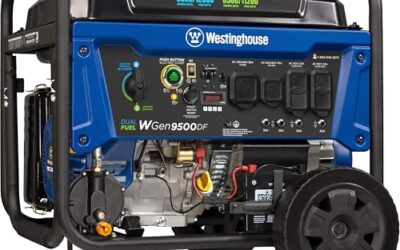
The WGen9500DF is the dual-fuel Westinghouse in this class: 9,500 running watts and 12,500 peak watts on gasoline from a 457 cc engine, with remote electric start, so it can be fired up from inside the rig on a cold morning. Its panel carries the 120/240V 50 amp 14-50R outlet this guide requires, alongside an L14-30R. For a 50 amp RV it covers the realistic load of two air conditioners plus the converter and smaller appliances, and the propane option suits owners who already carry large tanks. Keep its conventional output in mind: with total harmonic distortion specified under 23 percent, this is power for motors, heaters and chargers, not the pick for feeding sensitive electronics directly. Let the XP11000iH below carry that job.
The XP12000EH is DuroMax’s long-established dual-fuel model in this size: 9,500 running watts and 12,000 starting watts from a 457 cc, 18 HP engine, with electric start and a panel that includes the 120/240V 50 amp 14-50R outlet. It has been in the range for years, which makes it the known quantity of the group. Two cautions belong with this pick. First, the badge matters: the gasoline-only XP12000E is a different model with its own listing, so check that the machine you are looking at is the EH dual-fuel version. Second, this model is not a CARB version; a separate California variant exists in the range, so buyers who need CARB compliance should look for that variant specifically rather than assume this listing covers it.
The XP13000EH is the output leader here: 10,500 running watts and 13,000 peak watts on gasoline, and 10,000 running with 12,500 peak on propane, from a 500 cc engine with an 8.3 gallon tank. Current DuroMax specification for this model includes a CO sensor. The outlet panel is the fullest in the group: the 14-50R 50 amp outlet, an L14-30R, an L5-30R and GFCI duplex outlets, so the same machine can feed the RV at full service and still run separate tools or a second circuit at a property. Frame it honestly, though. This is the largest and heaviest class of portable in this guide, and its natural home is a big fifth wheel with a generator bay or a rig that stays put for a season, or double duty as a home backup machine. It is not a lightweight travel companion, and it does not pretend to be.
The XP11000iH is the inverter of the group, and the only pick whose power quality suits sensitive electronics as well as heavy loads. It is dual fuel: 11,000 peak and 9,000 running watts on gasoline, and 10,450 peak with 8,550 running watts on propane, from a 459 cc engine. Starting is by remote or push button, it carries DuroMax’s CO Alert, and it offers parallel capability for owners who might pair two inverter units later. DuroMax’s own product page confirms the panel includes a 50 amp outlet alongside a 30 amp outlet, which is what earns an inverter a place in a 50 amp guide at all, since most big inverters stop at 30 amps. If one generator has to run the air conditioners by day and the entertainment system and laptops in the evening, this is the one built for both halves of that job.
The WGen9500 is the gasoline-only sibling of the first pick, and the distinction is the whole story of this listing: same family, same 50 amp 14-50R outlet, and a listing that describes it as transfer switch ready with 30 amp and 50 amp outlets, but no propane capability. That is a fair trade for the owner who runs on gasoline anyway and would rather not pay for, or maintain, a dual-fuel system that never gets used. What you must not do is import the DF model’s dual-fuel specifications into this machine because the names look alike. Judge this pick on its own listing: a big conventional gas generator with the right outlet for a 50 amp rig, suited to owners who want the simplest version of this class of machine.
Full-timing in a large fifth wheel with two air conditioners: the DuroMax XP13000EH, for the highest running watts and the fullest outlet panel, accepting its size and weight.
One generator for the RV and for sensitive electronics: the DuroMax XP11000iH, the only inverter here, with a maker-confirmed 50 amp outlet.
Dual fuel and remote start without the biggest chassis: the Westinghouse WGen9500DF.
A proven dual-fuel design that has been in the range for years: the DuroMax XP12000EH, checking the EH badge before you order.
Gasoline only, no interest in propane: the Westinghouse WGen9500, judged on its own specification.
Common Mistakes
Trusting an “RV ready” label. Some widely recommended generators wear RV marketing while their largest outlet is a 30 amp L14-30R. The Champion 100519 is the standing example: its maker’s own sell sheet gives a 30 amp maximum outlet, so it cannot serve a 50 amp rig at full capacity. Always find the 14-50R in the maker’s outlet list.
Confusing sibling models. XP12000E and XP12000EH are different machines, as are the WGen9500 and the WGen9500DF. Fuel type, features and listings all differ between the siblings.
Shopping by peak watts. Peak watts describe a starting surge that lasts seconds. Running watts are what the RV actually lives on, and they are the figures compared in this guide.
Assuming big means clean. Conventional open-frame power carries high harmonic distortion. Only the inverter pick here is the electronics-friendly option; do not extend that quality to the conventional machines by association.
Ignoring the weight. These are 457 to 500 cc open-frame machines. The most powerful pick is also the heaviest thing in the group, and a generator that is miserable to move will be left behind.
Frequently Asked Questions
What outlet should I look for on a generator for a 50 amp RV?
A 120/240V 14-50R receptacle. That is the 50 amp outlet a 50 amp shore-power cord matches. Outlets named TT-30R or L14-30R are 30 amp, and a generator whose largest outlet is one of those cannot feed a 50 amp rig at full capacity, whatever its wattage.
Will 9,500 running watts run a 50 amp RV?
It will run a great deal of one: two air conditioners, the converter and the smaller continuous loads are within reach of the 9,500 running watt picks here. What it will not do is run literally everything at once indefinitely, since a 50 amp service can theoretically call for more. The 10,500 running watt XP13000EH buys extra headroom for the heaviest rigs.
Does running on propane reduce output?
Yes. Where these listings state both figures, propane output is lower: the XP13000EH makes 10,000 running watts on propane against 10,500 on gasoline, and the XP11000iH makes 8,550 against 9,000. Propane still wins on storage life and clean running, so the trade is a deliberate one, not a flaw.
Why is only one pick an inverter?
Because very few inverter generators offer a true 50 amp outlet; most stop at 30 amps. The XP11000iH is here because DuroMax confirms a 50 amp outlet on its panel. If clean power matters more than the last increment of wattage, it is the pick. If the load is air conditioners, heaters and chargers, the conventional picks do the same work.
A
admin
We compare specs, materials and verified owner reviews before a product earns a spot. Rankings are never paid.
Affiliate disclosure. As an Amazon Associate we earn from qualifying purchases at no extra cost to you. Prices accurate as of the date shown.
Compare five wired gaming mice on sensor, weight, buttons and cable feel, from the Logitech G203 and G502 HERO to the Razer Basilisk V3 and HyperX Haste 2.
The best and worst zero turn mowers, explained: top electric and gas picks, models and buying mistakes to avoid, and how to match deck size to your lawn.
The best striping push mowers use a roller kit to bend grass into crisp light and dark bands. Our November 2026 guide compares fit, weight and mounting.
Compare the best generator brands, Honda, Generac, Champion, Westinghouse and WEN, by noise, fuel choice, warranty and one proven model from each line.
Compare four pool cleaners for different pool sizes, surfaces and pump setups, from corded robots to pressure-side and suction models, and find your match.
Compare the best striping zero turn mowers for deep, even bands: fabricated decks, heavy frames and roller-friendly layouts, with gas and electric picks.

 1. Westinghouse WGen9500DF
 2. DuroMax XP12000EH
 3. DuroMax XP13000EH
 4. DuroMax XP11000iH
 5. Westinghouse WGen9500