Key takeaways
- Compare the best camera chest packs for wildlife photography by fit, closure, weight and storage, and keep your optics protected and ready at your chest.
A wildlife photography day runs on two optics: the camera that makes the picture and the binoculars that find the subject in the first place. A chest pack keeps the second optic, or a compact camera body, sealed in a padded case against your sternum instead of swinging from a neck strap, so it stays clean in brush and dust, stops bouncing when you walk, and comes up to your eyes in one quiet motion while your main camera hangs ready at your side.
The five packs below are the chest-worn designs with published internal dimensions, stated weights and clear closure systems. They range from an eight-ounce minimalist case to modular rigs with detachable rangefinder pouches and rain covers. Each is sized around binocular dimensions, the same space a compact mirrorless body needs, and each is judged on fit, access speed, storage and carry comfort.
As an Amazon Associate, we earn from qualifying purchases.
Quick answer
The Eberlestock Recon is the strongest all-round chest pack: tall internal space, a magnetic lid, a front zipper pocket and a modular system for adding pouches. The Vortex GlassPak is the lightest pick and the simplest. The NEW VIEW CamoRanger carries the most small gear, the Badlands Bino X2 is the modular option, and the MOXULE BINO R2 Pro covers the budget tier.
Eberlestock Recon Modular Bino Pack (Large)

The Recon is the most photography-friendly design in this group because its Large size offers a tall internal compartment, listed at 9 inches high by 5.5 inches wide by 2.5 inches deep, which swallows tall 50 mm class binoculars and gives compact camera bodies more vertical room than most chest packs allow. The magnetic lid opens forward, and the forward-pull shoulder harness adjusts from the front, so the pack can be snugged down without reaching behind your back.
Storage is practical rather than generous: a large front zipper pocket for a lens cloth, memory cards or a phone, plus a stretch pocket on each side. The real draw is the EMOD system, a set of attachment points that accepts maker accessories such as a rangefinder pouch, a rain fly and a utility pouch, so the rig grows with your kit. At 13.6 ounces in nylon, it sits in the premium tier, earned through fit range and modularity.
Specs
- Internal dimensions: 9 x 5.5 x 2.5 inches (Large)
- Weight: 13.6 ounces
- Material: nylon
- Closure: magnetic lid
- Harness: adjustable forward-pull shoulder harness
- Pockets: large front zipper pocket, dual side stretch pockets
- System: EMOD compatible with maker accessory pouches
- Listed color: Dry Earth
Badlands Bino X2 (Large)
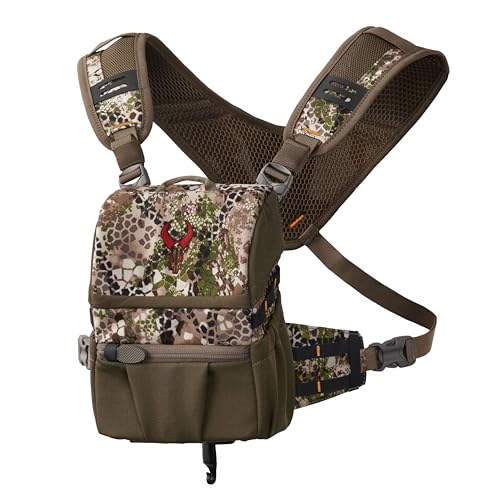
The Bino X2 is built around a magnetic closure that works in both directions: the magnets hold the lid shut while you move and hold it open while you glass, so the lid never flops back onto the binoculars mid-look. Badlands lists the Large interior at 7.25 inches high by 5.5 inches wide by 3 inches deep, a depth figure that suits fuller-bodied binoculars, and the pack includes tethers and quick-release rings so the optic stays attached to the harness even when it is out of the case.
Attachment points on the sides and bottom anchor the brand’s accessory line, which includes a bottom pocket, a rangefinder case, an everything pouch, a bear spray pocket and an ammo sleeve, all sold separately. A bow hook on the harness underlines its hunting roots, but the quiet lid and tethered layout translate directly to wildlife work where a subject can vanish at a zipper’s rasp. This is a premium-tier modular pick for photographers who also carry a rangefinder.
Specs
- Interior dimensions: 7.25 x 5.5 x 3 inches (Large)
- Closure: magnetic lid, magnets hold lid open and shut
- Attachment: side and bottom accessory points
- Included: binocular tethers, quick-release rings, bow hook
- Accessories: rangefinder case, bottom pocket and pouches sold separately
- Listed color: Approach OG
Vortex Optics GlassPak Binocular Harness
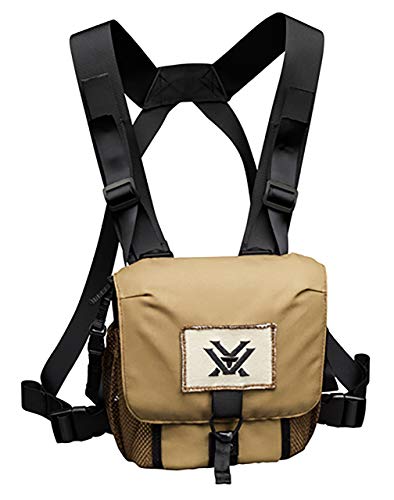
The GlassPak is the minimalist of the group and, at a maker-stated 8 ounces, by far the lightest. Instead of magnets, the full-coverage lid is secured by a bungee and nylon tab, a closure with no metal parts to click against a tripod leg and nothing to demagnetize a compass. The case measures 6.75 by 6.25 by 3.75 inches and is shaped for a range of full-size binoculars, and the bundle includes the harness strap and two binocular tether straps, so it is complete as sold.
Two mesh side pockets take a lens pen, calls or a wind checker, and a zippered back pocket sits flat against the chest for a phone or a permit. There is no modular expansion and no rain cover, which keeps both weight and cost of ownership down; it is a mid-range tier pack. Vortex backs it with the company’s unconditional lifetime VIP warranty, the strongest stated warranty in this roundup.
Specs
- Weight: 8 ounces
- Dimensions: 6.75 x 6.25 x 3.75 inches
- Fit: a range of full-size binoculars
- Closure: full-coverage lid with bungee and nylon tab
- Pockets: two mesh side pockets, zippered back pocket
- Included: harness strap, binocular case, two tether straps
- Listed color: tan
- Warranty: unconditional lifetime VIP warranty
NEW VIEW CamoRanger Binocular Harness Chest Pack (Large)

The CamoRanger is the storage maximalist here, with six compartments spread across the front, back and sides, an inner pouch for a cleaning cloth, and a rain cover stored in a bottom pouch rather than left at home. The main pouch closes with a buckle instead of a zipper, a deliberate choice for quiet one-handed access, and it is sized for most full-size 10×50 and 10×56 binoculars, the tall glass many wildlife photographers carry for dawn and dusk work.
A detachable rangefinder pouch rides on MOLLE webbing with a magnetic flap, dual MOLLE straps run down each side, and two integrated straps keep the binoculars tethered. The straps are adjustable and breathable. It sits in the mid-range tier and is the natural pick for photographers who want the chest pack to double as their small-gear organizer.
Specs
- Fit: most full-size 10×50 and 10×56 binoculars (Large)
- Fabric: polyester
- Closure: buckle closure on main pouch, magnetic flap on rangefinder pouch
- Included: detachable rangefinder pouch, rain cover in bottom pouch, two binocular straps
- Storage: six compartments including front, back and side pouches
- Straps: adjustable, breathable, dual MOLLE straps each side
- Sizes: Medium and Large
- Listed color: Tree Camo
MOXULE Binocular Harness Chest Pack (BINO R2 Pro)

The MOXULE takes the storage-first approach in a shell of 500D treated nylon, a heavier fabric than most packs in this class use, paired with a magnetic lid for fast, quiet access. The layout separates gear well: a detachable rangefinder pouch up front, a rear mesh pocket that keeps a phone or gloves away from the optics, and a dedicated rain cover pocket so weather protection travels with the pack.
The main compartment is sized around standard 42 mm binoculars, which also makes it a tidy fit for a compact camera body with a short lens. The listing carries a Global Recycled Standard certification for its recycled content, a detail few outdoor products publish. The harness straps adjust at the shoulders, and the pack sits in the budget-to-mid-range tier, undercutting the modular premium rigs while keeping the features most photographers actually use.
Specs
- Shell: 500D treated nylon
- Closure: magnetic lid
- Fit: standard 42 mm binoculars
- Storage: detachable rangefinder pouch, rear mesh pocket, rain cover pocket
- Harness: adjustable shoulder straps
- Materials note: Global Recycled Standard certified recycled content
How to choose
Start with internal dimensions, not the size name on the label. Measure your binoculars or compact camera body at their tallest, widest and deepest points and compare those figures with the maker’s published internal dimensions, leaving a little room for the eyecups and strap lugs. Height is the figure that most often falls short, especially with 50 mm and 56 mm binoculars.
Next, pick a closure. Magnetic lids are the fastest and quietest and often hold themselves open, but some makers warn that lid magnets can affect compasses and should be kept away from medical devices, so follow the guidance for any device you wear. Bungee and buckle closures avoid magnets entirely and have fewer failure modes, at the cost of a slightly slower draw.
Then weigh storage against bulk. A front zipper pocket and two side pockets cover a lens cloth, cards and a phone for most photographers. Detachable rangefinder pouches and modular systems only earn their weight if you genuinely carry a rangefinder or bear spray. Finally, check the harness: forward-pull adjusters and padded or breathable straps matter on long days, and the whole rig has to sit flat under a backpack’s shoulder straps without the buckles stacking.
Who should skip
Skip chest packs if your binoculars or camera body exceed every published internal dimension here, as oversized 15×56 glass and gripped camera bodies with telephoto lenses belong in a sling or backpack instead. Skip them if you only ever carry a camera on a strap and rarely use binoculars, since the pack becomes dead weight. Anyone whose medical device guidance warns against chest-level magnets should choose the bungee or buckle designs, or skip the category. And if you need weather sealing for multi-day rain rather than shower protection, a dry-bag style carry is the better tool.
FAQ
Can a chest pack carry a camera instead of binoculars?
Yes, within the stated internal dimensions. These packs are shaped around binocular bodies, so compact mirrorless cameras and short lenses fit several of them, the tall Recon most easily. A camera with a battery grip or a long telephoto attached will not fit any pack here, so compare your body’s height and depth against the published figures before ordering.
Which closure is quietest in the field?
Magnetic lids and the CamoRanger’s buckle closure are the quietest designs here because neither uses a zipper on the main compartment. Bungee lids are also quiet but rely on cord tension. Whichever you choose, keep zippers for the secondary pockets, where speed matters less.
How do I choose between Medium and Large sizes?
Match the size to your optic’s measured height first: 42 mm class binoculars suit the standard sizes, while 50 mm and 56 mm models usually need the Large. If your binoculars fall between two published sizes, take the larger one, because a lid that will not close fully protects nothing.
Can I wear a chest pack with a backpack?
Yes. Chest packs are designed to ride below a backpack’s sternum strap, and slimmer harnesses with forward-pull adjusters sit flattest. Put the chest pack on first, then the backpack, and check that the shoulder straps do not stack buckles on the same point before a long walk.
Final verdict
For a single recommendation, take the Eberlestock Recon: the tallest interior, a well-sorted pocket layout and a modular system that adapts as your wildlife kit grows. Choose the Vortex GlassPak if low weight and a lifetime warranty matter more than storage, the NEW VIEW CamoRanger if you want maximum organization with a rain cover included, the Badlands Bino X2 for a modular magnetic rig with tethers, and the MOXULE BINO R2 Pro for a tough, storage-first pack in the lower tiers.