Key takeaways
- Speedlights for wildlife photography compared on guide number, recycle time, wireless control and battery type, across Canon, Nikon and universal mounts.
A speedlight earns its place in a wildlife kit in the hours when light is scarce: dawn and dusk sessions, shaded forest understory, and overcast days when plumage and fur lose their detail. Used at low power, flash lifts shadow detail, adds a catchlight to the eye, and restores color saturation without changing the look of the scene. Set up off-camera near a perch, feeder, or waterhole, it also lets a photographer work from a blind while the light stays where the subject is expected to land.
This guide compares five speedlight flash units on the published specifications that matter in the field: guide number and zoom range for reach, recycle time for bursts of action, battery system for long sits, and wireless control for off-camera placement. The picks span Canon, Nikon, and universal manual mounts across premium, mid-range, and budget tiers, so the right choice depends on your camera system.
As an Amazon Associate, we earn from qualifying purchases.
Quick answer
The Godox V860III and V1 lead this list for most wildlife shooters: lithium packs recycle in about 1.5 seconds and deliver hundreds of full-power pops per charge. Canon users get E-TTL with the TT685II-C on AA cells, Nikon users get first-party i-TTL from the SB-700, and the Neewer TT560 covers blind work on a budget.
Godox V1-C Round Head Flash (Canon)

The V1-C is the premium pick for Canon shooters. Its round flash head produces a more gradual light falloff than a conventional rectangular fresnel head, which suits feather and fur detail when the flash is used as a gentle fill at dawn or dusk. Output is rated at 76Ws, and the rechargeable lithium pack is the real field advantage: Godox rates recycle time at roughly 1.5 seconds at full power and up to 480 full-power flashes per charge, so a long morning in a blind does not mean rationing pops.
The built-in 2.4G wireless X system works as both transmitter and receiver, so the V1-C can sit on the hot shoe or fire off-camera alongside other Godox units near a perch. A 10-level LED modeling lamp helps with focus checks in dim hides. This listing is the Canon E-TTL II variant; other mounts are sold under separate listings.
Specs:
– Mount: Canon E-TTL II hot shoe (V1-C variant)
– Output: 76Ws round head; guide number 92 ft at ISO 100 at 105 mm
– Zoom range: 28 to 105 mm, auto and manual
– Battery: VB26-series lithium-ion pack, 7.2V, 2600mAh per listing
– Recycle time: approx. 1.5 s at full power; up to 480 full-power flashes per charge
– Wireless: built-in 2.4G X system, transmitter and receiver; HSS up to 1/8000s
– Modeling lamp: LED, 10 brightness levels
– Weight: approx. 530 g with battery
Godox V860III-N Li-ion Flash (Nikon)

For Nikon shooters who want lithium speed with a conventional fresnel head, the V860III-N pairs a guide number of 60 (meters, ISO 100, at 200 mm) with the same VB26 lithium platform as the V1. That long 200 mm zoom setting matters for wildlife work: it concentrates the beam for subjects at distance and for off-camera setups near a perch, while recycle time stays around 1.5 seconds at full power.
Godox adds field-friendly touches including a quick switch between TTL and manual modes, a TCM function that converts a TTL exposure into a manual value you can lock in, and a 10-level modeling light. The built-in 2.4G X receiver and transmitter make it easy to grow into a multi-light blind setup. This is the Nikon i-TTL variant; other mounts are separate listings.
Specs:
– Mount: Nikon i-TTL hot shoe (V860III-N variant)
– Guide number: 60 m at ISO 100 at 200 mm
– Zoom range: 20 to 200 mm, auto and manual
– Battery: VB26 lithium-ion pack, 7.2V, 2600mAh
– Recycle time: approx. 1.5 s at full power; up to 480 full-power flashes per charge per listing
– Wireless: built-in 2.4G X system, transmitter and receiver; HSS up to 1/8000s
– Modes: i-TTL, Manual, Multi; TCM conversion and quick TTL/M switch
– Weight: approx. 530 g with battery
Godox TT685II-C Flash (Canon)
The TT685II-C is the mid-range workhorse for Canon users who prefer AA batteries. It matches the V860III on headline numbers, with a guide number of 60 at 200 mm and full E-TTL II metering, but it runs on four AA cells, so spares are cheap and light. With Ni-MH rechargeables, Godox rates recycle time between 0.1 and 2.6 seconds depending on power level, fast enough for perched birds and mammals at typical fill-flash settings.
The built-in 2.4G X system supports both master and slave operation, and the TCM button converts a TTL reading into a repeatable manual setting, a useful trick when a subject returns to the same perch and you want identical exposure frame after frame. The head tilts and swivels for bouncing light off a blind wall or reflector. This listing is the Canon variant; other mounts carry separate ASINs.
Specs:
– Mount: Canon E-TTL II hot shoe (TT685II-C variant)
– Guide number: 60 m at ISO 100 at 200 mm
– Zoom range: 20 to 200 mm, auto and manual
– Battery: 4 x AA (alkaline or Ni-MH)
– Recycle time: approx. 0.1 to 2.6 s depending on output
– Wireless: built-in 2.4G X system, master and slave; HSS up to 1/8000s
– Modes: E-TTL II, Manual, Multi; TCM conversion
– Weight: approx. 405 g without batteries
Nikon SB-700 AF Speedlight (Nikon)

The SB-700 is the first-party Nikon option, and its appeal is integration rather than raw output. Its guide number of 28 (meters, ISO 100, at the 35 mm zoom position, rising to 38 at 120 mm) is lower than the Godox units above, but for fill flash at moderate distances that is rarely the limiting factor, and the smaller body is easier to carry in the field. The zoom head covers 24 to 120 mm and adjusts automatically to FX or DX format.
Wireless control runs through Nikon’s optical Creative Lighting System: the SB-700 can act as a commander or a remote, which works well at the short ranges typical of blind and feeder setups, though it needs line of sight and has no built-in radio. Recycle time with Ni-MH cells is rated at about 2.5 seconds at full power.
Specs:
– Mount: Nikon i-TTL hot shoe (FX and DX formats)
– Guide number: 28 m at ISO 100 at 35 mm; 38 m at 120 mm
– Zoom range: 24 to 120 mm auto zoom; 14 mm with built-in wide panel
– Battery: 4 x AA (alkaline, lithium, or Ni-MH)
– Recycle time: approx. 2.5 s at full power with Ni-MH cells
– Wireless: optical Creative Lighting System, commander and remote modes; no built-in radio
– Head movement: tilts down to -7 degrees and up to 90 degrees; swivels 180 degrees left and 90 degrees right
– Weight: approx. 360 g without batteries
Neewer TT560 Manual Flash (Universal)
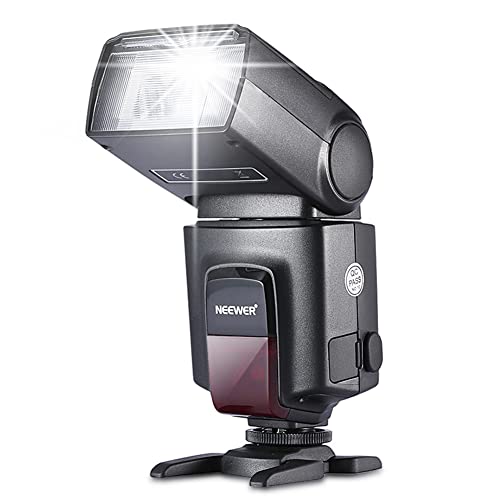
The TT560 is the budget pick and the simplest unit here: a manual-only flash with a single-contact hot shoe that fires on almost any camera with a standard shoe, regardless of brand. Output is set by hand in eight steps from full power down to 1/128, and the guide number of 38 (meters, ISO 100) is enough for feeder setups, close-range blind work, and fill at modest distances. Two optical slave modes let it fire when it sees another flash, one of them ignoring a TTL pre-flash.
There is no TTL metering, no high-speed sync, and no radio receiver, so exposure is worked out with test frames and the distance scale. For a fixed perch setup that rarely changes, that simplicity is a virtue, and the low cost makes it painless to leave one in a blind. It runs on four AA batteries and includes a mini stand for off-camera placement.
Specs:
– Mount: universal single-contact hot shoe (Canon, Nikon, Sony, Pentax, Olympus, Fujifilm and others)
– Guide number: 38 m at ISO 100
– Modes: Manual, S1 and S2 optical slave
– Power levels: 1/1 to 1/128 in 8 steps
– Head movement: tilts 0 to 90 degrees; swivels 0 to 270 degrees
– Battery: 4 x AA (alkaline or Ni-MH)
– Recycle time: approx. 0.1 to 5 s depending on output and cells
– Flash duration: 1/300s to 1/20000s; color temperature 5600K
– Weight: 286 g
How to choose
Start with the mount. TTL metering only works when the flash variant matches your camera system, so a Canon shooter needs the C variant and a Nikon shooter the N variant; the universal TT560 fires on anything but meters nothing. Second, decide on a battery system. Lithium packs recycle faster and last for hundreds of full-power pops, which suits action and long blind sessions, while AA units trade recycle speed for cells available anywhere.
Third, look at guide number and zoom: a flash that zooms to 200 mm throws light further, which helps with distant subjects and off-camera placements. Fourth, consider wireless. A built-in radio system is the flexible choice for multi-light blind setups, while optical systems need clear line of sight at short range. Finally, weigh size: smaller flashes ride better in a pack, and no speedlight is a sealed studio strobe, so plan a rain cover for wet sessions.
Who should skip
Skip a dedicated speedlight if you shoot only in open, bright conditions where fill flash changes little, or entirely at long range in daylight, where even a guide number of 60 adds nothing beyond a few meters. Video-first shooters should also pass: the small LED modeling lamps on these units are focusing aids, not continuous lights for filming. And if you already own several units in a camera brand’s proprietary radio system, a same-brand flash may integrate better than any pick here.
FAQ
Should I use TTL or manual flash for wildlife?
TTL is the faster choice for a moving subject in changing light, because the camera meters each frame. Manual power is better for a fixed setup, such as a perch or feeder at a known distance, because exposure stays identical and flash output does not vary between frames.
Does high-speed sync matter for wildlife photography?
It matters when you want fill flash in bright conditions with a wide aperture, because HSS lets the flash work at shutter speeds above the camera’s normal sync limit. The trade-off is reduced effective range, so HSS fill is a short-to-moderate distance tool.
Will a flash disturb the animals I photograph?
A low-power fill burst is a momentary light change, and many photographers use flash around habituated subjects at feeders and hides. Work at the lowest power that does the job, avoid repeated full-power firing at close range, and follow local rules, since some reserves restrict flash use.
How many flashes can I expect from one set of batteries?
It depends on power level. The lithium Godox units are rated for up to 480 full-power flashes per charge in their listings, while AA units vary widely with cell type; Ni-MH rechargeables give the fastest recycle times.
Final verdict
For Canon shooters, the Godox V1-C is the premium choice for its round head and fast lithium recycle, with the TT685II-C as the mid-range AA alternative keeping the same guide number and radio system. Nikon shooters split between the V860III-N for lithium speed and radio control, and the SB-700 for native integration in a smaller body. Anyone working a fixed blind setup on a budget, on any system, can start with the Neewer TT560.