Key takeaways
- Five dew heater straps compared for wildlife photography, covering telephoto fit, USB and 12V power options, heat settings and cold-weather cable ratings.
The best wildlife hours are often the worst hours for dew. A telephoto lens sitting in damp grass before dawn, or pointed at a clear night sky during an owl session, cools faster than the air around it. Once the front element drops below the dew point, condensation blooms across the glass and quietly softens every frame. A dew heater strap solves this at the source: it wraps around the lens barrel and holds the glass just warm enough that moisture never settles on it.
This roundup compares five dew heater straps that suit wildlife photography, from slim USB bands for mirrorless telephotos to a long 12-volt strap built for the biggest glass. Every figure quoted comes from the makers’ published specifications, including strap lengths, fit ranges, power draw and heat settings, so you can match a strap to your lens and power source before you buy.
As an Amazon Associate, we earn from qualifying purchases.
Quick answer
For most wildlife lenses, the Haida HD4635 is the safest buy, with three heat levels, a graphene element and a fit range covering barrels up to 110 mm. Choose the SVBONY SV192 for big telephotos on a 12V supply, the COOWOO narrow strip for slim barrels, and the MOVE SHOOT MOVE warmer for deep cold. The LOSHARP is the simple budget option.
Haida HD4635 Anti-Fog Belt

The Haida HD4635 is the premium pick here, built around a graphene heating element rather than a conventional resistance wire. Haida rates graphene for rapid, even heating, and the belt carries CE, RoHS and FCC certifications. It is aimed squarely at camera lenses rather than telescope tubes: it fits lens outside diameters under 110 mm, covering most 70-200mm and 100-400mm class telephotos used for wildlife work.
Control is handled by an inline regulator on the 1.5 m cable, with three heat settings that Haida publishes as temperature bands for the belt itself: low at 35 to 45 degrees Celsius, medium at 45 to 55, and high at 55 to 65. That spread makes it easy to run gentle warmth on a damp evening and reserve the top setting for frost. The hook-and-loop fastening goes on in seconds, useful when fitting it in the dark with gloves on.
Specs
- Heating element: Graphene
- Heat settings: 3 (low 35-45, medium 45-55, high 55-65 degrees Celsius)
- Fit: Lens outside diameters under 110 mm
- Power: USB, 5V (a 2A-capable source is recommended)
- Cable: 1.5 m with inline temperature regulator
- Fastening: Hook-and-loop
- Weight: 2.36 oz
- Model: HD4635
- Tier: Premium
One quirk: the controller carries an indicator light, handy for confirming the strap is on, but one more glow to manage around shy subjects.
COOWOO USB Lens Heater, Narrow Strip Version (LH-G3)
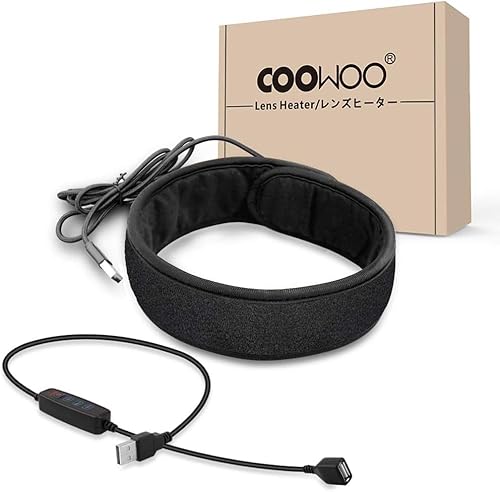
The COOWOO narrow strip is the mid-range all-rounder for standard camera lenses. It is a neoprene band powered over USB at 5V with a rated draw of 7W, and its inline controller offers low, medium and high modes so you can trade heat against power bank life. The narrow profile is the point: it sits on shorter barrels without crowding the focus or zoom rings, suiting compact telephotos and standard zooms.
Published fit guidance puts the strap on lenses up to roughly 41 cm in barrel circumference, so measure before ordering if your lens is unusually thick. The USB lead runs about 1.5 m including the regulator section, enough to reach a power bank in a jacket pocket or camera bag.
Specs
- Heating element: Resistance wire in a neoprene band
- Heat settings: 3 (low, medium, high) via inline regulator
- Strap length: 43 cm, narrow profile
- Fit: Lenses up to about 41 cm barrel circumference
- Power: USB, 5V, rated 7W
- Cable: About 1.5 m including regulator
- Model: LH-G3
- Tier: Mid-range
MOVE SHOOT MOVE Lens Warmer (350 mm)

The MOVE SHOOT MOVE warmer is the cold-weather specialist of the group. Its headline specification is the cable: a cold-flexible lead rated to stay pliable down to minus 25 degrees Celsius, where ordinary cables go stiff and brittle. The strap itself is 350 mm long, made from neoprene, and fits lenses and small telescopes up to 4.26 inches (about 108 mm) in diameter.
An inline temperature regulator gives you adjustable heat levels, and the design is known for fast warm-up, which suits photographers who set up in falling temperatures and need the glass protected before the first frames. Power comes over a USB-A connection, so it runs from the same power banks as the other USB straps in this list. For winter wildlife work or high-altitude night sessions, that cold rating is the deciding factor.
Specs
- Strap length: 350 mm
- Fit: Lenses and telescopes up to 4.26 in (about 108 mm) diameter
- Cable: Cold-flexible, rated to minus 25 degrees Celsius
- Construction: Neoprene
- Heat settings: Adjustable via inline temperature regulator
- Power: USB-A, 5V
- Tier: Mid-range
SVBONY SV192 Dew Heater Strip (560 mm)

The SV192 is the heavy-duty option, and the only strap here that does not run on USB. It takes 12V DC through a standard 5.5 x 2.1 mm jack, the connector used by most astronomy power tanks, and draws a maker-rated 19.2 to 21.6W. In exchange you get serious coverage: a 560 mm heated length on a roughly 720 mm total strip, 50 mm wide, sized for optics with an outside diameter below 178 mm.
That fit range covers the big wildlife glass, including 150-600mm zooms and large-aperture telephotos whose barrels defeat shorter straps. A three-position thermostat on the power lead switches between low, medium and high heat, and the 1.2 m cord reaches a battery pack on the ground beside a tripod. Photographers who already carry a 12V power tank will find this integrates neatly; USB-only shooters will need to add a 12V source.
Specs
- Heated length: 560 mm; total strip length about 720 mm; width 50 mm
- Fit: Outside diameters below 178 mm
- Power: 12V DC via 5.5 x 2.1 mm jack
- Input current: 1.7A, plus or minus 0.1A
- Rated power: 19.2 to 21.6W
- Controller: Three-position thermostat (low, medium, high)
- Power cord: 1.2 m
- Model: SV192 (FCAW9151B)
- Tier: Premium
LOSHARP Lens Heater, Base Version

The LOSHARP is the budget pick and the simplest device here. This base version has no control switch at all: plug it into a USB source and it heats, unplug it and it stops. The strip measures 16.5 inches long by 1.8 inches wide, uses a composite heating fiber, and runs at 5V with a working current the maker states as 1 to 2A. A generous 59-inch USB cable makes routing easy.
The always-on design is a real trade-off. There is no way to back the heat off on a mild night, so it drains a small power bank faster than a regulated strap running on low. As a first strap for occasional dew problems, or a cheap backup for a second body, that simplicity is easy to live with; photographers who shoot in the cold every week will outgrow it quickly.
Specs
- Strap size: 16.5 in long, 1.8 in wide
- Heating material: Composite heating fiber
- Power: USB, 5V; working current 1 to 2A
- Control: None, base version without a switch
- USB cable: 59 in
- Weight: 2.12 oz
- Model: LK-FRQ20201208A
- Tier: Budget
How to choose
Start with fit. Measure the circumference of your lens barrel where the strap will sit, usually just behind the front element, and compare it with the strap’s heated length rather than its total length, because the tail adds reach without adding warmth. Slim mirrorless telephotos suit the COOWOO narrow strip or the LOSHARP; big 150-600mm zooms need the SV192’s 560 mm of heated length.
Next, match the power system to what you already carry. USB straps run from any decent power bank, but check the output rating: most want a port that can supply 2A, and the strap’s wattage decides runtime. Divide the bank’s watt-hour rating by the strap’s rated watts for a rough ceiling on hours, then expect less in the cold. The SV192’s 12V input suits photographers who already run a power tank, but it is dead weight if your kit is USB-only.
Heat settings matter more than raw power. Dew control means holding the glass a few degrees above the dew point, not cooking it, so a regulated strap on low usually beats a fixed-output strap over a long session. Finally, think about the cable: in serious cold, a cold-flexible lead stays manageable, while standard cables stiffen and can tug a lightweight setup out of alignment.
Who should skip
Skip dew heater straps entirely if you shoot only in daylight in dry conditions; dew is a night, dawn and cold-weather problem, and a strap you never fit is just weight. Photographers whose lenses live under deep hoods in mild climates may find a hood alone keeps the front element clear on most outings.
Skip the SV192 if you have no 12V power source and no plans to buy one. Skip the LOSHARP if you shoot long sessions in variable conditions, because its lack of heat control wastes power. And if your problem is condensation inside the lens or on the rear element during storage, a strap will not fix it; that calls for dry storage, not barrel heat.
FAQ
How long will a power bank run a dew heater strap?
Divide the power bank’s watt-hour figure by the strap’s rated draw: a 7W strap on a 37 Wh bank gives a theoretical five hours or so, and real sessions land below that, especially in cold weather, which reduces battery performance. Regulated straps running on low stretch runtime considerably compared with full power.
Where on the lens should the strap sit?
Fit it around the barrel close behind the front element, since that is the glass you are protecting. Keep it clear of focus and zoom rings so it cannot interfere with handling, and make sure the fastening is snug enough that the strap cannot slide forward over the front cell.
Can a dew heater strap damage a lens?
These straps are low-power devices designed to hold glass slightly above ambient temperature, and the regulated models here publish belt temperatures well within the range camera gear tolerates. Sensible precautions: avoid the highest setting when a lower one keeps the glass clear, and remove the strap before packing the lens away while it is still warm.
Is a dew heater strap useful for wildlife photography in daylight?
Occasionally. Early starts after a cold night often begin with a misted front element, and a strap prevents that while you wait for first light. In full sun on a dry day it adds nothing, which is why most photographers treat it as a seasonal accessory rather than everyday kit.
Final verdict
For most wildlife photographers, the Haida HD4635 is the strap to buy: it fits the telephotos people actually carry, its three published heat bands cover everything from damp evenings to hard frost, and it runs from the USB power bank already in most bags. Step up to the SVBONY SV192 if you shoot big glass and own 12V power, choose the MOVE SHOOT MOVE if deep cold is your normal condition, and take the COOWOO narrow strip for slim barrels. The LOSHARP covers occasional dew on a budget, with no frills and no controls.