Key takeaways
- Compare the best lithium batteries for marine use — 12V 100Ah LiFePO4 picks from LiTime, Battle Born and Dakota Lithium for house banks and trolling motors, with BMS, weight and group size compared.
As an Amazon Associate we earn from qualifying purchases.
Affiliate Disclosure: This article contains affiliate links. If you buy through a link on this page, we may earn a commission at no extra cost to you. We base our picks on published product listings and manufacturer specifications, not on detailed research.

Why Lithium Has Taken Over Marine Battery Boxes
A boat battery lives a harder life than almost any battery on land. It is shaken by waves, splashed with salt water, left partly discharged at anchor for days, then asked to run a trolling motor for hours, keep the fish finder and lights alive through the night, and accept a fast recharge the next morning. A traditional lead acid battery tolerates that pattern poorly. It gives up only about half of its rated capacity in normal deep cycle use, it is heavy, it charges slowly, and it dislikes being left at a partial state of charge.
Lithium iron phosphate, usually written LiFePO4, answers most of those complaints at once. A 100 amp hour LiFePO4 battery delivers close to its full rated capacity, holds a steadier voltage under load so electronics and trolling motors run consistently until late in the day, charges much faster when the charging source is set up for it, and weighs roughly half as much as a comparable lead acid unit. On a boat, that weight saving is not cosmetic. Taking the equivalent of a heavy crew member out of a battery locker changes trim and makes lifting batteries in and out of tight compartments far easier on your back.
There are real conditions attached, and this guide will not hide them. A marine lithium battery needs a built-in battery management system, correct charge voltages, protection against charging in freezing conditions, secure mounting, proper fusing and marine grade cabling, and a clear separation between house loads and engine starting unless the battery is explicitly rated as dual purpose. Most of the picks below are deep cycle house and trolling motor batteries, not starting batteries, and their listings say so. Treat that boundary seriously, because a deep cycle battery asked to crank a large outboard can shut itself down at exactly the wrong moment.
Every pick here is a 12 volt, 100 amp hour LiFePO4 battery in a standard group size, the most common building block for a small to mid-size boat. One battery suits a kayak, a jon boat or a modest day boat with a single trolling motor. Two or more in parallel suit a bass boat, a pontoon or a cruising boat with a house bank. All specifications come from the listings and maker documentation. We have not tested these batteries ourselves.
Quick Picks
- Best trolling motor battery: LiTime 12V 100Ah Trolling Motor LiFePO4 (Group 31).
- Best premium house bank pick: Battle Born BB10012 100Ah LiFePO4.
- Best all-round Group 31 value pick: LiTime 12V 100Ah Group 31 LiFePO4.
- Best compact Group 24 pick: Dakota Lithium 12V 100Ah LiFePO4 (Group 24).
What to Check Before You Put Lithium in a Boat
Start with space and group size. Measure the battery box and tray, including height clearance for terminals and cable bends, before falling for any capacity figure. Group 24 and Group 31 are the two sizes in this guide. Group 31 is longer and usually the easier 100 amp hour fit, while Group 24 suits many production boats whose battery compartment was moulded around that footprint. A battery that does not fit the box is useless no matter how good its specification sheet looks.
Next, audit your charging sources. Your shore power charger, solar controller and alternator regulation each need a lithium profile or settings that match the battery maker guidance, typically a charge voltage in the mid 14 volt range for a 12 volt LiFePO4 pack, with no equalisation stage. An alternator charging a lithium bank directly can work very hard because the bank accepts current eagerly, so many boat owners add a DC to DC charger or external regulation.
Then plan protection and monitoring. Fit a correctly rated fuse close to the bank, use marine grade tinned cable sized for the trolling motor and inverter loads that actually run from the bank, secure every battery against movement in a seaway, and make sure you can see voltage and ideally state of charge without opening a locker. Salt water and loose terminals are a bad combination, so check connections regularly and keep terminals clean and protected.
Finally, keep engine starting honest. Unless you deliberately choose a dual purpose cranking rated lithium battery, keep a dedicated starting battery for the engine and let these deep cycle batteries do deep cycle work. A trolling motor battery and a house battery can share a bank, but the starting battery should stay separate.
How We Compare Marine Lithium Batteries
We compare on the factors that decide how a battery behaves on the water. Usable capacity matters more than the headline amp hour figure, because a lithium battery gives up nearly all of its rated capacity while a lead acid battery gives up roughly half. Continuous discharge current decides whether the battery can feed a trolling motor at full thrust without the battery management system cutting out. Low temperature protection matters because charging a lithium battery below freezing can damage it permanently. Weight and group size decide fit and trim, and warranty length and the maker’s track record in marine use are the last checks.
1. LiTime 12V 100Ah Trolling Motor LiFePO4 (Group 31) — Best Trolling Motor Battery
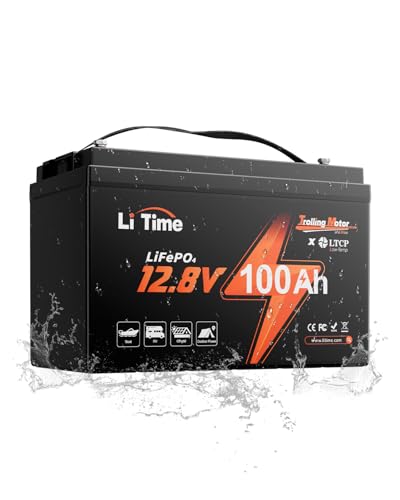
This is the most marine focused battery in this guide, and the listing says so directly. It is built for 12 volt to 36 volt trolling motor systems, it meets the ABYC E-13 standard, and it carries extra battery management system protection against dust, water and salt spray, plus safeguards against overcharge, overheat and short circuits. For a battery that will live in an open bilge or a splash prone compartment, that sealing matters more than any headline capacity figure.
The numbers are the familiar 100 amp hour, 12 volt, 1280 watt hour package, with a built-in 100 amp battery management system and a peak discharge rating that covers the surge when a trolling motor starts against a current. At about 22 pounds in a standard Group 31 case it is roughly two thirds lighter than a 12 volt 100 amp hour lead acid battery, which is a difference you feel the first time you carry it down a dock. The smart low temperature protection stops charging below freezing and stops discharging in deep cold, which is exactly the behaviour you want from a battery that will see early season mornings.
Expansion is generous: the listing supports wiring up to four in series and four in parallel, so a 24 volt or 36 volt trolling motor setup and a larger house bank are both possible from the same model. Cycle life is stated as more than 4000 cycles at full depth of discharge, with a ten year lifetime claim. That is a maker figure, not a measured result, and real life depends on charging discipline and temperature.
Choose this one first if a trolling motor is the main load. It is the pick that was designed for the job rather than adapted to it.
2. Battle Born BB10012 100Ah LiFePO4 — Best Premium House Bank Pick
Battle Born is the established premium name in this category, and the BB10012 is the battery that built that reputation. It is a 12 volt, 100 amp hour LiFePO4 deep cycle battery with an internal battery management system and high and low temperature protection, assembled in the United States and listed to UL 2054. The listing describes it for RV, marine, solar and off grid use, and it has a track record spanning years of marine and off grid deployments.
The specification sheet gives 100 amps of continuous discharge, a peak of 200 amps for 30 seconds, and a 10 year limited warranty. At about 31 pounds it is heavier than the budget LiFePO4 options, which reflects a more substantial case and cell assembly, and it is still far lighter than any lead acid battery of the same usable capacity. The cycle life range quoted by the maker is 3000 to 5000 cycles, which is conservative next to some rivals and arguably more honest for it.
What you are paying for here is not a bigger amp hour number. It is documentation, certification, a long warranty from a maker with a real support operation, and a battery that has been installed in thousands of boats and RVs. For a cruising boat where the house bank is a system you depend on far from help, that support matters.
Choose the Battle Born if you want the safest long term pick for a house bank and you value warranty and certification over saving weight and money. It is the conservative choice in this guide, and on a boat, conservative is often correct.
3. LiTime 12V 100Ah Group 31 LiFePO4 — Best All-Round Group 31 Value Pick
This is the general purpose sibling of the trolling motor model above, and for many boats it is the better buy. It is the same 12 volt, 100 amp hour, 1280 watt hour LiFePO4 package in a Group 31 case, with a built-in 100 amp battery management system, low temperature protection, and a maker cycle life claim of up to 15000 deep cycles. It weighs about 24 pounds and measures about 13 by 6.8 by 8.4 inches, so it drops into a standard Group 31 tray as a direct lead acid replacement.
The difference from the trolling motor version is emphasis rather than chemistry. This model is presented as a general deep cycle battery for RV, travel trailers, solar, off grid and home backup as well as marine use, while the trolling motor version adds the marine specific sealing and ABYC reference. If it lives where spray reaches it, the trolling motor version is worth the step up.
One practical note: the listing notes a maximum continuous charge current of 100 amps and a recommended charge current of 20 amps, with a charge time of about five hours at that recommended rate. That is a reminder to size your charger to the battery rather than assuming any charger will do.
Choose this one if you want a straightforward 100 amp hour Group 31 lithium house battery and your installation is dry and protected. It is the value centre of this guide.
4. Dakota Lithium 12V 100Ah LiFePO4 (Group 24) — Best Compact Group 24 Pick
Not every boat has room for a Group 31 battery. Many production boats, kayaks with battery boxes, and smaller centre consoles were built around Group 24 compartments, and this Dakota Lithium model is the compact answer. It is a 12 volt, 100 amp hour LiFePO4 battery in a Group 24 case, built for cold weather use, marine trolling, hunting and fishing, with internal heating that lets it accept charge in cold conditions where an unheated lithium battery would refuse.
The battery delivers 100 amps of continuous discharge and weighs about 27.6 pounds, which is heavier than the LiTime Group 31 models but still roughly half the weight of a comparable lead acid Group 24. The 11 year warranty is the longest in this guide, and Dakota Lithium has built its name specifically around outdoor and marine use rather than general solar storage.
The trade off is size against capacity density. A Group 24 case holding 100 amp hours is a tighter package, so check the exact dimensions against your box, including terminal height, before ordering. Also confirm that the internal heating suits your charging setup, since a heated battery still needs a lithium profile charger and correct charge voltages.
Choose the Dakota Lithium if your compartment is Group 24, if you fish in cold weather, or if the long warranty matters to you. It is the best fit for boats where space is the limiting factor.
Marine Lithium Compared at a Glance
All four picks are 12 volt, 100 amp hour LiFePO4 batteries with a built-in battery management system and 100 amps of continuous discharge. The differences are in group size, marine specific protection, weight and warranty. The LiTime trolling motor model leads on marine sealing and ABYC compliance. The Battle Born leads on certification and support. The LiTime Group 31 model leads on value for a dry installation. The Dakota Lithium leads on compact Group 24 fit and cold weather charging.
If you run one battery for everything on a small boat, pick the trolling motor LiTime. If you are building a house bank for a cruising boat, pick the Battle Born. If you want the most capacity for the least money in a dry locker, pick the LiTime Group 31. If your box is Group 24, pick the Dakota Lithium.
Installation and Care Tips for a Marine Lithium Bank
Secure the battery so it cannot move in a seaway. A battery sliding in a locker can crack a case, pull a cable loose or short a terminal, and the lighter a lithium battery is, the more easily it shifts if it is not strapped down. Use a proper battery box or tray, stainless hardware, and straps rated for the job.
Use marine grade tinned cable and properly crimped terminals, sized for the highest current the bank will actually deliver, not the average. Fit a fuse or breaker close to the battery positive terminal. Keep terminals clean, coated and covered, and check them at the start of each season and after any rough water.
Set every charging source to a lithium profile before the first charge. That includes the shore power charger, the solar controller and any alternator regulator or DC to DC charger. Never use an equalisation or desulfation mode on a lithium battery. If your charger has no lithium setting, replace the charger, not the battery.
Do not charge below freezing unless the battery has internal heating designed for it, and never bypass low temperature protection. Store the boat with the bank at a partial state of charge, disconnect loads that could drain it over winter, and check voltage before the first trip of the season.
Frequently Asked Questions
Can I use a lithium battery as a starting battery?
Only if the battery is explicitly rated as a dual purpose or cranking battery. The deep cycle batteries in this guide are house and trolling motor batteries. Keep a dedicated starting battery for the engine unless the maker states otherwise in the listing.
How many lithium batteries do I need for a trolling motor?
One 12 volt 100 amp hour battery suits a 12 volt trolling motor on a small boat for a day of moderate use. A 24 volt motor needs two in series, and a 36 volt motor needs three. Check your motor voltage and thrust before ordering, and remember that heavy wind and current increase consumption sharply.
Do I need a special charger for a marine lithium battery?
Yes. Every charging source needs a lithium profile with the correct voltage range and no equalisation stage. Using a charger set for lead acid can undercharge the battery, shorten its life, or in the worst case damage it. Budget for the charger as part of the conversion.
Is lithium safe on a boat?
LiFePO4 is the most thermally stable lithium chemistry in common use, and every battery here has a battery management system that protects against overcharge, over discharge, short circuits and temperature extremes. Safety still depends on correct installation: secure mounting, proper fusing, marine grade cabling and correct charging.
How long will a marine lithium battery last?
Maker cycle life claims range from 3000 to 15000 cycles depending on the model and the depth of discharge, with lifetime claims around ten years. Real life depends on charging discipline, temperature and how deeply the battery is cycled.
The Bottom Line
The best lithium battery for marine use depends on how your boat is set up, not on a single specification. For a trolling motor in a wet compartment, the LiTime trolling motor model is the purpose built choice. For a cruising house bank where support and certification matter, the Battle Born BB10012 is the premium pick. For a dry Group 31 installation on a budget, the LiTime Group 31 model is the value centre. For a compact Group 24 box or cold weather fishing, the Dakota Lithium is the fit.
Whichever you choose, treat the battery as part of a system. Correct charging, secure mounting, proper fusing and a dedicated starting battery are what turn a good lithium battery into a reliable marine installation. Get those right and the weight saving, the usable capacity and the fast charging will change how the boat feels every time you leave the dock.