We independently review everything we recommend. When you buy through our links, we may earn a commission. As an Amazon Associate we earn from qualifying purchases.
5 Best Ravin Crossbow Broadheads for Hunting (Nov 2026)
Compare five broadheads built for Ravin crossbows, from Ravin's own titanium, steel and aluminum heads to three-blade and two-blade crossbow designs.
Compare five broadheads built for Ravin crossbows, from Ravin's own titanium, steel and aluminum heads to three-blade and two-blade crossbow designs.
A Ravin leaves its owner with a narrower broadhead decision than most crossbow hunters face. The bows are fast enough to punish heads built for vertical bows, yet every Ravin-branded head on Amazon shares the same 100-grain weight and the same 2-inch cut, so the real choice comes down to ferrule material, blade retention and how much speed headroom a listing actually grants your model. Pick on those three points and the heads separate cleanly; pick on cut size alone and they all look identical.
This roundup is for Ravin owners first: shooters with flagship bows running near 500 feet per second, hunters on mid-speed models who want the maker’s own head without the flagship ferrule, and anyone who would rather run a crossbow line from another brand. The five heads below were chosen from their Amazon listings, comparing grain weight, cutting diameter, ferrule material, retention system and the speed each listing names.
Quick Picks
As an Amazon Associate we earn from qualifying purchases.
Product
Best for
Key spec from title
Ravin Titanium Broadheads
The toughest ferrule for the fastest Ravin bows
Ti6Al4V Grade 5 titanium, 2-inch cut
Ravin Steel Broadheads
A one-piece steel build for hard bone contact
416 stainless steel ferrule
Ravin Aluminum Broadheads
The lightest Ravin head for flatter flight
7075-T6 aluminum with a steel tip
G5 Megameat Crossbow
Three blades with replaceable cutting edges
2-inch cut, SnapLock collars
Rage Crossbow X
A wide two-blade cut with collar retention
SlipCam rear-deploy, Shock Collar
How to Choose
Start With the Speed Your Bow Actually Makes
Ravin bows span a wide speed range, and a head that behaves at 370 feet per second can open early or shed accuracy when a flagship bow launches it far harder. Work from the figure in your bow’s manual, then match it against the speed each listing names for its head. Ravin’s own listings rate the steel and aluminum heads at 450 feet per second and the titanium head up to 500, while the two outside brands build their crossbow lines for high-speed launches as well. Staying inside the named figure keeps blade retention working as designed.
Ferrule Material Is the Real Difference
Because the three Ravin heads share weight, cut and retention, the ferrule metal is what actually separates them. Titanium shrugs off bent ferrules when a head meets shoulder bone or a rib at an angle, and it never rusts in a wet pack. A one-piece 416 stainless steel ferrule gives up little in strength and resists corrosion nearly as well. Aluminum is the lightest build and keeps more speed downrange, but a hard bone hit can deform the softer body. Choose by the game you hunt and how often your heads strike bone.
Retention Decides Whether Blades Stay Shut
A mechanical head earns its accuracy by arriving closed, so the system holding the blades matters as much as the blades themselves. Ravin uses an internal spring clip on all three of its heads, which removes lock rings and O-rings from the equation entirely. G5 holds the Megameat’s blades with a SnapLock collar, and Rage uses its Shock Collar, both of which are parts that wear and need spares in the pack. None of these systems is free: clips fatigue, collars crack, and any head that has been fired once deserves a close inspection before it hunts again.
Blade Count, Cut Width and Upkeep
Two-blade heads in this group cut a 2-inch path with less resistance, which helps penetration on quartering shots and heavier game. The three-blade Megameat cuts the same listed diameter with an extra edge, trading a little penetration for a wider wound channel through soft tissue. Upkeep differs more than cut does. The Megameat and the Rage take replacement blades, so a damaged edge is a parts swap, while the Ravin heads are built around a one-piece ferrule and are usually replaced whole. Factor spare blades or spare heads into the season either way.
This is the head Ravin built for the top of its own range, and it suits owners of the fastest Ravin bows who want the strongest ferrule in the maker’s catalog. The single-piece titanium body keeps the same 100-grain weight and 2-inch rear-deploying cut as its steel and aluminum siblings, so flight and point of impact stay familiar, while the harder metal stands up better when a shot meets shoulder or heavy rib. Hunters who shoot often, recover their heads and expect to reuse them get the most from this one.
The steel version is the middle path in Ravin’s own line: the same internal spring clip, the same 2-inch cut and the same 100-grain weight, carried on a one-piece 416 stainless steel ferrule instead of titanium. That suits hunters on mid-speed Ravin models who want a head that tolerates bone contact and wet weather without moving to the flagship ferrule. The listing rates this head at 450 feet per second, which covers most of the Ravin range below the very fastest bows, and the stainless build shrugs off rust during a damp season.
Ravin’s aluminum head is the lightest route into the maker’s own lineup, built on a 7075-T6 aluminum ferrule with a hardened steel tip doing the punching. It keeps the family formula intact: 100 grains, a 2-inch rear-opening cut and the internal spring clip, with a listed figure of 450 feet per second. This is the sensible pick for hunters whose shots are mostly broadside deer at moderate range, where the softer ferrule rarely meets the kind of bone that would bend it, and where a lighter head keeps the bolt flatter.
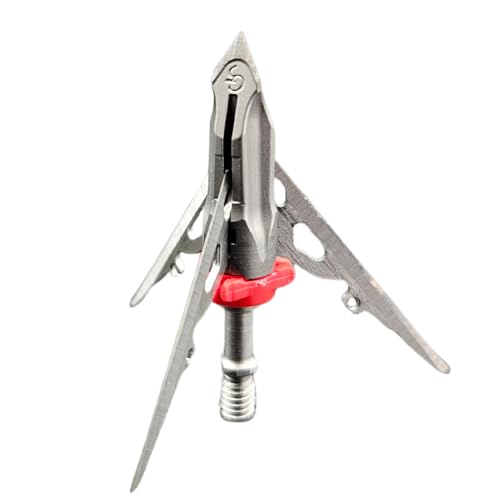
The Megameat is the three-blade alternative for a Ravin owner who does not want to stay inside the maker’s catalog. G5 builds this crossbow version around three machined steel blades that slide rearward on impact, a chisel tip and a SnapLock collar holding everything shut in flight, and the listing gives the same 2-inch cutting diameter as the Ravin heads. Its strongest argument is upkeep: the blades are replaceable, so a head that has done its work can be rebuilt instead of binned, and a 125-grain version sits on the range for heavier setups.
Rage’s Crossbow X is the established outside option: a two-blade mechanical built specifically for crossbow launch forces, with a SlipCam rear-deploying design and Shock Collar retention holding the blades until impact. The listing gives a 2-inch cutting diameter from .035-inch stainless blades on an aluminum ferrule, and the same listing carries a 125-grain option for hunters who want more weight up front. For a Ravin owner who has shot Rage heads for years and trusts the system, this is the familiar choice, provided the collars are kept fresh.
Which One Fits Your Situation
You Shoot One of the Fastest Ravin Bows
Take the Ravin Titanium. Bows running near 500 feet per second are exactly what its listing names, and the titanium ferrule is the build most likely to come through a hard, angled hit still straight enough to shoot again. The steel and aluminum heads carry lower figures in their listings, so the flagship bow deserves the flagship head.
You Want the Maker’s Own Head on a Mid-Speed Bow
Choose between the Ravin Steel and the Ravin Aluminum. Both carry the same weight, cut and spring-clip retention, so decide on the shots you actually take: steel for cover where bone contact is likely, aluminum where most shots are broadside and moderate range. Either keeps you inside the maker’s fit and speed guidance.
You Would Rather Rebuild Heads Than Replace Them
The G5 Megameat fits this habit best. Its blades swap out with the maker’s kit, so one ferrule can serve several seasons, and the three-blade cut suits deer-sized game through soft tissue. Keep spare SnapLock collars with the spare blades, because the collar is part of every rebuild. That habit also keeps point of impact steady, since the same ferrule stays on your bolts season after season instead of a fresh head changing the balance.
You Already Trust Collar-Retained Two-Blade Heads
Stay with the Rage Crossbow X. Its SlipCam deployment and Shock Collar retention are a known quantity, the cut matches the Ravin heads at 2 inches, and the 125-grain option on the same listing lets you add front weight without changing brands. Fresh collars each season keep the system honest.
Common Mistakes
Shooting compound-bow mechanicals from a fast Ravin because the grain weight matches, even though the retention was never built for crossbow launch forces.
Skipping the maker’s fit notes for your exact bow model, when a head can be rated for the brand in general and still be flagged against specific models.
Hunting with a collar or spring clip that has already been through a shot, a pass through a target, or a season of heat in storage.
Swapping between 100-grain and 125-grain heads without shooting both at hunting distance to confirm where each one actually lands.
Using the hunting heads for practice until the edges dull, instead of keeping a matched field point or a single sacrificial head for sighting in.
Frequently Asked Questions
Does a broadhead have to be made by Ravin to work in a Ravin crossbow?
No. Crossbow heads use standard threaded inserts, so a crossbow head from G5 or Rage screws into Ravin bolts the same way. What matters is the speed figure in the listing and the maker’s fit notes for your model, because a head built for slower bows can open early or lose accuracy when a fast Ravin launches it.
Should I pick the titanium, steel or aluminum Ravin head?
All three weigh 100 grains and cut 2 inches, so decide on ferrule strength and the speeds in each listing. Titanium is rated to 500 feet per second and takes the hardest hits, steel is the corrosion-resistant middle ground rated to 450, and aluminum is the lightest build for broadside shots at moderate range.
Can I reuse a mechanical broadhead after it has taken game?
Often, yes, after a careful inspection. Spin the head to check the ferrule is straight, confirm the blades sit flush and open evenly, and replace any bent blade, tired collar or fatigued spring clip. A head that hit heavy bone or the ground should be retired to practice duty rather than trusted on the next animal.
How many broadheads should I carry for a hunt?
A single 3-pack is the minimum most hunters start with: one head can be sacrificed to confirm point of impact before the season, leaving two for the quiver. Hunters who travel or hunt several days in a row usually carry a second pack, plus spare collars or blades for the designs that use them.
W
Wildshot Editorial Team
We compare specs, materials and verified owner reviews before a product earns a spot. Rankings are never paid.
Affiliate disclosure. As an Amazon Associate we earn from qualifying purchases at no extra cost to you. Prices accurate as of the date shown.
The best mirrorless Micro Four Thirds cameras offer compact bodies, fast autofocus and a huge shared lens range. Compare four current OM SYSTEM and Lumix picks.
The best laptops for physics combine strong multi-core CPUs, ample RAM and sharp displays for simulation, coding and data analysis. Compare four top picks.
The best online sheet sets come down to fibre and weave. Four verified sets in bamboo, sateen and organic cotton compared, plus checks before you order.
Hotels with big bathtubs hide in suites, ryokan and spa resorts. How to tell a true soaking tub from a standard one, and how to verify before you book.
The best floor rugs for dogs are low-pile, non-slip and machine washable. Three verified picks compared by size, pile and backing for real dog households.
Looking for the best wireless cell phone chargers? Compare Qi2 15W magnetic pads, 3-in-1 stands and travel chargers for iPhone and Android before you buy.
Best Samsubg Galaxy S5 Battery Extenders compared: extended batteries and battery cases for the Galaxy S5, checked for capacity, bulk, fit and water resistance.
Find the best selling sound cards for gaming PC use, from budget PCIe 5.1 cards to high-resolution USB and premium internal models, with specs and fit guidance.


 G5 Megameat Crossbow Broadhead, 100 Grain (3-Pack)
 Rage Crossbow X, 100 Grain (3-Pack)