We independently review everything we recommend. When you buy through our links, we may earn a commission. As an Amazon Associate we earn from qualifying purchases.
Best Mirrorless Micro Four Thirds Cameras: Compact Interchangeable-Lens Picks
The best mirrorless Micro Four Thirds cameras offer compact bodies, fast autofocus and a huge shared lens range. Compare four current OM SYSTEM and Lumix picks.
The best mirrorless Micro Four Thirds cameras offer compact bodies, fast autofocus and a huge shared lens range. Compare four current OM SYSTEM and Lumix picks.
Introduction
Micro Four Thirds is the most compact interchangeable-lens camera system you can buy into, and that is exactly why it endures. The sensor is smaller than APS-C or full-frame, which lets manufacturers build smaller bodies and dramatically smaller lenses, especially telephoto lenses. A wildlife photographer can carry a 300mm-equivalent reach in a kit that fits a small bag, a travel photographer can pack two lenses instead of one, and a video creator gets strong stabilisation and deep depth of field in a body that does not tire the arms. The best mirrorless Micro Four Thirds cameras combine that portability with fast autofocus, capable video, and weather sealing.
OUR TOP PICK
OM SYSTEM OM-1 Mark II with 12-40mm f/2.8 PRO II Lens
This guide compares four current Micro Four Thirds mirrorless cameras from the two brands that build the system: OM SYSTEM, formerly Olympus, and Panasonic Lumix. Every camera below is sold on Amazon US, with specifications from the manufacturer and retailer listings. The keyword “micro 4 3” is read here as Micro Four Thirds, the standard name of the format, and every product in this article is a Micro Four Thirds interchangeable-lens mirrorless camera.
At a Glance
Product
Best for
Key spec
OM SYSTEM OM-1 Mark II with 12-40mm f/2.8 PRO II
Wildlife and fast action
20.4MP stacked sensor, 50fps with autofocus, weather sealed
Panasonic Lumix G9 II (body only)
Stills and video hybrid shooting
25.2MP sensor, Phase Hybrid AF, 8-stop stabilisation
OM SYSTEM OM-5 Mark II with 14-150mm f/4-5.6 II
Travel and hiking
20MP sensor, 370g body, 10.7x zoom kit lens
Panasonic Lumix GH7 with 12-60mm f/2.8-4
Serious video production
25.2MP sensor, 5.7K video, internal ProRes RAW
How to Choose a Micro Four Thirds Camera
Sensor and resolution: 20MP or 25MP
Current Micro Four Thirds cameras use either a 20-megapixel or a 25.2-megapixel sensor. The 25.2MP sensors in the Panasonic bodies give a little more cropping room and finer detail, while the 20MP sensors in the OM SYSTEM bodies pair with faster readout speeds for burst shooting. For prints, online sharing, and most publication work, both resolutions are ample. Resolution matters less than autofocus, stabilisation, and lens choice in this system.
Autofocus: subject detection changes everything
Modern Micro Four Thirds cameras detect and track people, animals, birds, cars, and motorcycles, locking onto eyes and holding focus as the subject moves. The OM-1 Mark II uses Cross Quad Pixel autofocus with 1,053 points across the frame, while the Panasonic G9 II and GH7 use Phase Hybrid autofocus, a first for the Lumix G series. For wildlife and sports, subject detection and tracking reliability matter more than any other single feature. Check which subjects each camera detects, since the lists differ between brands.
Stabilisation: the system’s quiet superpower
In-body image stabilisation is a Micro Four Thirds strength. The G9 II is rated at up to 8 stops of stabilisation, and the OM-5 Mark II at up to 6.5 stops, which means sharp handheld shots at shutter speeds that would blur on other systems. Stabilisation also smooths handheld video, reducing the need for a gimbal. Combined with stabilised lenses, the dual stabilisation systems in these cameras are among the best available at any sensor size.
The 2x crop factor: reach and depth of field
A Micro Four Thirds sensor has a 2x crop factor, so a 150mm lens frames like a 300mm lens on a full-frame camera. That is a large advantage for wildlife, birding, and sports, where long lenses are expensive and heavy on larger formats. The trade-off is depth of field: the smaller sensor gives deeper depth of field at the same aperture, which is helpful for landscapes and macro work but means less background blur for portraits unless you use a fast lens. Low-light performance also trails larger sensors, so fast lenses matter more here.
Video: resolution, frame rates, and codecs
If you shoot video, look beyond headline resolution. The GH7 records 5.7K video at up to 60 frames per second, 4K at up to 120 frames per second, and Full HD at up to 240 frames per second, with internal ProRes RAW recording and real-time LUT support. The G9 II and OM-1 Mark II both record 4K at 60 frames per second with strong stabilisation. Consider recording limits and heat management, since those matter more in practice than a resolution number.
Size, sealing, and the lens system
Micro Four Thirds bodies are compact, and the OM-5 Mark II body is listed at just 370g, but the real advantage is the shared lens system. OM SYSTEM and Panasonic lenses mount on each other’s bodies, so the choice of camera does not lock you out of the other brand’s lenses. That shared mount covers everything from ultra-wide zooms to super-telephoto primes. Weather sealing matters for outdoor work: the OM-1 Mark II and OM-5 Mark II are sealed against dust and moisture, with the OM-5 Mark II rated to IP53.
OM SYSTEM OM-1 Mark II with 12-40mm f/2.8 PRO II Lens
Top Pick
OM SYSTEM OM-1 Mark II with 12-40mm f/2.8 PRO II Lens
The OM-1 Mark II is the flagship of the OM SYSTEM line and the fastest camera in this guide, built for photographers who shoot wildlife, birds, and action. It uses a 20.4MP stacked BSI Live MOS Micro Four Thirds sensor with the TruePic X processor, and its Cross Quad Pixel autofocus system offers 1,053 points across the frame with subject detection for birds, animals, and vehicles. Continuous shooting reaches 50 frames per second with autofocus tracking, or 120 frames per second with focus and exposure locked, which gives a real advantage when a subject moves unpredictably.
This listing is a kit with the M.Zuiko Digital ED 12-40mm f/2.8 PRO II lens, a constant-aperture standard zoom that covers wide-angle to short telephoto with a bright f/2.8 aperture throughout the range. The body is weather sealed, the electronic viewfinder uses a 5.76-million-dot OLED panel, and the 3-inch screen articulates for low-angle and video work. Video reaches 4K at 60 frames per second. The camera uses the BLX-1 lithium-ion battery and records to SD cards, with Bluetooth, HDMI, and Wi-Fi connectivity.
For wildlife and action photography, the OM-1 Mark II is the strongest pick here: the burst rate, the autofocus coverage, and the sealed body suit long days outdoors, and the compact Micro Four Thirds lenses keep the kit light. The 20.4MP resolution is lower than the Panasonic bodies in this guide, and the sensor is smaller than full-frame, so low-light work benefits from fast lenses. For photographers who value speed, reach, and portability over maximum resolution, it is the flagship of the system for good reason.
Pros:
– Very fast burst shooting: 50fps with autofocus, 120fps with focus locked
– Cross Quad Pixel autofocus with 1,053 points and subject detection
– Bright 12-40mm f/2.8 PRO II kit lens with constant aperture
– Weather-sealed body built for outdoor and wildlife work
– Sharp 5.76-million-dot electronic viewfinder
Cons:
– 20.4MP resolution is lower than the 25.2MP Panasonic bodies here
– Smaller sensor means less background blur than larger formats
– Premium flagship tier within the Micro Four Thirds range
– Kit lens range ends at 40mm, so telephoto work needs another lens
The Panasonic Lumix G9 II is the most capable all-rounder in this guide, pairing a 25.2MP sensor with the first Phase Hybrid autofocus system in the Lumix G series. The new sensor and processor deliver fast, precise focusing with subject detection for people, animals, cars, and motorcycles, and burst shooting reaches 60 frames per second with continuous autofocus. That combination makes the G9 II equally comfortable shooting stills of moving subjects and video of fast action.
Stabilisation is a headline feature: the in-body system is rated at up to 8.0 stops, and combined with a stabilised lens the Dual I.S. 2 system reaches 7.5 stops across five axes. That lets you shoot handheld at slow shutter speeds and record smooth video without a gimbal. The camera records 4K video with professional tools, and the body uses the DMW-BLK22 lithium-ion battery. This listing is body only, so you choose the lens that fits your shooting, whether that is a versatile zoom or a fast prime.
For hybrid photographers who shoot both stills and video, the G9 II is the balanced choice: higher resolution than the OM SYSTEM bodies here, strong autofocus, and class-leading stabilisation in a body that stays compact. The trade-offs are the usual Micro Four Thirds ones: low-light performance trails larger sensors, and the body-only listing means budgeting for a lens separately. If you want one camera that does nearly everything well, this is it.
Pros:
– 25.2MP sensor gives extra detail and cropping room
– Phase Hybrid autofocus with fast, reliable subject detection
– Up to 8-stop in-body stabilisation for handheld stills and video
– 60fps burst shooting with continuous autofocus
– Body-only listing lets you choose your own lens
Cons:
– Sold body only, so a lens purchase is required
– Low-light performance trails larger-sensor cameras
– Smaller sensor gives deeper depth of field, with less background blur
– Video features are strong but not as deep as the GH7
OM SYSTEM OM-5 Mark II with 14-150mm f/4-5.6 II Lens
OM SYSTEM OM-5 Mark II with 14-150mm f/4-5.6 II Lens
The OM-5 Mark II is the travel camera in this guide, and its appeal is simple: a capable Micro Four Thirds camera in a body listed at just 370g, paired with a single zoom that covers almost everything. It uses a 20-megapixel Micro Four Thirds sensor with in-body image stabilisation rated at up to 6.5 stops, and the body is weather sealed to IP53, so rain and dust on the trail are not a problem. Video reaches 4K, and the compact body fits easily in a day pack or a jacket pocket with a small lens.
This listing pairs the silver body with the M.Zuiko Digital ED 14-150mm f/4-5.6 II lens, a 10.7x zoom that runs from wide-angle to long telephoto in a single lens. That range covers landscapes, street scenes, portraits, and distant wildlife without a lens change, which is exactly what a hiking or travel photographer wants. The lens is compact and light, matching the philosophy of the body, and the combination stays balanced in the hand.
For travel, hiking, and everyday carry, the OM-5 Mark II is the most practical pick here: light, sealed, stabilised, and sold with a genuinely versatile zoom. Its limitations are modest: 20MP resolution rather than 25.2MP, a variable-aperture kit lens that is slower at the long end, and autofocus that is capable rather than flagship-class. For photographers who walk far and shoot a bit of everything, those are fair trade-offs for a kit this light.
Pros:
– Very light body, listed at 370g, ideal for travel and hiking
– Weather sealed to IP53 for rain and dust on the trail
– Versatile 14-150mm kit lens covers wide to telephoto in one lens
– Up to 6.5 stops of in-body stabilisation
– Compact size makes it easy to carry all day
Cons:
– 20MP resolution is lower than the Panasonic bodies here
– Kit lens has a variable aperture that narrows at the long end
– Autofocus is capable but not flagship-class for fast action
– Smaller grip may feel cramped for photographers with large hands
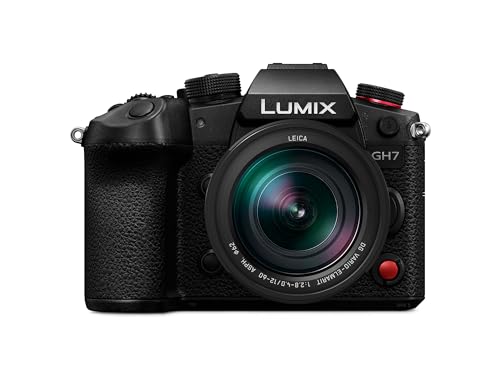
The Panasonic Lumix GH7 is the video specialist in this guide, built for filmmakers and hybrid creators who need professional video formats in a compact Micro Four Thirds body. It uses a 25.2MP sensor with Phase Hybrid autofocus and records 5.7K video at up to 60 frames per second, C4K, 4K at up to 120 frames per second, and Full HD at up to 240 frames per second for slow motion. Internal ProRes RAW recording, real-time LUT support, and Adobe Cloud compatibility streamline the path from shooting to post-production, and the camera can record to an external SSD or livestream directly.
This listing pairs the body with the Leica 12-60mm f/2.8-4 lens, a versatile standard zoom with a bright aperture at the wide end. The lens covers wide-angle to short telephoto, which suits documentary work, interviews, and run-and-gun shooting. The GH7 uses the same 5-axis stabilisation approach as the G9 II, keeping handheld footage smooth, and its Intelligent Hybrid autofocus system tracks subjects reliably during video. The body is built for long recording sessions with professional audio and monitoring options.
For video-first creators, the GH7 is the clear pick: no other camera in this guide matches its codec and frame-rate options, and the Micro Four Thirds lens range keeps the rig compact. For stills-only photographers, the video features add cost and complexity without benefit, and the 25.2MP stills resolution matches the G9 II rather than exceeding it. If video is your priority, this is the most capable Micro Four Thirds body available.
Pros:
– Professional video: 5.7K at 60fps, 4K at 120fps, internal ProRes RAW
– Real-time LUT and Adobe Cloud support for faster post-production
– 25.2MP sensor with Phase Hybrid autofocus
– Versatile 12-60mm f/2.8-4 kit lens for documentary work
– Strong stabilisation for smooth handheld footage
Cons:
– Video-first feature set adds cost for stills-only photographers
– Smaller sensor trails larger formats in low-light video
– No built-in ND filters for bright outdoor shooting
– Heavier and more complex than the travel-oriented OM-5 Mark II
Which Micro Four Thirds Camera Fits You
The right choice follows your subject. Wildlife and action photographers should start with the OM-1 Mark II: its burst rate, autofocus coverage, and sealed body are built for fast, unpredictable subjects, and the 12-40mm f/2.8 kit lens is a strong general-purpose optic. Hybrid shooters who split time between stills and video will get the most from the G9 II, which pairs the highest stills resolution here with fast autofocus and stabilisation that leads its class.
Travel and hiking photographers should look at the OM-5 Mark II, the lightest and most portable camera in this guide, whose 14-150mm kit lens covers nearly every situation without a lens change. Video-first creators should choose the GH7, whose codecs, frame rates, and workflow features are unmatched in the system. All four share the same lens mount, so lenses bought for one body work on the others, and that shared system is the real long-term value of Micro Four Thirds: invest in glass once, and upgrade bodies as your needs change.
Frequently Asked Questions
What does Micro Four Thirds mean?
Micro Four Thirds is a mirrorless camera system with a sensor smaller than APS-C or full-frame, shared by OM SYSTEM and Panasonic. The 2x crop factor makes lenses effectively twice as long as their marked focal length, and the shared mount means lenses from either brand fit bodies from either brand.
Are Micro Four Thirds cameras good for wildlife photography?
Yes, and wildlife is one of the system’s strengths. The 2x crop factor gives extra reach from compact telephoto lenses, the OM-1 Mark II shoots at 50 frames per second with autofocus, and subject detection tracks birds and animals. The smaller sensor trails larger formats in low light, so fast lenses help at dawn and dusk.
Can Micro Four Thirds cameras shoot professional video?
Yes. The GH7 records 5.7K video at up to 60 frames per second with internal ProRes RAW, and the G9 II and OM-1 Mark II record 4K at 60 frames per second with strong stabilisation. Micro Four Thirds cameras are widely used for documentary, travel, and online video work.### Do OM SYSTEM and Panasonic lenses work on each other’s cameras?
Yes. Micro Four Thirds is a shared mount, so OM SYSTEM M.Zuiko lenses fit Panasonic Lumix G bodies and Panasonic Lumix G lenses fit OM SYSTEM bodies. Autofocus and stabilisation generally work across brands, though some advanced features work best within the same brand.
Is 20MP enough for Micro Four Thirds?
For most uses, yes. Twenty megapixels is ample for prints, online sharing, and publication work, and the 20MP sensors in the OM SYSTEM bodies pair with faster readout for burst shooting. The 25.2MP Panasonic sensors give extra cropping room if you regularly crop heavily.
Should I buy a kit lens or body only?
A kit lens is the simpler start: the 12-40mm f/2.8, 14-150mm, and 12-60mm kits in this guide each cover a useful range. Body only, as with the G9 II listing here, makes sense if you already own Micro Four Thirds lenses or want a specific lens that no kit offers.
Conclusion
The best mirrorless Micro Four Thirds cameras prove that a smaller sensor can be a strength rather than a compromise. The OM-1 Mark II leads for wildlife and action with its speed and autofocus, the G9 II is the most balanced hybrid for stills and video, the OM-5 Mark II is the lightest and most practical travel companion, and the GH7 is the video specialist with professional codecs and frame rates. All four share one lens mount and one philosophy: compact, capable cameras with a lens range no other system matches for size. Choose by subject, invest in lenses you will keep, and the body you pick today will serve you for years.
Disclosure: As an Amazon Associate, we earn from qualifying purchases.
W
Wildshot Editorial Team
We compare specs, materials and verified owner reviews before a product earns a spot. Rankings are never paid.
Affiliate disclosure. As an Amazon Associate we earn from qualifying purchases at no extra cost to you. Prices accurate as of the date shown.
Best Mirrorless Micro Four Thirds Cameras: Compact Interchangeable-Lens…Check price on Amazon
The best laptops for physics combine strong multi-core CPUs, ample RAM and sharp displays for simulation, coding and data analysis. Compare four top picks.
The best online sheet sets come down to fibre and weave. Four verified sets in bamboo, sateen and organic cotton compared, plus checks before you order.
Hotels with big bathtubs hide in suites, ryokan and spa resorts. How to tell a true soaking tub from a standard one, and how to verify before you book.
The best floor rugs for dogs are low-pile, non-slip and machine washable. Three verified picks compared by size, pile and backing for real dog households.
Looking for the best wireless cell phone chargers? Compare Qi2 15W magnetic pads, 3-in-1 stands and travel chargers for iPhone and Android before you buy.
Best Samsubg Galaxy S5 Battery Extenders compared: extended batteries and battery cases for the Galaxy S5, checked for capacity, bulk, fit and water resistance.
Find the best selling sound cards for gaming PC use, from budget PCIe 5.1 cards to high-resolution USB and premium internal models, with specs and fit guidance.
The best sleek laptop backpacks keep a slim, clean profile without giving up protection. Matein, Herschel, Fjallraven and SwissGear picks compared in detail.
The best outdoor security doorbell cameras from Ring, Blink, eufy and Arlo compared on video quality, night vision, power options and package detection.

 OM SYSTEM OM-1 Mark II with 12-40mm f/2.8 PRO II Lens
 Panasonic Lumix G9 II (Body Only)
 OM SYSTEM OM-5 Mark II with 14-150mm f/4-5.6 II Lens
 Panasonic Lumix GH7 with 12-60mm f/2.8-4 Lens