We independently review everything we recommend. When you buy through our links, we may earn a commission. As an Amazon Associate we earn from qualifying purchases.
Best Bike for Bad Roads: Durable Picks for Potholes, Gravel, and Rough Pavement
Find the best bike for bad roads today: durable hybrids with wide tires, suspension forks, and disc brakes built for potholes, gravel, and rough pavement.
Find the best bike for bad roads today: durable hybrids with wide tires, suspension forks, and disc brakes built for potholes, gravel, and rough pavement.
If your daily route is a patchwork of cracked asphalt, potholes, loose gravel, and stretches of unpaved track, the best bike for bad roads is one built to absorb punishment rather than chase speed. A narrow-tired road bike will rattle your hands, pinch-flat on sharp edges, and skid on loose surfaces, while a bike with wide tires, a sturdy frame, and a suspension fork turns the same route into a comfortable ride. The short answer: a dual-sport hybrid with 700c wheels, multi-terrain tires, a front suspension fork, and disc brakes is the most practical choice for most riders, and a fat-tire mountain bike is the stronger pick when your roads are mostly unpaved, sandy, or deeply rutted.
This guide explains what makes a bike survive bad roads, then reviews three real bikes sold on Amazon US that fit the brief. Every pick below is a complete bicycle, not a part or an accessory, and each one is listed with its Amazon ASIN so you can check the current listing before ordering.
Choosing a bike for bad roads is mostly about durability and control. Speed matters less than the ability to roll over broken surfaces without damage to the bike or discomfort to the rider. The six factors below are the ones that make the biggest difference.
Tire Width and Tread
Wide tires are the single most important feature for bad roads. A tire in the 38 mm to 50 mm range spreads your weight over a larger contact patch, which improves grip on loose gravel and softens the blow from potholes and cracks. Knobby or multi-terrain tread adds traction on dirt and gravel, while a slick center strip keeps rolling resistance reasonable on pavement. Narrow road tires, by contrast, sink into soft surfaces and are far more likely to pinch-flat when they hit a sharp edge. Before buying, check the tire size in the listing and confirm the frame has clearance for tires at least that wide, in case you want to fit something wider later.
Frame Material and Strength
Bad roads punish frames. Repeated impacts from potholes and washboard surfaces stress joints and welds, so a frame built for durability matters more than one built for minimum weight. Aluminum frames are a good middle ground: they are light enough for daily riding, resist rust, and handle rough use well when paired with a sensible design. Steel frames are heavier but famously tough and easy to repair, which is why they still appear on fat-tire and adventure bikes. Carbon fiber is light and comfortable, but it is an expensive choice for roads that regularly throw debris and impacts at the bike, and damage can be hard to spot. For most riders on bad roads, a well-built aluminum or steel frame is the sensible pick.
Suspension
Suspension is what separates a bike that survives bad roads from one that is pleasant to ride on them. A front suspension fork absorbs the sharp hits from potholes, rocks, and broken pavement before they reach your hands and shoulders. It does not need to be a long-travel downhill fork; even a modest suspension fork with lockout makes a noticeable difference on rough streets. Full suspension adds comfort on the roughest tracks but also adds weight, maintenance, and cost, and it is rarely necessary for road-based riding. A suspension seat post is a useful bonus on a hybrid, since it takes the edge off impacts that reach the saddle. If your roads are mostly paved but badly maintained, a front fork alone is usually enough.
Brakes
Reliable braking matters more on bad roads because loose gravel, dust, and wet patches all reduce grip. Disc brakes, whether mechanical or hydraulic, deliver consistent stopping power in wet and muddy conditions and keep working when rims are dirty or out of true. Mechanical disc brakes are simpler to maintain and are common on affordable hybrids, while hydraulic disc brakes offer stronger modulation for riders who tackle steep, loose descents. Linear-pull rim brakes can work on a commuter hybrid, but they lose effectiveness when rims get wet or coated in grit, and they wear rims down over time. If your route includes steep sections or frequent wet weather, disc brakes are worth prioritizing.
Gearing
Bad roads often come with hills, soft surfaces, and headwinds, and all of them demand low gears. A wide gear range lets you spin up a steep, rutted climb instead of grinding, and lets you keep momentum on flat stretches. A 21-speed or 24-speed drivetrain with a triple crankset gives a useful spread for most riders, while a modern wide-range single-chainring setup can be simpler and still cover the same ground. What matters is the lowest gear: it should be low enough to climb a loose, uneven slope without standing on the pedals. Twist shifters are simple and common on hybrids, while trigger shifters give more precise control. Either works, as long as the shifting is crisp and the chain stays put on rough ground.
Fit, Wheels, and Carrying Capacity
A bike that fits you will handle bad roads far better than one that does not. The right frame size keeps your weight balanced between the wheels, which improves traction and control on loose surfaces, and it keeps you comfortable enough to ride with relaxed arms that can absorb shocks. Wheels matter too: double-wall rims are stronger than single-wall rims and resist going out of true after hard hits, and 26-inch or 700c wheels both work well, with 700c wheels rolling over obstacles slightly more easily. Finally, think about carrying capacity. Bad-road riding often means commuting or touring, so rack and fender mounts, and a sturdy rear rack, turn a recreational bike into a practical daily tool. A bike that can carry a bag or groceries without a backpack is one you will ride far more often.
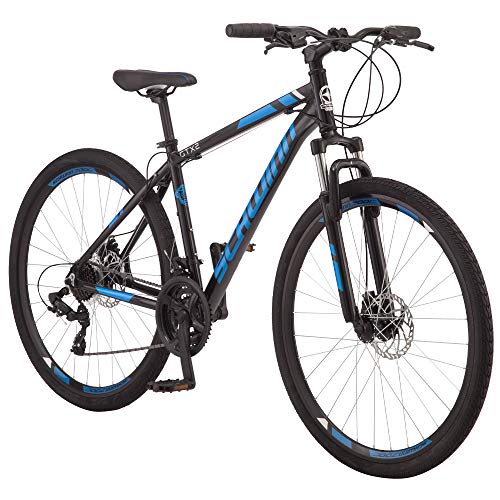
The Schwinn GTX 2 is a dual-sport hybrid built for exactly the kind of mixed riding this guide covers. Its lightweight aluminum frame is paired with a front suspension fork, 700c wheels, and multi-terrain tires, and the listing describes it as suitable for paved roads and unpaved trails alike. That combination is the core of what makes a bike work on bad roads: the fork takes the sting out of potholes and broken pavement, the tires grip on gravel and dirt, and the aluminum frame keeps the whole package manageable for daily use.
The drivetrain is a 21-speed setup with Shimano EZ-Fire trigger shifters and a Shimano rear derailleur, giving a wide enough range for steep, rutted climbs and faster paved sections. Mechanical disc brakes provide consistent stopping power in wet and dusty conditions, which is a meaningful advantage over rim brakes when your roads are unpredictable. The upright dual-sport geometry keeps the rider in a comfortable, confident position with a good view of the road ahead, which helps you spot potholes and debris early. The listed rider-height range and 18-inch frame suit a broad range of adult riders, and the bike is described as suitable for commuting, fitness riding, and weekend exploring.
One point to note: the listing is identified as the GTX 2.0 with model number S2786C and model year 2020, so confirm the frame size and color options on the current listing before ordering, since size availability can vary. Overall, this is the most complete bad-road package in this roundup, and it is the pick to start with if your route mixes pavement, gravel, and dirt.
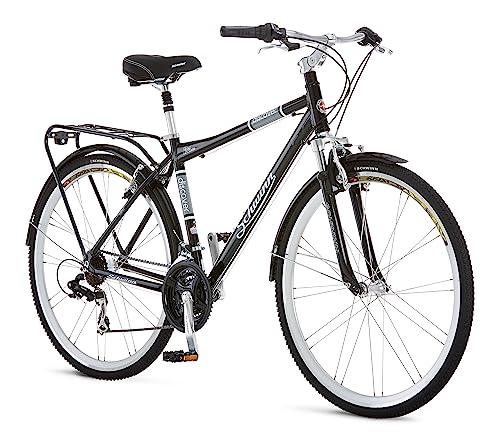
The Schwinn Discover is a comfort-oriented hybrid aimed at riders whose bad roads are mostly urban: cracked streets, speed bumps, patched asphalt, and the occasional gravel path. It pairs a lightweight aluminum frame with a suspension fork and a suspension seat post, so impacts are absorbed at both ends of the bike. That double layer of cushioning is genuinely useful on streets that never seem to get resurfaced, and it makes longer rides far less tiring on the hands and lower back.
The bike runs 700c wheels with 38 mm tires, a width that rolls well on pavement while still offering enough volume to smooth out rough patches and grip on packed dirt. A 21-speed SRAM grip shifter and rear derailleur handle hills and headwinds, and Promax alloy linear-pull brakes provide the stopping power. Practical extras set the Discover apart for daily use: full fenders keep road spray and grit off you and the bike, and a rear cargo rack means you can carry a bag or groceries without wearing a backpack. The swept-back upright handlebars and padded saddle reinforce the comfort-first design.
As a partial fit, be aware of its limits. Linear-pull rim brakes are less effective than disc brakes in wet or gritty conditions, and the 38 mm tires and comfort geometry are better suited to rough pavement and light gravel than to deep ruts, sand, or technical trails. If your roads are mostly paved but badly maintained, the Discover is a strong and practical choice; if your route regularly turns to loose dirt or mud, the GTX 2 above is the better fit.
The DEYGIA 24-speed hybrid is a budget-friendly option for riders who want a capable bad-road commuter without the weight and complexity of a full mountain bike. Its carbon steel frame is built for stability, and the listing describes it as suitable for flat roads, gravel roads, and other terrains. The 700c wheels carry 700 x 32C tires, and the bike uses a 3 x 8 drivetrain with trigger shifting, giving 24 speeds to cover climbs, headwinds, and faster paved stretches.
Dual disc brakes front and rear are the standout feature at this level, offering more consistent stopping power in wet and dusty conditions than rim brakes. Internal cable routing keeps the lines protected from dirt and snagging, and the bike arrives largely pre-assembled with tools and instructions included, which simplifies setup. The upright hybrid riding position and lightweight frame make it a reasonable choice for commuting and recreational riding on mixed surfaces.
As a partial fit, the 32C tires are on the narrow side for genuinely rough unpaved roads: they will handle packed dirt and light gravel, but they offer less cushioning and grip than the wider tires on the Schwinn picks when the surface turns loose, sandy, or deeply rutted. The carbon steel frame is also heavier than aluminum. Treat this as a good-value pick for mostly paved routes with rough patches and occasional gravel, rather than as a dedicated off-road machine.
What to Check Before You Buy
Before ordering any bike for bad roads, run through a short checklist. First, confirm the frame size against your height using the sizing chart on the listing, since a bike that is too large or too small will handle poorly on loose surfaces. Second, check the tire width and whether the frame and fork have clearance for wider tires later. Third, confirm the brake type and whether the bike uses disc or rim brakes, and whether spare pads are easy to find. Fourth, look at the assembly requirements: most bikes shipped in a box need the handlebars, pedals, and front wheel fitted, plus a check of bolts, tire pressure, and brake adjustment, so budget for a professional assembly if you are not confident doing it yourself. Fifth, check the listed weight limit and the availability of replacement parts such as tires, tubes, and brake pads in your size. Finally, confirm the return policy and warranty terms on the listing, since a bike is a large item and returning one is not trivial.
Once the bike arrives, a few setup steps make a real difference on bad roads. Set tire pressure toward the lower end of the range printed on the tire sidewall for extra cushioning and grip on rough surfaces, and check it weekly since rough riding can cause slow leaks. Keep the chain clean and lubricated, because grit from unpaved roads wears drivetrains quickly. Check spoke tension and wheel trueness after the first few rides, since new wheels often settle after hard impacts. And carry a basic repair kit with a spare tube, tire levers, and a small pump, because a flat is far more likely on debris-strewn roads than on smooth tarmac.
FAQ
What type of bike is best for bad roads?
A dual-sport hybrid or a gravel bike is the best all-round choice for bad roads, because it combines wide multi-terrain tires, a durable frame, and a comfortable upright position. A front suspension fork and disc brakes add comfort and control. If your roads are mostly unpaved, sandy, or deeply rutted, a fat-tire mountain bike with very wide tires is the stronger option, though it is slower on pavement.
How wide should tires be for potholes and gravel?
Tires between 38 mm and 50 mm wide are a good target for bad roads. That width provides enough air volume to absorb impacts and enough contact area to grip loose gravel, while still rolling acceptably on pavement. Tires narrower than 32 mm are more likely to pinch-flat on sharp edges and sink into soft surfaces, so they are a poor match for rough routes.
Do I need suspension for bad roads?
A front suspension fork is highly recommended if your roads include potholes, broken pavement, or washboard surfaces. It absorbs sharp impacts before they reach your hands and shoulders, which reduces fatigue and improves control. Full suspension is rarely necessary for road-based riding, and a suspension seat post can be a useful addition on a hybrid.
Are disc brakes better than rim brakes on bad roads?
Disc brakes generally perform better on bad roads because they keep working consistently in wet, muddy, and dusty conditions, and they are unaffected by a rim that has gone slightly out of true after a hard hit. Rim brakes can work on a commuter hybrid, but they lose effectiveness when rims get wet or coated in grit.
Can I ride a hybrid bike on unpaved roads?
Yes, a dual-sport hybrid with multi-terrain tires can handle packed dirt, light gravel, and dry unpaved paths. It will struggle on deep sand, thick mud, or technical trails, where a mountain bike or fat-tire bike is the right tool. Match the bike to the worst surface you ride regularly, not the best.
Bottom Line
The best bike for bad roads is the one that matches the worst surface on your regular route. For most riders, that means a dual-sport hybrid with wide multi-terrain tires, a front suspension fork, and disc brakes, and the Schwinn GTX 2 is the strongest all-round pick in this guide. If your roads are rough city streets rather than trails, the comfort-focused Schwinn Discover with its suspension fork, suspension seat post, fenders, and rear rack is a practical alternative. And if you want a budget-friendly hybrid for mostly paved routes with rough patches and light gravel, the DEYGIA 24-speed hybrid covers the essentials. Whichever you choose, confirm the frame size, check the tire width and brake type on the current listing, and set the bike up properly before your first ride over broken ground.
Disclosure: As an Amazon Associate, we may earn from qualifying purchases.
W
Wildshot Editorial Team
We compare specs, materials and verified owner reviews before a product earns a spot. Rankings are never paid.
Affiliate disclosure. As an Amazon Associate we earn from qualifying purchases at no extra cost to you. Prices accurate as of the date shown.
Find the best gaming desks for 3 monitors: the width, depth, weight capacity, and cable routing a triple-screen setup actually needs, plus a top pick built for three large screens.
Discover the best stationary bike workout setup: top indoor bikes, interval and endurance plans, and how to choose the right bike for home training today.
Looking for the best 250 four stroke dirt bike? Compare five 250cc four-stroke trail and enduro bikes, their engines, gearboxes, and wheels before you buy.
Choosing a college laptop starts with GB. Compare laptops with 8GB and 16GB RAM and 256GB and 512GB SSD storage, and learn how much is enough for study.
Discover the best rechargeable OTC hearing aids for workplace conversations, with clear speech, noise reduction, battery life and Bluetooth calls for offices.
Compare the best narrow frame rollator walkers for tight doorways and small spaces, with widths, weight limits, seat sizes, wheels and folding compared.
Our eufy video doorbell s4 review 2026 covers the 3K panoramic camera, radar detection, OmniTrack AI tracking, local storage and wired setup in this guide.
Find the best bike tyre levers for road, gravel and mountain bikes. Compare plastic, steel-core and stainless sets, spoke hooks and rim-safe picks today.

 DEYGIA 24-Speed 700C Hybrid Bike