We independently review everything we recommend. When you buy through our links, we may earn a commission. As an Amazon Associate we earn from qualifying purchases.
Best Cold Weather Rechargeable Batteries for Winter Gear, Trail Cameras and Flashlights
Find the best cold weather rechargeable batteries for trail cameras, flashlights and winter gear. Low-self-discharge NiMH picks rated to -4 degrees F.
Find the best cold weather rechargeable batteries for trail cameras, flashlights and winter gear. Low-self-discharge NiMH picks rated to -4 degrees F.
The best cold weather rechargeable batteries are low-self-discharge NiMH cells with a stated low-temperature rating, and the clearest example in this guide is the Panasonic eneloop family, rated for performance down to minus 4 degrees Fahrenheit. Cold weather is hard on every battery chemistry because ion movement slows as the temperature falls, internal resistance rises, and usable capacity drops. A cell that runs a flashlight for hours at room temperature can fade much sooner on a freezing morning, and an alkaline cell can fade sooner still. That is why the short answer matters more than the brand name: for rechargeable use in winter, choose a low-self-discharge NiMH battery with a published cold rating, keep a spare set warm in an inside pocket, and match the capacity to the device.
Quick answer: If you want one set for most winter jobs, start with the Panasonic eneloop AA 8-pack. It offers a balance of capacity, a long cycle life, and a stated rating down to minus 4 degrees Fahrenheit. For high-drain devices such as camera flashes and bright flashlights, step up to the eneloop pro AA. For smaller devices that take AAA cells, the eneloop AAA 8-pack is the matching choice. All three are rechargeable NiMH cells, all three are pre-charged and ready to use, and all three share the same low-temperature rating. None of them is rated below minus 4 degrees Fahrenheit, so for sustained use far below that point, plan on shorter runtimes and spare cells kept warm.
Quick Picks
Our Short List of 3
Editor’s Choice
1. Panasonic eneloop AA, 8-Pack — Best Overall for Cold Weather
Chemistry First: Why Low-Self-Discharge NiMH Leads for Rechargeable Cold Use
The chemistry of a rechargeable battery decides how it behaves when the temperature drops. Standard alkaline cells are not rechargeable and are a poor cold-weather choice, losing a large share of their usable capacity in freezing conditions. Nickel-metal hydride, known as NiMH, is the established rechargeable chemistry for AA and AAA sizes, and the low-self-discharge version is the one to look for. Low-self-discharge NiMH cells hold their charge far longer on the shelf than older NiMH cells, so a set charged in autumn is still useful when winter arrives.
The newer 1.5 V lithium-ion rechargeable AA cells are also worth knowing about. In cold-weather comparisons for trail cameras, 1.5 V lithium-ion rechargeables have performed ahead of NiMH in fridge and freezer conditions, closer to non-rechargeable lithium cells, while NiMH has still performed well ahead of alkaline cells. The trade-off is that lithium-ion AA cells use internal voltage-regulating circuitry and need a compatible charging approach. For most readers, low-self-discharge NiMH remains the simpler and more predictable rechargeable choice, and it is the chemistry behind every pick in this guide.
Look for a Stated Low-Temperature Rating
A battery that is simply labelled rechargeable tells you nothing about cold weather. Look for a specific low-temperature figure from the manufacturer, stated in degrees Fahrenheit or Celsius, and treat a missing figure as a warning sign. The eneloop family states performance down to minus 4 degrees Fahrenheit, which is minus 20 degrees Celsius, and that figure appears in the product information for the AA and AAA cells and for the pro versions. A stated rating does not mean the battery delivers its full room-temperature runtime at that temperature. It means the manufacturer has set an operating floor, and you should expect reduced runtime as you approach it.
Capacity in Milliamp-Hours and What It Means in the Cold
Capacity, measured in milliamp-hours, or mAh, describes how much charge a cell can hold. A higher mAh figure usually means a longer runtime in the same device, but the comparison only works within the same size and chemistry. An AA cell at 2100 mAh holds far more charge than an AAA cell at 850 mAh, which is expected because the AAA cell is physically smaller. Within AA NiMH cells, the standard eneloop at up to 2100 mAh and the eneloop pro at up to 2500 mAh typical show the usual pattern: the pro cell holds more charge per cycle, which helps high-drain devices, but it gives up cycle life in return.
In cold weather, treat the mAh figure as a room-temperature starting point. As the temperature falls, the usable share of that capacity falls with it, so a device that runs for a set number of hours indoors will run for fewer hours outdoors. Buying a higher-capacity cell helps, but it does not remove the cold-weather penalty. Carrying a spare set is the more reliable answer.
Cycle Life: How Many Times You Can Recharge
Cycle life is the number of charge and discharge cycles a cell is rated for, and it matters because rechargeable batteries are bought to be reused. The standard eneloop AA and AAA cells are rated for up to 2100 recharge cycles, which is a long service life for household and outdoor devices. The eneloop pro AA cells are rated for up to 500 recharge cycles, which is far fewer, because the pro cells are tuned for capacity rather than longevity. If a device is used often and recharged often, the standard cell is the better long-term value. If a device draws heavy current in short bursts and needs maximum capacity per charge, the pro cell earns its place despite the shorter cycle life.
Self-Discharge and Shelf Life
Self-discharge is the charge a battery loses while it sits unused, and it is a quiet problem for seasonal gear. An older NiMH cell could lose a large share of its charge in weeks, which made it a poor choice for a flashlight stored in a car or a trail camera checked once a month. Low-self-discharge NiMH cells change that picture. The standard eneloop cells are stated to hold 70 percent of their charge for up to 10 years when stored, while the eneloop pro cells are stated to hold 85 percent of their charge after one year. For winter gear, the practical point is simple: charge the cells, store the spares somewhere cool and dry, and they should still be ready when you need them. Avoid leaving rechargeable cells in a hot vehicle in summer, since heat ages them faster than cold storage does.
Size, Fit and Device Compatibility
AA and AAA are not interchangeable, and no amount of capacity makes a wrong size work. Check the device before ordering, including trail cameras, headlamps, flashlights, remote controls, game controllers, and handheld radios. Some devices are sensitive to voltage, and NiMH cells run at a nominal 1.2 V per cell, compared with 1.5 V for a fresh alkaline cell. Most modern devices designed for rechargeable cells handle that difference without trouble, but a few older or voltage-sensitive devices may show a low-battery warning sooner with NiMH cells. If a device manual names a preferred battery type, follow it. Also check whether the device takes four or eight cells, so the pack size matches the need.
Charging, Storage and Winter Habits
How you charge and store rechargeable batteries matters as much as which cells you buy. Use a charger made for NiMH cells, and a smart charger that stops or slows charging when a cell is full is better than a simple timed charger. Do not charge frozen cells straight from the cold; let them return to room temperature first, and charge them indoors. Keep spare cells in an inside pocket when you are out in the cold, so the set you swap in is already warm and delivers its best runtime. Rotate sets rather than leaving one set in a device for months, and store spares partly charged in a cool, dry place rather than fully drained.
The Best best cold weather rechargeable batteries Reviewed
1. Panasonic eneloop AA, 8-Pack — Best Overall for Cold Weather
Top Pick
1. Panasonic eneloop AA, 8-Pack — Best Overall for Cold Weather
The Panasonic eneloop AA 8-pack is the best overall pick in this guide because it balances the four things that matter most in winter: a stated cold rating, a long cycle life, low self-discharge, and enough capacity for most AA devices. Each cell offers capacity up to 2100 mAh, is rated for recharging up to 2100 times, and is stated to hold 70 percent of its charge for up to 10 years in storage. The low-temperature rating is down to minus 4 degrees Fahrenheit, which covers most winter use, including trail cameras, flashlights, headlamps, and handheld radios left out in freezing weather.
The 8-pack size is practical. Many trail cameras take eight AA cells, and a flashlight plus a spare set is easy to cover with eight cells. The cells come pre-charged at the factory using solar power, so they are ready to use out of the package, and they are made in Japan.
The limits are honest ones. This is a NiMH cell, so it will still lose some runtime as the temperature falls toward its minus 4 degree Fahrenheit floor, and it is not rated below that point. Its capacity is lower than the pro version, so a high-drain camera flash will cycle through it sooner. For everyday winter devices, though, the trade is favourable: you give up some per-charge capacity and gain a far longer cycle life.
2. Panasonic eneloop pro AA, 4-Pack — Best for High-Drain Devices
Runner-Up
2. Panasonic eneloop pro AA, 4-Pack — Best for High-Drain Devices
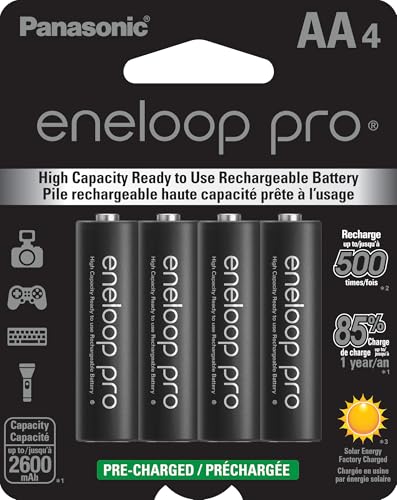
The Panasonic eneloop pro AA 4-pack is the high-capacity choice for devices that draw heavy current. Each pro cell delivers up to 2500 mAh typical capacity, with a 2450 mAh minimum, which is a clear step above the standard eneloop AA. That extra capacity shows up where it counts: camera flashes that recycle faster and fire more often, bright flashlights on high mode, and motor-driven devices that demand strong current. The cells are pre-charged and ready to use, hold 85 percent of their charge after one year in storage, and share the family low-temperature rating down to minus 4 degrees Fahrenheit.
The trade-off is cycle life. The pro cells are rated for recharging up to 500 times, compared with up to 2100 times for the standard eneloop AA. That is still a long service life for most users, but it is a real difference, and it is the reason the pro cell is a specialist rather than the default. If a device is recharged every few days, the standard cell will last longer overall. If a device needs maximum runtime per charge and is recharged less often, the pro cell is the better tool. Like the standard cell, it is a NiMH cell rated down to minus 4 degrees Fahrenheit, so it is not a sub-zero specialist below that floor.
3. Panasonic eneloop AAA, 8-Pack — Best AAA for Smaller Winter Devices
3. Panasonic eneloop AAA, 8-Pack — Best AAA for Smaller Winter Devices
The Panasonic eneloop AAA 8-pack covers the smaller devices that the AA picks cannot serve. Headlamps, compact flashlights, remote controls, and small radios often take AAA cells, and those devices still need to work on a cold morning. Each AAA cell offers capacity up to 850 mAh, is rated for recharging up to 2100 times, and is stated to hold 70 percent of its charge for up to 10 years in storage. The low-temperature rating is the same as the AA cells: down to minus 4 degrees Fahrenheit.
The AAA cell is physically smaller than an AA cell, so its capacity figure is lower, and that is expected rather than a flaw. An 850 mAh AAA cell will not run a device as long as a 2100 mAh AA cell, but the devices are different sizes and usually draw less current. For a headlamp on a winter walk or a remote control in an unheated room, the AAA eneloop is the right size and the right chemistry, with the same low-self-discharge benefit as its AA sibling. The partial-fit note is straightforward: this is a low-capacity cell by AA standards, so it suits low-drain and moderate-drain AAA devices rather than heavy loads, and like the other picks it is rated down to minus 4 degrees Fahrenheit rather than below it.
What to Check Before You Buy
Before you buy, check the device first and the listing second. Confirm the battery size, the number of cells the device takes, and whether the manual recommends NiMH rechargeable cells or warns against them. Confirm the chemistry on the listing: the picks in this guide are low-self-discharge NiMH, and a listing that only says rechargeable without naming the chemistry deserves a closer look. Confirm the capacity in mAh, the cycle-life figure, and the low-temperature rating, and be cautious when any of those figures is missing.
Check the pack size against your needs. A trail camera that takes eight AA cells needs an 8-pack or two 4-packs, while a flashlight that takes four cells is covered by a single 4-pack. Check whether you already own a NiMH charger, since rechargeable cells need one, and a smart charger is worth having if you recharge often. Plan for spares: in winter, a second charged set kept warm is more useful than a slightly higher mAh figure on a single set.
FAQ
Are rechargeable batteries good in cold weather?
Rechargeable batteries can work well in cold weather, but the chemistry matters. Low-self-discharge NiMH cells with a stated low-temperature rating, such as the eneloop cells in this guide, are a solid rechargeable choice down to minus 4 degrees Fahrenheit. They perform ahead of alkaline cells in the cold, though they still lose some runtime as the temperature falls. The newer 1.5 V lithium-ion rechargeable AA cells have performed ahead of NiMH in some cold-weather comparisons, while non-rechargeable lithium cells remain the strongest cold performer overall.
What temperature can eneloop batteries handle?
The eneloop AA, eneloop AAA, and eneloop pro cells in this guide are stated to deliver performance in extreme temperatures down to minus 4 degrees Fahrenheit, which is minus 20 degrees Celsius. That is a stated operating floor, not a promise of full room-temperature runtime at that temperature. Expect shorter runtimes as you approach the floor, and keep spare cells warm in an inside pocket. Do not charge cells while they are still frozen; let them return to room temperature and charge them indoors.
Is NiMH or lithium-ion better for cold weather?
For rechargeable AA cells, 1.5 V lithium-ion cells have shown stronger cold-weather runtime than NiMH in trail-camera comparisons, coming closer to non-rechargeable lithium cells in fridge and freezer conditions. NiMH remains the simpler and more established rechargeable choice, with standard sizes, standard chargers, and a long track record. Lithium-ion AA cells need compatible charging and use internal circuitry to hold a steady 1.5 V output. If you want the simplest winter setup, NiMH is a sound choice.
How many times can you recharge eneloop batteries?
The standard eneloop AA and AAA cells are rated for recharging up to 2100 times, while the eneloop pro AA cells are rated for up to 500 times. The pro cells trade cycle life for higher capacity per charge. Actual cycle life depends on the charger, how deeply the cells are discharged, and storage conditions. Using a smart NiMH charger, avoiding full discharges when possible, and storing cells in a cool, dry place all help a set last longer.
Should I keep spare batteries warm in winter?
Yes. Keeping a spare set in an inside pocket is one of the simplest ways to improve cold-weather runtime. A warm cell delivers more of its rated capacity than a cold one, so swapping in a warm set when the first set fades is more effective than waiting for the cold set to recover. Charge spare cells indoors, let cold cells return to room temperature before charging, and rotate sets so no single set sits unused in a device for months.
Bottom Line
The best cold weather rechargeable batteries for most readers are low-self-discharge NiMH cells with a stated rating down to minus 4 degrees Fahrenheit, and the Panasonic eneloop family is the clearest match for that description. Start with the eneloop AA 8-pack for general winter gear, add the eneloop pro AA 4-pack for high-drain devices that need extra capacity, and use the eneloop AAA 8-pack for smaller AAA devices. None of these cells is rated below minus 4 degrees Fahrenheit, and none will deliver its full room-temperature runtime in deep cold, so carry a spare set kept warm and expect shorter runtimes on the coldest days. Choose the right size, check the temperature rating before you buy, and let a second charged set do the work that a single set cannot.
Disclosure: As an Amazon Associate, we may earn from qualifying purchases.
W
Wildshot Editorial Team
We compare specs, materials and verified owner reviews before a product earns a spot. Rankings are never paid.
Affiliate disclosure. As an Amazon Associate we earn from qualifying purchases at no extra cost to you. Prices accurate as of the date shown.
Find the best gaming desks for 3 monitors: the width, depth, weight capacity, and cable routing a triple-screen setup actually needs, plus a top pick built for three large screens.
Discover the best stationary bike workout setup: top indoor bikes, interval and endurance plans, and how to choose the right bike for home training today.
Find the best bike for bad roads today: durable hybrids with wide tires, suspension forks, and disc brakes built for potholes, gravel, and rough pavement.
Looking for the best 250 four stroke dirt bike? Compare five 250cc four-stroke trail and enduro bikes, their engines, gearboxes, and wheels before you buy.
Choosing a college laptop starts with GB. Compare laptops with 8GB and 16GB RAM and 256GB and 512GB SSD storage, and learn how much is enough for study.
Discover the best rechargeable OTC hearing aids for workplace conversations, with clear speech, noise reduction, battery life and Bluetooth calls for offices.
Compare the best narrow frame rollator walkers for tight doorways and small spaces, with widths, weight limits, seat sizes, wheels and folding compared.
Our eufy video doorbell s4 review 2026 covers the 3K panoramic camera, radar detection, OmniTrack AI tracking, local storage and wired setup in this guide.
Find the best bike tyre levers for road, gravel and mountain bikes. Compare plastic, steel-core and stainless sets, spoke hooks and rim-safe picks today.