We independently review everything we recommend. When you buy through our links, we may earn a commission. As an Amazon Associate we earn from qualifying purchases.
Best Fire Resistant File Safes for Home and Office Document Protection
Four verified fire resistant file safes for documents and hanging files, compared by capacity, fire rating, water protection and lock type.
Four verified fire resistant file safes for documents and hanging files, compared by capacity, fire rating, water protection and lock type.
Disclosure: As an Amazon Associate, we earn from qualifying purchases.
Our top pick: SentrySafe FHW40100 Fireproof/Waterproof File Safe. Runner-up: SentrySafe FHW40300 Fireproof/Waterproof Safe with Keypad.
A fire resistant file safe has one job that matters more than any other: keep the papers inside readable after the worst day a home or office can have. Birth certificates, property deeds, passports, wills, tax records and insurance papers are the kind of documents that are painful and slow to replace, and a safe that protects them from fire and water is cheap insurance against a long administrative headache. The four safes in this guide were each checked against a real Amazon US listing with a verified ASIN, and all four are file safes in the true sense: they are built to hold documents and hanging file folders, not jewellery, cash or small valuables alone.
Every fire and water rating in this guide is a manufacturer or laboratory figure as stated on the listing or reported in specialist coverage. These safes are described here as UL classified or ETL verified where the listing says so, because those are the ratings the makers claim and the labs recorded. Nothing in this guide is presented as an independently researched result, and readers should confirm the rating printed on the live product page before ordering, since a rating belongs to a specific model and a specific test, not to a brand in general.
Quick Picks
SentrySafe FHW40100 Fireproof/Waterproof File Safe — Best overall: a 0.66 cubic foot file safe with a key lock, carrying handles and hanging-file capacity, UL classified for 30 minutes at 1550 degrees Fahrenheit and ETL verified waterproof for 72 hours.
SentrySafe FHW40300 Fireproof/Waterproof Safe with Keypad — Best keypad pick: a digital keypad in place of a key, built for documents and hanging file folders, with a 14.1 by 16.6 by 13.8 inch exterior.
SentrySafe 1170 Fireproof Document Box — Best simple document chest: a compact 0.61 cubic foot key-lock box in a document and file chest format.
Honeywell 1114 Lightweight Fire and Water Chest — Best lightweight chest: a 0.39 cubic foot chest that holds letter and legal paper flat, ETL verified for 1 hour at 1700 degrees Fahrenheit and 100 hours submerged at 1 metre.
The SentrySafe FHW40100 is the top pick in this guide because it covers the most ground in a single unit. It is a file safe, not a document box, which means it is shaped around hanging files: at 0.66 cubic feet it is sized for letter-size hanging files, so the folders a home office already uses can go straight in without being folded, rolled or refiled. That matters more than it sounds, because a safe that forces a change of filing system is a safe whose contents end up living on top of it instead of inside it.
The fire rating is the strongest practical credential in this guide. As stated on the listing and in specialist coverage, the FHW40100 is UL classified for 30 minutes at 1550 degrees Fahrenheit. That is a laboratory classification, not a guarantee about any particular fire, and it should be read as such, but it is the kind of figure that lets a buyer compare one safe against another on equal terms. The water protection is rated in the same way: ETL verified waterproof for 72 hours, which covers the long soak that follows a fire, when sprinklers and hoses have done their work and the safe sits in standing water for hours.
Carrying handles are a small detail that becomes important in exactly the situation the safe is bought for. A file safe that can be carried is a file safe that can be moved out of a damaged room, handed to a relative, or taken to a temporary office while a home is repaired. The key lock is the simplest lock type in this guide, with no batteries and no code to remember, which is an advantage when the safe is opened rarely and the key is kept somewhere sensible. The trade-off is the one every key lock carries: lose the key and the safe becomes a problem of its own, so a spare key stored separately is part of owning this model.
Specs
– Model: FHW40100
– Capacity: 0.66 cubic feet, as stated on the listing
– Lock: Key lock
– Fire rating: UL classified 30 minutes at 1550 degrees Fahrenheit, as stated on the listing
– Water protection: ETL verified waterproof for 72 hours, as stated on the listing
– Format: File safe with carrying handles, sized for letter-size hanging files
Pros
– UL classified fire rating and ETL verified water protection in one unit
– Sized for letter-size hanging files, so existing folders fit without refiling
– Carrying handles make it movable after an incident
– Key lock needs no batteries or codes
Cons
– A key lock means a lost key is a real problem, so a spare must be stored separately
– At 0.66 cubic feet it holds files, not a large archive
SentrySafe FHW40300 Fireproof/Waterproof Safe with Keypad
Runner-Up
SentrySafe FHW40300 Fireproof/Waterproof Safe with Keypad
The SentrySafe FHW40300 is the runner-up and the keypad pick in this guide. Where the FHW40100 uses a key, the FHW40300 uses a digital keypad, which changes the daily experience of owning a safe. A code can be shared with a spouse or a business partner without handing over a physical key, and it can be changed when someone leaves a household or a role. For a safe that is opened more than a few times a year, that convenience is real.
The exterior measures 14.1 by 16.6 by 13.8 inches, as stated on the listing, which makes it a substantial box that needs a measured spot on a shelf, in a closet or under a desk. Measure before ordering, because a safe that does not fit its intended spot ends up on the floor, where it is easier to kick, harder to reach and more likely to be left open. Inside, it is built for documents and hanging file folders, the same file-safe brief as the top pick, so the same folders transfer across without refiling.
A keypad brings a battery to keep an eye on. Most owners will find the keypad works for a long time between changes, but a dead battery at the wrong moment is the known weakness of every electronic lock, and the listing should be checked for the backup entry method before buying. The FHW40300 is the pick for a household or small office where more than one person needs access and a key would be passed around or copied, and where the convenience of a code outweighs the simplicity of a key.
Specs
– Model: FHW40300
– Exterior dimensions: 14.1 by 16.6 by 13.8 inches, as stated on the listing
– Lock: Digital keypad
– Format: Built for documents and hanging file folders
Pros
– Digital keypad allows shared access without a physical key
– Built for documents and hanging file folders
– Code can be changed when access needs to change
Cons
– A keypad needs batteries, so a dead battery is a known weakness to plan around
– The exterior is substantial, so the intended spot must be measured first
– No fire or water rating figure was recorded from the listing checked for this guide
The SentrySafe 1170 is the simplest safe in this guide, and that simplicity is its case. It is a fireproof document box in a document and file chest format, with a key lock and 0.61 cubic feet of capacity. There is no keypad to programme, no code to remember and no battery to replace. It opens with a key, closes with a key, and sits quietly on a shelf until it is needed.
At 0.61 cubic feet it is close in size to the top pick, and the chest format suits documents and files that are stored flat or in folders rather than hung. That is a genuine distinction: a chest is a good home for a small stack of passports, deeds and certificates kept in folders, while a file safe with hanging rails is better for an active filing system that is added to week by week. Buyers who keep a small, stable set of irreplaceable papers will find the chest format natural, and buyers who file constantly will prefer the FHW40100 or the FHW40300.
The 1170 is also the pick for a buyer who wants the fewest moving parts. A key lock has one failure mode, a lost key, and one remedy, a spare key stored separately. There is nothing to programme and nothing to forget. Its place in this guide is as the straightforward option: less to learn, less to maintain, and a format that fits a modest set of documents without fuss.
Specs
– Model: 1170
– Capacity: 0.61 cubic feet, as stated on the listing
– Lock: Key lock
– Format: Document and file chest
Pros
– Simple key lock with no batteries or codes to manage
– Document and file chest format suits a small, stable set of papers
– Close in capacity to the top pick
Cons
– A chest format is less suited to an active hanging-file system
– No fire or water rating figure was recorded from the listing checked for this guide
– A lost key is the single failure mode, so a spare must be stored separately
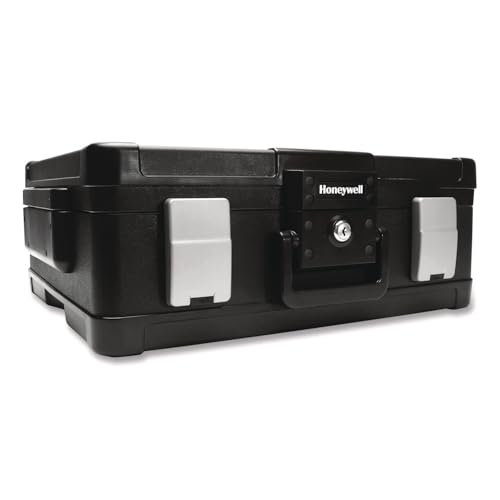
The Honeywell 1114 is the lightweight chest in this guide, and the lightest safe here by a clear margin. At 0.39 cubic feet it is the smallest of the four, and it is built to hold letter and legal paper flat. That flat storage is its defining feature: legal-size paper goes in without folding, which matters for documents that must stay flat to stay usable, such as certificates with seals, deeds and large-format papers.
Its ratings are the headline figures in this guide. As stated on the listing and in specialist coverage, the 1114 is ETL verified for 1 hour at 1700 degrees Fahrenheit and for 100 hours submerged at 1 metre. Those are laboratory figures reported by the brand, not independently researched results, and they should be read alongside the size: this is a small chest with strong ratings, suited to a handful of the most important papers rather than a full filing drawer.
The lightweight build is a practical advantage in two situations. The first is portability: a chest that is easy to carry is easy to grab in an evacuation and easy to move between a home and an office. The second is placement: a light chest can sit on a shelf that would not comfortably hold a heavier safe. The trade-off is capacity. At 0.39 cubic feet there is room for the essential papers and little else, so this is the pick for a buyer who wants the strongest ratings on a small set of documents, with a larger file safe or a filing cabinet handling the rest.
Specs
– Model: 1114
– Capacity: 0.39 cubic feet, as stated on the listing
– Lock: Key lock
– Format: Chest that holds letter and legal paper flat
– Fire rating: ETL verified 1 hour at 1700 degrees Fahrenheit, as stated on the listing
– Water protection: ETL verified 100 hours submerged at 1 metre, as stated on the listing
Pros
– ETL verified fire and water ratings as stated on the listing
– Holds letter and legal paper flat without folding
– Lightweight build is easy to carry and easy to place on a shelf
Cons
– Smallest capacity in this guide, suited to essential papers only
– Ratings are laboratory figures as reported by the brand, not independently researched results
– A key lock means a spare key must be stored separately
How to Choose
Start with what goes inside. List the documents the safe must hold, then measure them. A safe bought for hanging files needs rails and the right interior width, which is why the FHW40100 and the FHW40300 lead this guide for active filing. A safe bought for a small set of certificates and deeds that stay flat suits a chest format, which is the 1170 and the Honeywell 1114. Measure the largest paper the safe must hold flat, because a safe that forces a fold in a legal-size document has already failed at its job.
Next, read the ratings the way they are written. A UL classification and an ETL verification are laboratory figures attached to a specific model and a specific test, and they let one safe be compared with another on equal terms. The FHW40100 is UL classified for 30 minutes at 1550 degrees Fahrenheit and ETL verified waterproof for 72 hours; the Honeywell 1114 is ETL verified for 1 hour at 1700 degrees Fahrenheit and 100 hours submerged at 1 metre. Those figures describe different tests, so compare like with like: fire duration with fire duration, water duration with water duration, and always confirm the rating on the live product page, since a rating belongs to the model named on that page.
Then choose the lock by how the safe will actually be used. A key lock is the simplest option, with no batteries and nothing to remember, and it suits a safe that is opened rarely by one person. A digital keypad suits a safe opened more often, or shared between two or more people, because a code can be shared and changed without copying a key. Whichever lock is chosen, plan for its failure mode before buying: a spare key stored separately for a key lock, and a note of the backup entry method for a keypad.
Finally, measure the spot where the safe will live. The FHW40300 exterior is 14.1 by 16.6 by 13.8 inches, and every safe in this guide needs a shelf, closet floor or desk space that fits it with room to open the lid or door fully. A safe that does not fit its spot ends up somewhere inconvenient, and an inconvenient safe is a safe that gets left open or unused. Weight matters here too: the Honeywell 1114 is the lightest option in this guide and the easiest to place high on a shelf, while the larger SentrySafe models are heavier and better kept low.
FAQs
What size fire resistant file safe do I need for hanging files?
Choose by the filing system, not by the safe. The SentrySafe FHW40100 is sized for letter-size hanging files at 0.66 cubic feet, and the FHW40300 is built for documents and hanging file folders, so both suit an active filing system. A chest format like the SentrySafe 1170 or the Honeywell 1114 suits documents stored flat or in folders. Count the folders that must fit, measure the largest paper, and check that the interior suits the filing method already in use.
What does a UL classified or ETL verified rating actually mean?
It means a laboratory tested the model to a stated standard and recorded the result. The FHW40100 is UL classified for 30 minutes at 1550 degrees Fahrenheit, and the Honeywell 1114 is ETL verified for 1 hour at 1700 degrees Fahrenheit and 100 hours submerged at 1 metre. These are manufacturer and laboratory figures as stated on the listings, not independently researched results, and they describe a specific test on a specific model. Confirm the rating on the live product page before ordering.
Should I choose a key lock or a digital keypad?
Choose a key lock for the simplest ownership: no batteries, no code to remember, and one failure mode, a lost key, which a spare key stored separately solves. Choose a digital keypad, like the one on the SentrySafe FHW40300, when more than one person needs access or the safe is opened often, because a code can be shared and changed. Either way, settle the backup plan before buying, not after the safe is locked.
Conclusion
For most homes and small offices, the SentrySafe FHW40100 is the top pick, with a UL classified fire rating, ETL verified water protection, carrying handles and room for letter-size hanging files. The SentrySafe FHW40300 is the runner-up for anyone who wants a digital keypad and shared access, and the SentrySafe 1170 is the straightforward key-lock chest for a modest set of documents. The Honeywell 1114 is the lightweight pick for a small set of essential papers, with the strongest ratings in this guide and room for letter and legal paper to lie flat. Before buying, list the documents, measure the papers and the spot the safe will occupy, and confirm the rating on the live product page.
W
Wildshot Editorial Team
We compare specs, materials and verified owner reviews before a product earns a spot. Rankings are never paid.
Affiliate disclosure. As an Amazon Associate we earn from qualifying purchases at no extra cost to you. Prices accurate as of the date shown.
Looking for the best vegan mattresses? Compare four Amazon-listed, wool-free mattresses by materials, firmness, thickness, trial, and warranty before you buy.
Find the best lightweight soft and absorbent bath towels for daily showers. Compare plush Turkish cotton sets that dry fast and stay soft wash after wash.
Searching for the best inexpensive garbage disposals? Compare five budget continuous-feed models on power, size, mounting, noise, and warranty before you buy.
Searching for the best blankets for Florida? Compare lightweight, breathable bamboo, cotton, and cooling blankets made for warm, humid nights all year round.
Four thorn proof gardening gloves compared on hide, gauntlet length and palm reinforcement, for pruning roses, clearing blackberries and handling cactus.
Find the best window fans for homes with reversible airflow, thermostats, and quiet twin-blade designs that cool bedrooms and living rooms well every day.
Discover the best floor keyboard rugs for classrooms, playrooms, and home offices, with expert tips on size, material, durability, and keyboard designs.
Discover the best butts humping pillows for laughs and cozy lounging, with soft novelty designs, sizes, covers, and tips for choosing a fun gag gift today.

 SentrySafe FHW40100 Fireproof/Waterproof File Safe
 SentrySafe FHW40300 Fireproof/Waterproof Safe with Keypad
 SentrySafe 1170 Fireproof Document Box
 Honeywell 1114 Lightweight Fire and Water Chest