We independently review everything we recommend. When you buy through our links, we may earn a commission. As an Amazon Associate we earn from qualifying purchases.
Best Window Fans for Cooling: 5 Twin and Low-Profile Fans for Fresh Air
The best window fans for cooling pull in cool evening air and exhaust hot indoor air. Compare five twin and low-profile window fans by fit, speeds, and reversing.
The best window fans for cooling pull in cool evening air and exhaust hot indoor air. Compare five twin and low-profile window fans by fit, speeds, and reversing.
As an Amazon Associate we earn from qualifying purchases.
A window fan cools differently from every other fan in a house. A tower fan or a desk fan only moves the air already in the room, so on a hot evening it pushes warm air around faster. A window fan trades air with the outdoors: set to intake, it pulls cooler evening air in; set to exhaust, it pushes the day’s accumulated hot air out; and in a house with two openings, one fan on intake and another on exhaust can move a stream of fresh air through whole rooms. That exchange is why the best window fans for cooling earn their place in bedrooms without air conditioning, in rentals where installing an air conditioner is not allowed, and in shoulder seasons when the nights are cool but the days still heat the house. This guide presents five genuine window fans, four twin-blade models and one low-profile design, and explains fit, reversing, and controls so the fan chosen actually matches the window it has to live in.
OUR TOP PICK
Holmes Dual 8-Inch Blade Twin Window Fan (HAWF2043-N)
Affiliate disclosure: This article contains affiliate links. If you buy through a link on this page, we may earn a commission at no additional cost to you.
How Window Fan Cooling Actually Works
The physics are simple and worth understanding, because they decide how a fan should be used. A window fan cannot make air colder than the outdoor air. Its cooling comes from timing and direction. During the day, indoor air in a sun-heated room is often hotter than shaded outdoor air by late afternoon, and almost always hotter by evening. Running a fan on exhaust during the late afternoon pushes that built-up heat out. Switching to intake after sunset pulls the cooler night air in, and running on intake through the night charges the room with cool air before the next day begins. Closed curtains on sun-facing windows during the day, and a second open window or door to give the air a path, multiply the effect of any model in this guide.
Direction control is therefore the central feature. Fans reverse in three ways. Electronic reversing changes blade direction at a button press, which is the most convenient. Independent motors let one blade intake while the other exhausts, exchanging air in a single window. Manual reversing means lifting the fan out and turning it around, or rotating fan heads by hand, which is simple and reliable but easy to put off. Every pick below reverses by one of these methods, and the method is stated for each.
What to Check Before Buying
Window fit, measured honestly. Twin window fans fit double-hung and slider windows within a stated width range, using built-in accordion extenders or extra panels to fill the sides. The ranges in this guide run from about 24 inches up to about 40 inches depending on the model. Measure the opening the fan will sit in, not the glass, and check the height as well: a standard twin fan body is around 12 to 13 inches tall, while the low-profile Vornado pick is much shorter and suits windows that cannot open far. A fan that almost fits cools badly and rattles, because gaps around the sides short-circuit the airflow.
Speeds and noise. Two speeds are the minimum in this category and three are common. More speeds matter mainly at night: a low setting that can run in a bedroom without dominating the room is what makes a window fan a sleep tool rather than a daytime-only appliance. Listings rarely state comparable noise figures across brands, so speed count and bedroom intent are the practical guides.
Thermostat and timer. A programmable or adjustable thermostat turns the fan off when the room reaches a set temperature and back on when it warms, which suits overnight running as outdoor air cools. A timer serves the opposite habit, shutting the fan down after a set period. The Holmes, Genesis, and Lasko picks below include thermostat control in some form; the Comfort Zone and Vornado picks lean on modes, speeds, and remote control instead.
Remote and controls. A window fan is operated from across the room more often than a desk fan is, because it sits in the window and often behind furniture. A remote, included with the Comfort Zone and Vornado picks, removes the nightly walk to the window. Manual dials and buttons are simpler and never get lost, which some households genuinely prefer.
Screens, covers, and weather. A removable bug screen matters in summer, when an open window at night invites insects toward the light. A fabric cover lets the fan stay installed in cooler weather without a draft. Water-resistant or weather-resistant construction, described for the Holmes motors and the Vornado case, suits windows that take direct rain.
How the Picks Were Chosen
Every pick below is a window fan: a fan designed to mount in a window opening, with extenders, panels, or a case shaped for that opening, and with intake and exhaust airflow for room cooling. No pick is a tower fan, a desk fan, a box fan without a window fit, or a whole-house attic fan. The five cover the main buying shapes in the category: a thermostat-led twin fan with water-resistant motors, a three-mode twin fan with a remote and a bug screen, a low-profile fan for short openings, a high-velocity twin fan with a wide fit and its own thermostat, and a Bluetooth twin fan with independently reversible motors and app control. Details such as speed counts, fit ranges, and included accessories are taken from each listing and from manufacturer descriptions as checked for this guide.
The 5 Best Window Fans for Cooling
1. Holmes Dual 8-Inch Blade Twin Window Fan (HAWF2043-N)
Top Pick
1. Holmes Dual 8-Inch Blade Twin Window Fan (HAWF2043-N)
The Holmes is the weather-ready twin fan in this guide. The listing describes two 8-inch blades with independently reversible motors, so one side can draw cool air in while the other pushes warm air out, exchanging air through a single window without lifting the fan out to turn it around. The motors are described as water-resistant, which suits an exposed window that takes rain, and the fan includes a thermostat control with an LED one-touch style interface in the model’s description, so it can hold a comfort level overnight rather than running flat out until morning.
Fit is handled with extender panels, with the model’s stated range reaching up to about 37 inches in published descriptions of this fan family, covering most double-hung bedroom windows. Two speed settings keep the control scheme simple: a stronger setting for the evening purge of hot air and a lower one for overnight intake. The Holmes name has been attached to this twin-fan design for many years and production details have shifted across versions, so the current listing’s exact control layout and panel count are worth a final check before ordering. For a bedroom window that faces the weather and a household that wants set-and-forget overnight cooling, this is the most direct pick here.
View it on Amazon: https://www.amazon.com/dp/B000065DK8
2. Comfort Zone Twin Window Fan with Remote Control (CZ310R)
Runner-Up
2. Comfort Zone Twin Window Fan with Remote Control (CZ310R)
The Comfort Zone CZ310R is the three-mode pick. Its listing describes three operating functions, commonly presented as cool, circulate, and exhaust: intake for pulling evening air in, exhaust for pushing hot air out, and a circulate setting that runs the two sides in opposite directions to exchange air in place. Three speeds sit behind those modes, and a remote control runs the fan from the bed or the sofa, which in practice is what makes the mode system get used rather than set once and forgotten.
The fit range is stated at about 23.5 to 37 inches with expandable panels, among the wider ranges in this guide, and the listing includes two practical extras that competitors often skip: a removable bug screen and a removable fabric cover. The screen matters on summer nights, and the cover lets the fan stay in the window during a cool spell without leaking a draft, instead of being uninstalled and stored. The listing gives an airflow figure in feet per second and describes the fan for home, kitchen, bedroom, and office windows. Choose this one when one fan has to handle the full daily cycle, intake, exchange, and exhaust, from across the room.
View it on Amazon: https://www.amazon.com/dp/B004TAYQXE
3. Vornado TRANSOM Window Fan (Ice White)
The TRANSOM is the shape outlier, built for windows the twin fans cannot use. Instead of two round blades in a tall body, it uses a long, low case, described at about 7 to 8 inches of needed opening height, that sits in a horizontal window and leaves much of the view and light intact. The listing describes four speeds, a remote control, a weather-resistant case, and a reversible exhaust mode that switches the unit electronically between drawing air in and pushing air out, without removing it from the window.
The stated fit range is about 26 to 40 inches wide, the widest in this guide, suiting wide horizontal sliders and picture-style windows as well as standard double-hung openings. Air is moved through the long chamber rather than by exposed twin blades, so the look is closer to a slim appliance than to a traditional fan, which matters in a living room. The trade-offs are the category ones: it serves one window orientation style well, horizontal openings, and its airflow character is a broad, even stream rather than the focused blast of a twin fan. For a short opening, a wide slider, or any room where a tall twin fan would block the window, this is the pick designed for the job.
View it on Amazon: https://www.amazon.com/dp/B08R6B9RD1
4. Genesis Twin Fan High Velocity Reversible AirFlow Fan (A1WINDOWFAN)
4. Genesis Twin Fan High Velocity Reversible AirFlow Fan (A1WINDOWFAN)
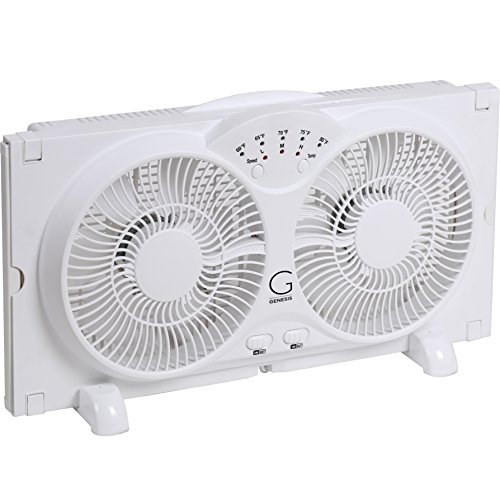
The Genesis is the airflow-led twin fan. The listing describes two 9-inch fan heads, each with its own independent copper motor, three speed settings, and reversible airflow so the heads can intake, exhaust, or run in opposite directions for exchange. A built-in thermostat with LED indicator lights covers a stated range of about 60 to 80 degrees, letting the fan respond to room temperature through the night, and the listing describes the model as ETL certified.
Size is stated at about 24 by 12 by 4 inches, with two expandable side panels that can add up to about 6.5 inches on each side, giving one of the wider fits among the twin fans here and covering broad double-hung windows that narrower fans leave gapped. Published descriptions of this model cite a high stated airflow figure for the twin heads, consistent with its high-velocity positioning. There is no remote in the listing’s feature set, so control happens at the unit, and at about 8.4 pounds in published specifications it is among the heavier picks to lift in and out. Choose it for a large bedroom or living room where moving a lot of air matters more than operating the fan from the sofa.
View it on Amazon: https://www.amazon.com/dp/B01CK64AQG
5. Lasko Bluetooth Enabled Twin Window Fan (W09560)
The Lasko W09560 is the connected pick. The listing describes a twin 9-inch window fan with two independently electrically reversible motors, so intake, exhaust, and simultaneous exchange are all available from the controls, plus a digital thermostat and an 8-hour timer. Its distinguishing feature is Bluetooth control through the Lasko Connect app, which lets speeds, direction, thermostat, and timer be set from a phone, including scheduling the evening exhaust and night intake cycle described earlier in this guide without touching the unit.
Published descriptions give a fit range of about 24 to 32 inches wide, narrower than the Comfort Zone and Genesis ranges, so measuring matters most with this pick. Three speeds are controlled electronically, and the listing describes the fan for bedroom and indoor home use, with ETL listing and a safety fuse plug among its stated features. The honest trade-off is dependence on the app for the full feature set: the fan works as a window fan without a phone, but the scheduling that makes it special lives in the app. For a household already comfortable running home devices from a phone, and a window inside its fit range, it is the most automated cooling in this guide.
View it on Amazon: https://www.amazon.com/dp/B081HDYTF4
Side-by-Side Comparison
Pick
Form
Speeds
Reversing from listing
Fit from listing
Standout extra
Holmes HAWF2043-N
Twin 8-inch
2
Independent electronic
Up to about 37 in
Water-resistant motors, thermostat
Comfort Zone CZ310R
Twin 9-inch
3
Cool, circulate, exhaust modes
About 23.5 to 37 in
Remote, bug screen, fabric cover
Vornado TRANSOM
Low-profile
4
Electronic exhaust mode
About 26 to 40 in
Weather-resistant case, remote
Genesis A1WINDOWFAN
Twin 9-inch
3
Reversible heads
Panels add about 6.5 in per side
Thermostat with LED indicators
Lasko W09560
Twin 9-inch
3
Independent electronic
About 24 to 32 in
Bluetooth app, thermostat, timer
The table shows where the differences sit. Fit range and reversing method decide whether a fan can do the job at all; remotes, thermostats, and apps then decide how much of the job it does by itself.
Getting the Most Cooling From a Window Fan
Installation and routine matter as much as model choice. Seat the fan snugly and extend the side panels fully, then fill any remaining gaps with foam or a towel for the season, because air leaking around the sides is air not moving through the room. Lower the sash onto the fan body where the design allows it, which locks the unit in place and seals the top. Run exhaust in the late afternoon to clear the day’s heat, switch to intake once outdoor air feels cooler than indoor air, and give the air a path by opening a door or a second window on the other side of the home. Keep the intake side’s outdoor area in mind: a fan above a hot patio or beside an air-conditioning condenser unit pulls in warmer air than one above shaded ground. Clean the blades and screen at the start and middle of the season, since dust loading quietly cuts airflow, and store the fan indoors over winter unless its cover and the window arrangement genuinely suit leaving it installed.
What to Avoid
Avoid buying on blade size alone without measuring the window, because an ill-fitting fan leaks around every edge. Avoid single-direction fans for cooling duty, since the evening exhaust and night intake cycle needs both directions or a fan that can be turned around easily. Avoid running intake during the hottest afternoon hours, when it imports heat, unless the goal is simply air movement. Avoid installing a fan in a window a child can reach through, and follow the listing’s guidance on rain exposure for models without water-resistant construction. Finally, avoid expecting refrigeration: on a night when outdoor air stays hot and humid, a window fan improves comfort with moving fresh air but cannot match an air conditioner, and choosing between the two honestly matters more than any difference between the five picks here.
Verdict
The best window fans for cooling are the ones that fit the window and reverse without a fight. Choose the Holmes for water-resistant motors and thermostat-led overnight running, the Comfort Zone CZ310R for three modes, a remote, and the screen-and-cover bundle, the Vornado TRANSOM for short or wide horizontal windows, the Genesis for high airflow across a wide opening, and the Lasko W09560 for app-controlled scheduling of the whole cooling cycle. All five exchange indoor air for outdoor air, which is the one cooling trick no room fan can copy.
A
admin
We compare specs, materials and verified owner reviews before a product earns a spot. Rankings are never paid.
Affiliate disclosure. As an Amazon Associate we earn from qualifying purchases at no extra cost to you. Prices accurate as of the date shown.
Five generators with a genuine 50 amp 14-50R outlet confirmed from maker and listing specs, covering dual fuel, maximum output and one true inverter option for RV power.
Compare five wired gaming mice on sensor, weight, buttons and cable feel, from the Logitech G203 and G502 HERO to the Razer Basilisk V3 and HyperX Haste 2.
The best and worst zero turn mowers, explained: top electric and gas picks, models and buying mistakes to avoid, and how to match deck size to your lawn.
The best striping push mowers use a roller kit to bend grass into crisp light and dark bands. Our November 2026 guide compares fit, weight and mounting.
Compare the best generator brands, Honda, Generac, Champion, Westinghouse and WEN, by noise, fuel choice, warranty and one proven model from each line.
Compare four pool cleaners for different pool sizes, surfaces and pump setups, from corded robots to pressure-side and suction models, and find your match.

 1. Holmes Dual 8-Inch Blade Twin Window Fan (HAWF2043-N)
 2. Comfort Zone Twin Window Fan with Remote Control (CZ310R)