We independently review everything we recommend. When you buy through our links, we may earn a commission. As an Amazon Associate we earn from qualifying purchases.
Best Wired Gaming Mice: Five Corded Picks for PC Players
Compare five wired gaming mice on sensor, weight, buttons and cable feel, from the Logitech G203 and G502 HERO to the Razer Basilisk V3 and HyperX Haste 2.
Compare five wired gaming mice on sensor, weight, buttons and cable feel, from the Logitech G203 and G502 HERO to the Razer Basilisk V3 and HyperX Haste 2.
As an Amazon Associate, we earn from qualifying purchases made through links on this page.
A wired gaming mouse still makes sense for a lot of PC players. There is no battery to charge, no wireless receiver to lose, and no connection mode to troubleshoot in the middle of a match. The cable is the only compromise, and modern flexible cords have made that compromise smaller than it used to be. This guide compares five wired gaming mice from Logitech G, Razer and HyperX that are sold on Amazon US, looking at the specifications each manufacturer publishes: sensor range, weight, button count, cable type and switch design.
The five mice split into clear camps. The Logitech G203 Lightsync and Razer DeathAdder Essential are simple, proven shapes with modest sensors and few extras. The Logitech G502 HERO is the heavy, button-packed option for players who bind a lot of commands. The Razer Basilisk V3 adds a tilting scroll wheel and optical switches. The HyperX Pulsefire Haste 2 goes the other direction entirely, chasing the lowest possible weight and the highest polling rate in this group. Reading the sections below by grip style and game type will get you to the right one faster than reading them in order.
What to look for in a wired gaming mouse
Sensor and DPI range. Every mouse here uses an optical sensor, but the published ranges differ widely, from 6,400 DPI on the DeathAdder Essential to 26,000 DPI on the Basilisk V3 and Pulsefire Haste 2. In practice, most players settle between 400 and 3,200 DPI, so treat the maximum figure as headroom rather than a target. What matters more is that the sensor tracks cleanly at the sensitivity you actually use, and all five sensors here come from established gaming lines.
Weight. Weight shapes how a mouse feels over a long session. The Pulsefire Haste 2 weighs 53 grams and suits fast, sweeping aim in shooters. The G502 HERO weighs about 121 grams before its optional tuning weights, and that heft helps some players keep slow, deliberate movements steady. Neither approach is better in the abstract; it depends on your games and your arm.
Shape and grip. The DeathAdder Essential and Basilisk V3 are right-handed ergonomic shapes with a pronounced thumb rest area. The G203, G502 HERO and Pulsefire Haste 2 use lower, more symmetrical shells, although the G502 adds a thumb wing. Palm grip players usually prefer the taller ergonomic shells, while fingertip and claw grip players often prefer the flatter ones.
Buttons and software. Button counts run from five on the DeathAdder Essential to eleven on the G502 HERO and Basilisk V3. Extra buttons matter most in MOBA, MMO and strategy games. Each brand uses its own software (Logitech G HUB, Razer Synapse and HyperX NGENUITY) to assign commands and store profiles, and the G203, G502 HERO and Basilisk V3 can also keep settings in onboard memory so they travel between PCs.
Cable and polling rate. A stiff cable drags on the desk edge and fights your aim. Razer fits the Basilisk V3 with its flexible Speedflex cable and HyperX fits the Haste 2 with the HyperFlex 2 cable; both are designed to reduce that drag. Polling rate is how often the mouse reports its position: 1,000 Hz is the long-running standard here, while the Pulsefire Haste 2 reports up to 8,000 times per second for players whose PCs and games can use the extra reports.
The G203 Lightsync is Logitech G’s simplest wired gaming mouse, and its specification sheet is refreshingly short. The sensor reaches 8,000 DPI, there are six programmable buttons, and the LIGHTSYNC RGB lighting gives a wave of colour effects that can sync with other Logitech G gear through G HUB. The shell is a compact, low-profile shape at roughly 85 grams, small enough that it suits small and medium hands best, and it works for palm, claw and fingertip grips at that size.
Logitech gives the G203 a metal spring button tensioning system, which keeps the left and right clicks consistent and reduces the force needed to actuate them. The report rate is 1,000 Hz, the standard figure for wired play, and the mouse stores one profile in onboard memory. The cable is a plain rubber cord of about 2.1 metres, long enough for most desk layouts, including PCs that sit on the floor.
Who it is for: players who want a light, simple mouse from a major gaming line, especially those with smaller hands or a fingertip grip.
Limitations from the spec sheet: the 8,000 DPI ceiling is the lowest here alongside the DeathAdder Essential, the cable is a standard rubber cord rather than a flexible paracord-style design, and the compact shell can feel cramped for large hands using a full palm grip.
The DeathAdder name is one of the longest-running in gaming mice, and the Essential keeps the shape that made it popular: a right-handed ergonomic shell with flared main buttons and rubber side grips. Razer fits a true 6,400 DPI optical sensor, five independently programmable Hyperesponse buttons and Razer mechanical mouse switches rated for 10 million clicks. The mouse weighs about 96 grams and connects with a standard cable of roughly 1.8 metres.
That specification is deliberately basic. There is a single green LED logo rather than full RGB lighting, and the 6,400 DPI sensor is a generation behind the sensors in the other mice in this guide. What you get instead is a large, comfortable shape that fills the palm, which is exactly why the design has survived for so long. Razer Synapse handles button assignments and DPI stages.
Who it is for: palm grip players with medium or large hands who value a proven ergonomic shape over lighting and extras, and players who mostly play at low or moderate sensitivities where 6,400 DPI is plenty.
Limitations from the spec sheet: the sensor ceiling is the joint lowest in this guide, the mechanical switches carry a lower click-life figure than the optical switches in the Basilisk V3, lighting is a single green colour, and the shape is right-handed only.
The G502 HERO is the maximalist option in this group. Its HERO 25K sensor tracks up to 25,600 DPI, and the shell carries eleven programmable buttons, including a removable DPI shift button by the thumb and a dual-mode scroll wheel that switches between a notched ratchet mode and a free-spinning mode for long documents and inventory screens. LIGHTSYNC RGB lighting, onboard memory for profiles and G HUB support round out the feature list.
Weight is the defining trait. The mouse itself weighs about 121 grams, and Logitech includes five 3.6 gram weights that fit into compartments in the base, so you can add up to 18 grams and shift the balance. Players who like a solid, planted feel often prefer this; players who flick the mouse around shooters usually do not. The braided cable resists tangling, and the sculpted right-handed shape with its thumb wing suits palm and claw grips.
Who it is for: players who bind many commands in MOBA, MMO or strategy games, and anyone who prefers a heavier mouse they can tune with added weights.
Limitations from the spec sheet: at about 121 grams before weights it is by far the heaviest mouse here, the button layout can feel busy for players who only need the basics, and the right-handed sculpted shape does not suit left-handed players.
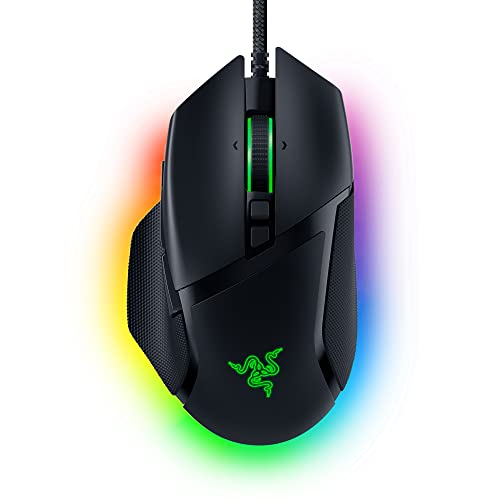
The Basilisk V3 is Razer’s feature-heavy wired mouse. The Focus+ optical sensor reaches 26,000 DPI, and the eleven programmable buttons include a multi-function trigger on the thumb side. Its standout part is the HyperScroll tilt wheel: it clicks side to side for extra inputs, and it can switch between a tactile ratchet mode and a smooth free-spin mode, with an automatic mode that spins freely on fast flicks and returns to tactile steps when the wheel slows.
Under the main buttons, Razer uses its second-generation optical mouse switches, which actuate with light rather than a metal contact and are rated for 70 million clicks. The mouse weighs about 101 grams, glides on feet made of pure PTFE, and lights up with eleven Chroma RGB zones including an underglow strip. The Speedflex cable is soft and flexible, built to minimise drag against the desk.
Who it is for: players who want one mouse that covers shooters and command-heavy games, and anyone who scrolls long pages or timelines often enough to use a free-spinning tilt wheel.
Limitations from the spec sheet: at about 101 grams it is mid-weight rather than light, the ergonomic shell is right-handed only, and the full feature set depends on Razer Synapse for assignments and lighting control.
The Pulsefire Haste 2 is built around two numbers: 53 grams of weight and a polling rate of up to 8,000 Hz. The HyperX 26K sensor tracks up to 26,000 DPI, the HyperX switches are rated for 100 million clicks, and the shell is a symmetrical shape sized for claw and fingertip grips. Virgin-grade PTFE skates and the flexible HyperFlex 2 cable keep the glide consistent with the light build, because a stiff cable would overpower a mouse this light.
This is a focused design. There are six buttons, the lighting is a single RGB zone on the scroll wheel, and there is no tilt wheel, no weight system and no thumb rest. HyperX NGENUITY software handles DPI stages, polling rate and button assignments. The 8,000 Hz polling rate is the headline for competitive shooter players, though it asks more of the PC than 1,000 Hz and not every game benefits equally from it.
Who it is for: competitive shooter players who aim with fast, wide movements and want the lightest wired mouse in this guide, with the highest polling rate in this group.
Limitations from the spec sheet: the six-button layout is the joint sparsest here, the symmetrical shell gives no sculpted palm support for relaxed play, and the highest polling settings can raise CPU use in games that were not built with them in mind.
Comparison table
Mouse
Sensor (max DPI)
Weight
Buttons
Polling rate
Cable
Logitech G203 Lightsync
8,000 DPI
About 85 g
6
1,000 Hz
Standard rubber
Razer DeathAdder Essential
6,400 DPI
About 96 g
5
1,000 Hz
Standard
Logitech G502 HERO
25,600 DPI
About 121 g, plus optional weights
11
1,000 Hz
Braided
Razer Basilisk V3
26,000 DPI
About 101 g
11
1,000 Hz
Speedflex flexible
HyperX Pulsefire Haste 2
26,000 DPI
53 g
6
Up to 8,000 Hz
HyperFlex 2 flexible
Frequently asked questions
Does a wired mouse have less input delay than a wireless one?
A wired connection removes the wireless link from the chain entirely, so there is no receiver placement or radio interference to manage. Modern gaming wireless is very close in practice, but wired remains the simplest option: plug it in and the connection is as direct as it gets.
How much DPI do I actually need?
Most players use between 400 and 3,200 DPI depending on game and screen resolution. Every mouse in this guide covers that range comfortably. The higher ceilings on the G502 HERO, Basilisk V3 and Haste 2 are headroom, not a requirement, and turning DPI up beyond what your aim uses only makes the cursor harder to control.
What polling rate should I choose?
A 1,000 Hz rate, which reports position every millisecond, is the standard for wired gaming and is enough for the large majority of players. The Pulsefire Haste 2 can report up to 8,000 times per second; competitive players with high-refresh monitors may value that, while everyone else can leave the setting at a lower rate.
Which of these mice suits a palm grip?
The DeathAdder Essential and Basilisk V3 have the tall, sculpted right-handed shells that support a full palm grip, and the G502 HERO works well for palm grip too. The G203 and Pulsefire Haste 2 are flatter and better matched to claw and fingertip grips.
Can I use these mice on a console or a Mac?
All five connect over USB and work as standard pointing devices on PC and Mac. Button remapping and lighting control need each brand’s software, which is built mainly for Windows, and console support depends on the game and platform rather than the mouse.
Conclusion
Pick by shape and weight first. The DeathAdder Essential is the comfortable ergonomic baseline, the Basilisk V3 layers a tilt wheel and optical switches onto a similar idea, and the G502 HERO is the heavy, button-rich choice for command-heavy games. The G203 Lightsync keeps things small and simple, while the Pulsefire Haste 2 is the specialist pick for players chasing the lightest build and fastest reporting. All five are wired, all five are current models in their makers’ gaming lines, and the comparison table above puts the deciding numbers side by side.
A
admin
We compare specs, materials and verified owner reviews before a product earns a spot. Rankings are never paid.
Affiliate disclosure. As an Amazon Associate we earn from qualifying purchases at no extra cost to you. Prices accurate as of the date shown.
The best window fans for cooling pull in cool evening air and exhaust hot indoor air. Compare five twin and low-profile window fans by fit, speeds, and reversing.
Five generators with a genuine 50 amp 14-50R outlet confirmed from maker and listing specs, covering dual fuel, maximum output and one true inverter option for RV power.
The best and worst zero turn mowers, explained: top electric and gas picks, models and buying mistakes to avoid, and how to match deck size to your lawn.
The best striping push mowers use a roller kit to bend grass into crisp light and dark bands. Our November 2026 guide compares fit, weight and mounting.
Compare the best generator brands, Honda, Generac, Champion, Westinghouse and WEN, by noise, fuel choice, warranty and one proven model from each line.
Compare four pool cleaners for different pool sizes, surfaces and pump setups, from corded robots to pressure-side and suction models, and find your match.

 Logitech G203 Lightsync
 Razer DeathAdder Essential
 Logitech G502 HERO
 Razer Basilisk V3
 HyperX Pulsefire Haste 2