Key takeaways
- Find the best solar spotlights for trees, flags, and garden features. One verified pick, plus a buying guide on brightness, waterproofing, and runtime.
A solar spotlight puts light exactly where you want it without trenching for wire, hiring an electrician, or adding an outdoor outlet. Stake one into a garden bed and it can wash a tree trunk in light, aim one at a flagpole so the flag stays visible after dark, or screw one to a wall to pick out a house number, a statue, or the front steps. The panel charges from daylight, the light switches itself on at dusk, and the whole fixture costs nothing to run once it is in the ground.
The catch is that solar spotlights fail in predictable ways, and most failures show up weeks after installation rather than on the first night. A light tucked under a tree never gets enough sun to charge, so it fades early. A cheap seal lets rain past the lens, the lens fogs, and the beam dims for good. Choosing well means reading the listing closely: the waterproof rating, the battery and runtime figures, the lighting modes, and how far the head and panel tilt. This guide explains each point, then recommends one solar spotlight verified as currently listed for sale on Amazon.
As an Amazon Associate, we earn from qualifying purchases.
Quick Picks
| Pick | Best For | Key Features |
|---|---|---|
| NYMPHY Solar Spot Lights Outdoor Waterproof, 56 LED, 4 Pack (Cool White) | Lighting several garden features at once in a wet climate | 56 LEDs per light, three brightness modes, IP68 waterproof rating, anti-fog lens, ground stake or wall mount |
How We Chose
We judged solar spotlights on the factors that decide whether a light is still doing its job in its second season: a published waterproof rating, a battery and runtime stated plainly, a head that aims where it is needed, a panel that can find the sun, and lighting modes that suit the spot. We counted each distinct design once, even when the same light is sold in several pack sizes or colors, so a four-pack and a six-pack of the same model do not count as two different products. We left out wired low-voltage landscape lights, solar path lights, string lights, and flood lights, because those are different tools for different jobs. A path light marks a walking surface with a low glow, while a spotlight throws a focused beam upward at a feature. Mixing the two types in one list would only confuse the choice.
Every figure in this guide comes from the product listing itself. Where a listing does not give a figure, we say so rather than filling the gap with a guess. Nothing here is presented as detailed research. Listings change, and a spotlight that is in stock today can sell out tomorrow, so confirm the listing details on Amazon before ordering.
Buying Guide: What to Look for in a Solar Spotlight
Brightness and lumens
Only some solar spotlight makers publish a lumen figure, and the ones that do range widely, from a few hundred lumens for a small accent light to around 800 lumens for a bright stake-in spotlight and 1,000 lumens for a large single head. LED count alone tells you little, because a light with fewer, larger LEDs can outshine one with many small ones, and a focused beam reads brighter than a wide wash at the same lumen figure. When a listing gives no lumen figure at all, treat the light as an accent light for a shrub or a doorway rather than a beam for a tall tree or a flagpole, and look for other evidence of output, such as the number of LEDs, the beam angle, and the runtime on high. A spotlight that cannot state its brightness is still usable, but you should buy it for a modest job and keep expectations in line with the listing.
Waterproof rating
A solar spotlight lives outside in every weather, so the waterproof rating is the single most useful number on the listing. Ratings in this category run from IP65, which the makers describe as protection against rain and snow, through IP67 and up to IP68, the immersion-level rating. A light rated IP68 has the strongest sealing of the group, and that matters most for lights sitting low in planting beds that flood during a downpour or sit under melting snow. One listing in this category describes its light only as water-resistant, with no IP rating at all, which makes its weather protection impossible to compare. If your yard sees heavy rain, sprinklers, or standing water, favor the highest rating you can find. An anti-fog lens design is also worth having, because a fogged lens dims the beam even when the electronics are fine.
Battery and runtime
Runtime depends on the mode, the season, and how much sun the panel received, so a single runtime figure is rarely the whole story. The better listings state a runtime for each mode, for example a long runtime on low, a medium runtime on medium, and a shorter runtime on high. A light that runs all night on low but only six hours on high is honest about the trade-off, and six hours on high still covers a full winter night in most of the country. Look for the battery capacity where it is stated, since capacities in this category run from small cells around 1500mAh up to 2500mAh in separate-panel designs. A bigger battery holds more charge for cloudy stretches, but it only helps if the panel is large enough to fill it. Where a listing states neither battery size nor runtime per mode, expect the light to fade earlier on cloudy days and plan the placement accordingly.
Panel placement and angle
A solar spotlight is two devices in one housing: a light and a solar panel, and they often want to point in different directions. The light needs to aim up at a flag or a trunk, while the panel needs to face the sun. On lights where the head and the panel adjust independently, you can have both. On lights where they are fixed together, you have to compromise, and the compromise usually costs you charging time. Separate-panel designs go further and put the panel on a cable, so the light can sit in shade while the panel sits in sun. That design suits trees and walls in partial shade. Before buying, check that the spot you have in mind gets direct sun for a good part of the day, and remember that a panel shaded by the very tree you want to light will charge poorly. A panel that tilts through a wide angle, around 90 to 120 degrees, is easier to aim at the sun through the seasons.
Lighting modes and color
Look for at least a low and a high setting, and preferably a medium setting as well, so you can trade brightness for runtime. Some spotlights add a choice of color temperatures, such as warm white around 3000K for a soft look on brick and stone, or cool white around 6500K for a crisp, daylight-like beam. A few add color-changing modes or app control, which suit holiday displays and garden parties more than everyday lighting. Motion sensing appears on some wall-mounted solar lights, but most stake-in spotlights switch on automatically at dusk and run until dawn or until the battery runs down, with no motion detection at all. Decide whether you want a light that is always on through the night or one that only flares when something moves, because that choice changes the runtime you need.
Mounting and pack size
Most solar spotlights in this category come with a ground stake and a set of wall screws, so the same light can stake into a bed or screw to a wall, a fence post, or a gutter. A pack of four covers a small bed, a pair of shrubs, and a doorway, while a pack of twelve suits a long fence line or a row of shrubs. Buying a pack is usually better value than buying singles, but count the design once when comparing products, because the same light sold in a four-pack and a six-pack is still one light. Check the height of the fixture too, since a light around 11 inches tall sits neatly in a bed without disappearing into the planting, while a larger single head stands out more and suits a flagpole or a tall tree.
1. NYMPHY Solar Spot Lights Outdoor Waterproof, 56 LED, 4 Pack (Cool White)
Best for: Lighting several garden features at once in a wet climate.
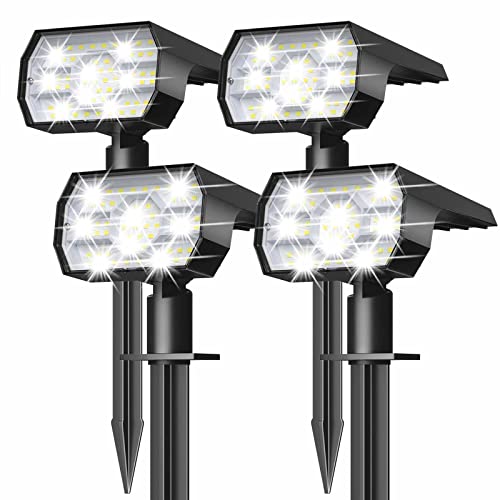
The NYMPHY 56 LED four-pack is a set of four cool white stake-in spotlights, each with 56 LEDs and three brightness modes: low, medium, and high. The listing states an IP68 waterproof rating, the highest rating found among the solar spotlights compared for this guide, and describes an anti-fog lens design meant to keep the lens clear and the light steady. The housings are ABS, and the listing rates them to work from minus 4 degrees Fahrenheit to 140 degrees Fahrenheit, which covers most winter nights and summer heat. Each light can go into the ground on its stake as a landscape spotlight or onto a wall with the included screws, so the same four lights can cover a small bed, a pair of shrubs, a doorway, or a run of fence posts.
The panel is polycrystalline, listed at up to 20 percent conversion, and it senses dusk and dawn to switch between charging and lighting. You switch each light on once, and it runs itself from then on, with no motion detection. The listing states a runtime of up to 6 to 20 hours depending on sunlight and mode, which is an honest way to put it, since runtime always depends on the mode and the day’s sun. The same design is also sold in warm white and in a six-pack, and we counted the design once rather than treating each pack size or color as a separate product.
Key specs (from the listing):
- LEDs: 56 per light, cool white
- Modes: 3, low, medium, and high
- Waterproof rating: IP68, with anti-fog lens design
- Runtime: up to 6 to 20 hours, depending on sunlight and mode
- Operating range: minus 4 degrees Fahrenheit to 140 degrees Fahrenheit
- Panel: polycrystalline, listed at up to 20 percent conversion
- Mounting: ground stake or wall screws included
- Switching: automatic on at dusk and off at dawn, no motion detection
- Pack: 4 lights
Pros:
- IP68 waterproof rating, the highest stated rating among the spotlights compared here
- Anti-fog lens design helps keep the beam clear in wet weather
- Three brightness modes let you trade output for runtime
Cons:
- No lumen figure is stated in the listing, so brightness cannot be compared numerically
- Battery type and capacity are not stated in the listing
Why it fits: This is a solar-powered spotlight in the strict sense: a stake-in landscape light that throws its beam at a garden feature and charges from its own panel, with no wiring and no outlet. The four-pack format matches the way these lights are actually used, with one light per shrub, tree, or doorway, and the IP68 rating plus anti-fog lens address the most common way a cheap solar spotlight fails, which is water getting past the seal. The three modes and the wide operating temperature range make it a practical choice for a yard that sees heavy rain, snow, and sprinklers, and the automatic dusk-to-dawn switching means there is nothing to remember after installation.
Frequently Asked Questions
How much sun does a solar spotlight need each day?
Most solar spotlights need a full day of direct sun to reach the runtime stated in the listing. A panel in partial shade, or shaded by the very tree the light is meant to illuminate, will charge poorly and the light will fade earlier in the night. Place the panel where it gets sun for a good part of the day, and remember that short winter days and low sun angles reduce charging in the colder months.
What is the difference between a solar spotlight and a solar flood light?
A solar spotlight throws a focused beam at a single feature, such as a tree, a flagpole, a statue, or a house sign. A solar flood light spreads a wide wash of light over a large area, such as a driveway or a garage front, often with two or three heads. The two are different tools, and a spotlight will not light a driveway well, just as a flood light will not pick out a single tree cleanly.
Do solar spotlights work in winter?
They do, but with shorter runtimes. Cold itself is less of a problem than short days, low sun angles, and snow sitting on the panel. A light rated to work down to minus 4 degrees Fahrenheit will keep operating through most winter nights, but expect fewer hours of light after a cloudy December day than after a sunny June day. Clearing snow off the panel helps it charge.
How long do solar spotlights last?
The LEDs themselves can last for years, but the small rechargeable battery is usually the first part to weaken, often after a few seasons. Listings that name the battery type and capacity, or describe it as replaceable, make it easier to plan for that. A high waterproof rating also helps longevity, because water damage is the other common cause of early failure.
Can I mount a solar spotlight on a wall instead of staking it in the ground?
Most stake-in solar spotlights in this category include wall screws as well as a ground stake, so the same light can screw to a wall, a fence post, or a gutter. Wall mounting suits doorways, house numbers, and signs, while staking suits beds and lawns. Check the listing to confirm that screws are included before ordering.
Conclusion
A good solar spotlight is a simple device judged on a few honest numbers: a waterproof rating you can compare, a runtime stated per mode, a panel that can face the sun while the light faces its target, and a mounting kit that fits your spot. The NYMPHY 56 LED four-pack covers those points well, with the strongest waterproof rating in its group, three brightness modes, and the flexibility to stake into a bed or screw to a wall. Match the light to the job, give the panel real sun, and a single pack will light several features in the yard without a trench, a transformer, or an outlet.
Verified: Nov 25, 2026 — ASINs checked on Amazon.