We independently review everything we recommend. When you buy through our links, we may earn a commission. As an Amazon Associate we earn from qualifying purchases.
3 Best Casio Portable Digital Pianos (November 2026)
Returning to piano after time away? Compare three portable Casio digital pianos with weighted hammer action, built-in speakers and practice-friendly features.
Returning to piano after time away? Compare three portable Casio digital pianos with weighted hammer action, built-in speakers and practice-friendly features.
Coming back to the piano after months or years away is a different decision from buying a first keyboard. Your hands remember more than you expect, but your fingers are slower, your reading is rusty, and a light unweighted keyboard will feel wrong within a week. The real choice is how much of a real piano feel you want to carry home, and how much extra sound and practice help you need while you rebuild.
This guide is for returning pianists who played before, stopped, and now want a portable Casio they can set up in a living room, practise quietly with headphones, and move aside when the room is needed. Each pick below is a Casio portable digital piano with a weighted hammer-action keyboard, chosen from the name and specifications shown on its Amazon listing.
Quick Picks
As an Amazon Associate we earn from qualifying purchases
Product
Best for
Key spec from title
Casio CDP-S160
Rebuilding basic technique in a slim, simple piano
88-key weighted piano with Scaled Hammer Action Keyboard and Duet Mode
Casio CDP-S360
Returning players who want many sounds and rhythms to explore
88-key compact piano with 700 tones and 200 rhythms
Casio Privia PX-S1100
A slim piano with a refined touch and wireless connection
88-key touch-responsive weighted piano with Bluetooth and German Grand Tone
How to Choose
Start with the key action, not the sound list
A returning pianist should judge the keyboard before anything else. A scaled hammer action, where the lower keys feel heavier than the higher keys, rebuilds the finger strength and control that fade during a break. All three pianos here use a form of Casio hammer action, but they are not identical: the CDP-S160 keeps things straightforward, the CDP-S360 uses a scaled weighted hammer action with textured keys, and the PX-S1100 uses a Smart Scaled Hammer Action with ebony and ivory textures. If you played an acoustic piano before, sit with the action question first and treat extra tones as a bonus.
Decide how portable the piano really needs to be
Portable means different things in different homes. The CDP-S360 weighs just over 24 pounds and can run on six AA batteries or its included power supply, so it can move from a bedroom to a kitchen table without a hunt for a socket. The CDP-S160 is also built slim for easy storage and transport. The PX-S1100 is slim too, at barely more than the keys themselves in depth, but its Amazon listing gives corded electric power and a weight of 31.6 pounds, so plan a regular spot for it near an outlet rather than carrying it from room to room every day.
Think about how you will practise, not just how you will play
Returning players improve fastest with short, regular sessions, and the right practice features make those sessions easier to start. Duet Mode on the CDP-S160 splits the keyboard so a teacher or a family member can play alongside you in the same range. The CDP-S360 adds a 6-track MIDI recorder, so you can record a left hand and practise the right hand against it. The PX-S1100 connects through Bluetooth and the Casio Music Space app, which suits players who like to follow lessons or play along with music from a phone or tablet.
Check speakers, headphones and pedals before you buy
A piano that sounds thin through its own speakers will push you towards headphones, which is fine for late practice but less inviting for daytime playing. All three models here have built-in stereo speakers and a headphone output, so check the speaker arrangement and the headphone jack type for the model you choose. The CDP-S160 and CDP-S360 include a sustain pedal in the box according to their listings, while the PX-S1100 listing describes its included Bluetooth adapter rather than a pedal bundle, so confirm what is in the box and whether you need a separate pedal or stand.
The 3 Best Options
Casio CDP-S160
Top Pick
Casio CDP-S160
Best for: Returning pianists who want a straightforward weighted piano for rebuilding technique.
Returning pianists who want a straightforward weighted piano for rebuilding technique.
Watch out for
The listing gives fewer detailed specifications than the other two models, so check the tone list and included accessories on the Amazon page before ordering.
The CDP-S160 is the simplest restart in this group, and that is its strength. Its 88-key weighted keyboard with Scaled Hammer Action gives returning fingers a piano-like resistance without a long list of controls to learn, and Duet Mode makes it easy to share the keyboard with a teacher during a lesson. The slim and portable body suits a player who wants the piano out for practice and tucked away afterwards, and the built-in speakers mean there is nothing extra to connect for a normal session.
Watch out for: The listing gives fewer detailed specifications than the other two models, so check the tone list and included accessories on the Amazon page before ordering.
Casio CDP-S360
Runner-Up
Casio CDP-S360
Best for: Returning players who want variety, rhythms and recording to keep daily practice interesting.
Specs:
88 keys with scaled, weighted hammer-action keyboard and simulated ebony and ivory textures
700 tones including stereo grand piano, plus 200 rhythms
Returning players who want variety, rhythms and recording to keep daily practice interesting.
Watch out for
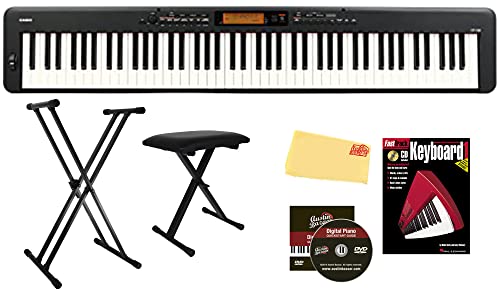
This listing is a bundle with a stand and bench, so confirm you have room for the stand, and note that Bluetooth needs the separate WU-BT10 adapter rather than being built in.
The CDP-S360 is the pick for a returning player who gets bored practising scales alone. It keeps the scaled weighted hammer action and slim body of the compact Casio line, then adds 700 tones and 200 rhythms, so a familiar piece can be tried with a different sound or a backing rhythm when motivation dips. At just over 24 pounds, with battery power as an option alongside the included power supply, it is the easiest of the three to move around the house, and the 6-track MIDI recorder turns it into a genuine practice tool rather than only a sound source.
Watch out for: This listing is a bundle with a stand and bench, so confirm you have room for the stand, and note that Bluetooth needs the separate WU-BT10 adapter rather than being built in.
Casio Privia PX-S1100
Casio Privia PX-S1100
Best for: Returning pianists who want a slim, refined piano for regular playing at home with wireless app and audio connection.
Returning pianists who want a slim, refined piano for regular playing at home with wireless app and audio connection.
Watch out for
The listing shows corded electric power rather than battery power, so this is a piano for a fixed spot near an outlet, and at 31.6 pounds it is the heaviest of the three.
The PX-S1100 is the most refined-feeling piano here, and the best match for a returning player who already knows they will stick with it. Its Smart Scaled Hammer Action reproduces the individual character of each of the 88 keys, and the ebony and ivory textured surfaces give a confident grip in any climate. The included WU-BT10 Bluetooth MIDI and audio adapter lets you connect wirelessly to a phone or tablet with no extra power supply, and you can play along with music through the powerful stereo speaker system or explore Bluetooth-compatible MIDI devices and software.
Watch out for: The listing shows corded electric power rather than battery power, so this is a piano for a fixed spot near an outlet, and at 31.6 pounds it is the heaviest of the three.
Which One Fits Your Situation
You played years ago and want the gentlest restart
Choose the Casio CDP-S160. Its weighted action rebuilds finger strength without overwhelming you with tones and menus, and Duet Mode is genuinely useful if you take a few refresher lessons. Set it up somewhere you will see it every day, because a simple piano that is easy to start is the one a returning player actually practises on.
You lose interest practising the same pieces the same way
Choose the Casio CDP-S360. The 700 tones, 200 rhythms and 6-track recorder give you ways to vary a session when scales feel dull, and the battery option means you can practise in a different room when the usual spot is busy. The bundle stand and bench also mean you do not need to hunt for furniture before your first session.
You know you will play most days and want the best touch
Choose the Casio Privia PX-S1100. Its Smart Scaled Hammer Action and textured keys reward a player who can already tell the difference between a good action and a merely adequate one, and the included Bluetooth adapter keeps the setup tidy for app lessons and play-along practice. Give it a permanent place near a socket and a proper bench.
You share a home and practise at awkward hours
Choose any of the three, but use the headphone output every time. The CDP-S360 is the lightest to move to a quiet room and can run on batteries, the CDP-S160 is the simplest to set up and put away, and the PX-S1100 pairs well with a phone for silent play-along practice through Bluetooth audio. Whichever you pick, a closed-back headphone and a regular short session matter more than the model.
Common Mistakes
Buying an unweighted keyboard because it is cheaper, then finding that your hands tire and your dynamics disappear when you return to a real piano feel.
Choosing a piano for its tone count and ignoring the key action, which is what your fingers meet every single day.
Assuming every portable piano runs on batteries: the PX-S1100 in this guide is listed as corded electric, so check power before you plan to play away from a socket.
Ordering a bundle without checking what it contains: the CDP-S360 bundle here includes a stand and bench, while the standalone PX-S1100 listing does not describe the same bundle contents.
Practising only pieces you already know, instead of using Duet Mode, a recorder or rhythms to rebuild reading, timing and weaker-hand control.
Setting the piano somewhere inconvenient and then wondering why practice keeps slipping to tomorrow.
Frequently Asked Questions
Is a weighted keyboard necessary for a returning pianist?
Yes, for most returning players it is. A weighted hammer action rebuilds the finger strength and dynamic control that fade during a break, and it keeps your playing transferable to an acoustic piano. An unweighted keyboard can feel fast at first, but it teaches a lighter touch that does not carry over, so all three pianos in this guide use a Casio hammer action.
Can I practise quietly with headphones on these Casio pianos?
Yes. All three models have a headphone output alongside their built-in stereo speakers, so you can practise late in the evening without disturbing the household. The CDP-S360 lists a 3.5mm headphone jack, and the PX-S1100 can also play audio from a connected device through Bluetooth, which suits silent play-along sessions.
Do these portable Casio pianos run on batteries?
Only one of the three is listed that way. The CDP-S360 can run on six AA batteries or its included power supply. The PX-S1100 listing gives corded electric power, so it needs an outlet. Check the power source on the Amazon listing for the exact model you order, rather than assuming every portable piano is battery powered.
Which Casio is best if I want to play with a teacher again?
The CDP-S160 is the most direct choice, because its Duet Mode splits the keyboard so a teacher can play alongside you in the same range. The CDP-S360 is also useful for lessons, since its recorder lets you play back a passage and hear your own timing. The PX-S1100 suits a player who already works with app-based lessons through Bluetooth and the Casio Music Space app.
W
Wildshot Editorial Team
We compare specs, materials and verified owner reviews before a product earns a spot. Rankings are never paid.
Affiliate disclosure. As an Amazon Associate we earn from qualifying purchases at no extra cost to you. Prices accurate as of the date shown.
How to choose a wall mounted lithium storage battery for solar and home backup, from capacity and inverter compatibility to mounting, heating, and safety listings.
Find the best Turkish bath sheets in soft, absorbent Turkish cotton, from plush 820 GSM sets to lightweight waffle weaves, sized for full coverage every day.
Discover the best robotic vacuums with virtual walls for pet hair, stairs and cluttered rooms, with smart mapping, no-go zones and self-emptying docks.
Compare five budget smartphones from T-Mobile, Cricket, Ulefone, MIRO, and Unnecto, and match storage, screen size, and carrier freedom to your daily use.
Compare five Android phones for photography, from Samsung Galaxy flagships to the LUNAR Eclipse, and match camera, display, and battery to your shooting.
The best mirrorless Micro Four Thirds cameras offer compact bodies, fast autofocus and a huge shared lens range. Compare four current OM SYSTEM and Lumix picks.