We independently review everything we recommend. When you buy through our links, we may earn a commission. As an Amazon Associate we earn from qualifying purchases.
Best 1/2 HP Sump Pumps With Tethered Float Switches
Shopping for the best 1 2 hp sump pumps tethered models? Compare five verified picks on flow at 10 feet of lift, cast iron builds, pit fit and value.
Shopping for the best 1 2 hp sump pumps tethered models? Compare five verified picks on flow at 10 feet of lift, cast iron builds, pit fit and value.
A tethered float switch is the oldest and simplest way to run a sump pump automatically: a sealed float rides on a short cord, rises with the water, and tips a switch inside the float body to run the pump. Because the float needs room to swing through its arc, these pumps belong in wider pits, and in return they give you a long, adjustable pumping range that empties more water per cycle and lets the motor rest longer between runs. In the 1/2 HP class, that combination suits homes with a high water table, a big footprint collecting roof runoff, or a pit that fills fast during heavy rain.
This guide compares five 1/2 HP submersible sump pumps that all use a genuine tethered float switch — no vertical floats, no electronic sensors, and no sewage models with oversized discharge ports. Every pick below is a current Amazon US listing, and each one is judged on the numbers that decide real performance: flow at 10 feet of lift rather than the headline figure at zero lift, housing material, shut-off head, amp draw, minimum basin size, and warranty length. If your pit is at least 14 inches across and you want simple, proven automatic operation, one of these five pumps will fit the job.
As an Amazon Associate, we earn from qualifying purchases.
Quick answer
The Superior Pump 92501 is the best overall 1/2 HP tethered-float sump pump for most wide pits: a cast iron body, 3,480 gallons per hour at 10 feet of lift, and a three-year warranty. Need more flow? The Flotec FPZT7300 moves 4,140 gallons per hour at the same lift. Narrower pits and tighter budgets are covered below.
Superior Pump 92501 — Best Overall
Top Pick
Superior Pump 92501 — Best Overall
Horsepower: 1/2 HP
Switch: tethered float with piggyback plug
Flow: 4,200 GPH at 0 ft; 3,480 GPH at 10 ft of lift
The Superior Pump 92501 earns the top spot because it gets the fundamentals right in the proportions most homes need. The housing is cast iron, which sheds motor heat into the pit water far better than plastic and gives the pump the weight to sit still through long, hard cycles. Its published curve delivers 4,200 gallons per hour at zero lift and, more usefully, 3,480 gallons per hour at 10 feet of lift — right in the strong band for this horsepower class and enough for a fast-filling pit under a large roof. The shut-off head of 25 feet covers deep basements and discharge runs that climb to grade level and beyond.
The tethered float uses a piggyback plug, so the pump can be run manually for a pit cleanout simply by plugging the pump cord in directly. The float range is adjustable by repositioning the cord clamp, which lets you set a longer draw-down in a deep pit and reduce how often the motor cycles. The motor is a continuous-duty split capacitor design with thermal protection, it passes solids up to 1/2 inch, and the 1-1/2 inch discharge matches standard residential plumbing. A three-year warranty rounds out a package with no real weak point for a standard 18-inch or wider basin.
Flow claims only mean something at a stated lift, and at the working height that matters — 10 feet of discharge head — the Flotec FPZT7300 leads this group with 4,140 gallons per hour. That is roughly a fifth more water per hour than the next strongest pick here, and it shows up in the situations that flood basements: spring thaw with a saturated water table, or a storm that keeps refilling the pit while the pump is still drawing it down. A 7.3-amp motor drives that output, and the maximum lift of 23 feet means the curve stays useful in deeper pits before it fades.
The body is a one-piece zinc housing, which sits between thermoplastic and cast iron for weight and heat handling, and the pump keeps a compact 10-inch width for a high-output model. The tethered float turns the pump on at about 13.5 inches of water and off at about 4.5 inches, a wide range that suits the pump’s high-flow role: fewer, longer cycles that move serious volume each time. It passes solids up to 3/8 inch, uses the standard 1-1/2 inch discharge, and carries a three-year warranty. If your pit inflow has ever beaten a smaller pump, this is the tethered 1/2 HP model built to win that race.
Superior Pump 92507 — Best Cast-Iron Build
Superior Pump 92507 — Best Cast-Iron Build
Horsepower: 1/2 HP
Switch: tethered float with piggyback plug
Flow: 4,200 GPH at 0 ft; 3,480 GPH at 10 ft of lift
Buyers who shop by construction first should look at the Superior Pump 92507. It shares the heavy cast iron housing of the 92501 — the build that dissipates heat during continuous running, resists the knocks of a working pit, and anchors the pump against the torque of its own discharge — and pairs it with a 25-foot power cord. That cord is the real differentiator: in deep pits, crawl space installations, and basins set away from the nearest outlet, a 10-foot cord forces awkward and unsafe workarounds, while 25 feet reaches a proper GFCI outlet with slack to spare.
Performance matches the top pick: 4,200 gallons per hour at zero lift, 3,480 gallons per hour at 10 feet, and a 25-foot shut-off head. The tethered float is the same adjustable piggyback design, the motor is the same continuous-duty split capacitor unit drawing 7.6 amps, and solids handling is 1/2 inch through a 1-1/2 inch discharge. At 23.6 pounds it is the heaviest pump in this guide, which is exactly the point for a cast-iron build: mass keeps the pump planted and the iron keeps it cool, cycle after cycle, and the three-year warranty backs the construction.
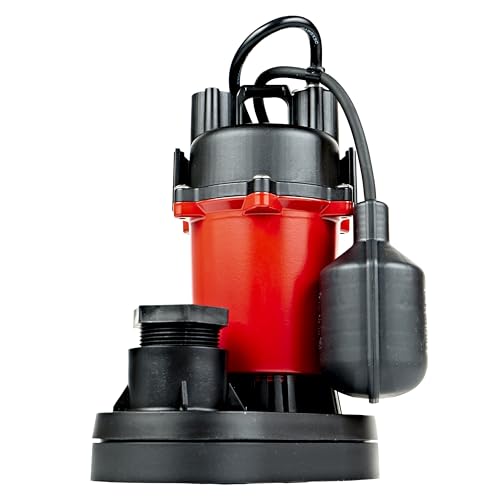
Red Lion RL-SP50T — Best for Narrow Pits
Red Lion RL-SP50T — Best for Narrow Pits
Horsepower: 1/2 HP
Switch: tethered float, piggyback style
Flow: 3,600 GPH at 0 ft; 2,520 GPH at 10 ft of lift
Tethered floats and narrow pits are natural enemies, because the float needs a clear arc to rise and fall without catching the basin wall. The Red Lion RL-SP50T is the tethered model engineered closest to that problem: Red Lion rates it for basins as small as 14 inches in diameter, the tightest fit of any pump in this guide, and its slim body leaves the float the room it needs. If your basin measures in the 14 to 16 inch range and you still want tethered-float operation — with its long draw-down and easy manual override — this is the pick designed for that space.
The housing is aluminum, so the pump weighs under 10 pounds and is easy to lower into a cramped pit or pull for cleaning. The permanent split capacitor motor draws only 4.4 amps, the lowest in this group, which makes it a friendly load for homes pairing a primary pump with a battery backup inverter. Output is honest mid-pack performance: 3,600 gallons per hour at zero lift and 2,520 gallons per hour at 10 feet, with a strong 28-foot shut-off head that beats several heavier pumps here. The float turns on at about 14.5 inches and off at about 5.5 inches, the discharge is 1-1/2 inch FNPT, and coverage is a two-year warranty.
The Flotec FPZS50T is the value-line way into a tethered 1/2 HP pump. It trades the heavy housings of the picks above for a zinc motor housing with a thermoplastic pump body and base, which cuts the weight to 10 pounds and keeps the unit at the accessible end of the Flotec range. What it does not give up is useful performance: 3,000 gallons per hour at 10 feet of lift is a solid figure for a typical basement, and the 22-foot maximum lift handles standard discharge heights without strain.
At only 8 inches wide, the body is the narrowest here, which helps in older, smaller basins — though the tethered float still needs its swing room, so treat 14 inches as the practical minimum pit diameter. The float switches on at about 14 inches and off at about 6 inches, the motor draws a modest 4.1 amps, and the discharge is the standard 1-1/2 inch size. Solids handling is 3/16 inch, the smallest in this group, so this pump suits cleaner pit water rather than gritty inflow. The one-year warranty is the shortest here, which is the honest trade behind the budget slot: proven Flotec hydraulics and a full tethered-float setup, with lighter construction and shorter coverage.
How to choose
Begin with the pit, because it decides whether a tethered pump can work at all. Measure the basin diameter: 18 inches or more gives any tethered float a free swing, 14 to 16 inches limits you to compact models like the Red Lion above, and anything narrower calls for a different switch type entirely — see the section below. Confirm the float can travel from its lowest to highest position without touching the wall, the inlet pipe, or the pump body, since a hung float is the most common cause of tethered-pump failures.
Next, size by flow at your actual lift, not by the box headline. Measure the vertical distance from the pit waterline to the highest point of the discharge run, then compare pumps at that height — for most homes that is the 10-foot figure used throughout this guide. A pump that moves 3,000 to 3,500 gallons per hour at 10 feet handles the great majority of residential inflow; choose the high-output Flotec if your pit has ever gained on a running pump. Check the shut-off head too: it should clear your lift by a comfortable margin, or real-world flow will fall off a cliff.
Then weigh build and running costs. Cast iron sheds heat and survives long duty cycles, aluminum and zinc split the difference, and thermoplastic keeps weight and cost down for lighter service. Amp draw matters if the pump shares a circuit or pairs with a battery backup: the Red Lion sips 4.4 amps while the big Superior motors draw 7.6. Finally, look at cord length against the distance to a GFCI outlet — never solve a short cord with an extension lead in a wet pit — and treat warranty length as a fair signal of how the maker rates its own construction.
Who should skip
Skip tethered pumps altogether if your basin is under 14 inches in diameter. A float that cannot complete its arc will eventually wedge against the wall or the discharge pipe, and the failure mode is a flooded basement. Narrow pits are exactly what vertical float and electronic switch pumps exist for, and forcing a tethered model into one is the most expensive mistake in this category.
Also skip this class if your pit is shallow. Tethered switches need a tall water column to work through — most of these floats do not switch on until the water is 13 to 15 inches deep — so a shallow basin can overflow before the pump ever runs. And if your water carries heavy grit, sand, or sewage solids, these sump models are the wrong tool: solids ratings here run from 3/16 to 1/2 inch, and a dedicated effluent or sewage pump with a 2-inch discharge is the correct answer. Finally, anyone whose basement floods when the power fails should budget for a battery backup system alongside any pump in this guide, because no corded primary pump of any switch type runs during an outage.
Frequently Asked Questions
How wide does a pit need to be for a tethered float switch?
Plan on 18 inches of diameter for unrestricted float movement, which is the size most tethered pumps are rated around. Compact models such as the Red Lion RL-SP50T are rated down to a 14-inch minimum basin. Below 14 inches, choose a vertical float or electronic switch pump instead, because a tethered float that touches the wall can stick in either the on or off position.
How long do tethered float switches last?
The float switch is the wear item on any automatic sump pump, and makers generally advise inspecting it every season and replacing the tether switch roughly every two years in hard service, since it is inexpensive insurance against the most common failure. Piggyback designs make this easy: the switch unplugs and swaps without replacing the pump, and the pump can be plugged in directly to run manually in the meantime.
Can I adjust when a tethered pump turns on and off?
Yes, within limits. The on and off levels are set by the length of cord between the float and its anchor point on the pump or discharge pipe. A longer free cord widens the pumping range, so the pit draws down further and the motor cycles less often; a shorter cord narrows the range for shallower pits. Follow the maker’s minimum cord length so the float can still tip fully in both directions.
Is 1/2 HP enough, or should I buy a bigger pump?
For most homes, 1/2 HP is the sweet spot: it covers high water tables, large roof areas, and discharge lifts around 10 feet with capacity to spare. Move up in size only if a 1/2 HP pump demonstrably cannot keep pace with inflow during storms, or if your lift is unusually tall. Oversizing a pump in a small pit causes short, frequent cycles that wear the motor and switch faster than steady longer runs.
Final verdict
For most basements with a pit wide enough to swing a float, the Superior Pump 92501 is the buy: cast iron construction, strong flow at working lift, an adjustable piggyback tether, and a three-year warranty in one proven package. If inflow volume is your problem, the Flotec FPZT7300 out-pumps everything else here at 10 feet of lift. The Superior 92507 adds the heaviest cast-iron build and a 25-foot cord for deep or awkward pits, the Red Lion RL-SP50T fits tethered operation into a 14-inch basin while sipping amps, and the Flotec FPZS50T covers clean-water pits on a budget. Match the pump to your pit diameter and your lift first, and any of these five will serve well.
Product and ASIN Reference
Product
ASIN
Superior Pump 92501
B000IJSVWM
Flotec FPZT7300
B00ID8QWGC
Superior Pump 92507
B000X0BDNU
Red Lion RL-SP50T
B005X54GDY
Flotec FPZS50T
B00MCC2ZQQ
A
admin
We compare specs, materials and verified owner reviews before a product earns a spot. Rankings are never paid.
Affiliate disclosure. As an Amazon Associate we earn from qualifying purchases at no extra cost to you. Prices accurate as of the date shown.
The best and worst zero turn mowers, explained: top electric and gas picks, models and buying mistakes to avoid, and how to match deck size to your lawn.
The best striping push mowers use a roller kit to bend grass into crisp light and dark bands. Our November 2026 guide compares fit, weight and mounting.
Compare the best generator brands, Honda, Generac, Champion, Westinghouse and WEN, by noise, fuel choice, warranty and one proven model from each line.
Compare four pool cleaners for different pool sizes, surfaces and pump setups, from corded robots to pressure-side and suction models, and find your match.
Compare the best striping zero turn mowers for deep, even bands: fabricated decks, heavy frames and roller-friendly layouts, with gas and electric picks.
Compare the best walk-behind wide cut mowers on Amazon: 30-inch decks from EGO and Toro, checked for drive type, battery runtime, cutting height range and exactly what is included in the box.


 Red Lion RL-SP50T — Best for Narrow Pits
 Flotec FPZS50T — Best Budget