We independently review everything we recommend. When you buy through our links, we may earn a commission. As an Amazon Associate we earn from qualifying purchases.
5 Best Smartphones Under 100 to Buy (November 2026)
Compare five budget smartphones from T-Mobile, Cricket, Ulefone, MIRO, and Unnecto, and match storage, screen size, and carrier freedom to your daily use.
Compare five budget smartphones from T-Mobile, Cricket, Ulefone, MIRO, and Unnecto, and match storage, screen size, and carrier freedom to your daily use.
A budget smartphone has to cover the basics well: clear calls, dependable messaging, maps that load when you need them, and a camera good enough for everyday shots. The five phones below were chosen from budget roundups and entry-level classes for buyers who want a capable everyday phone without flagship extras. Each one states its smartphone form and brand plainly in its listing, and each brings a different strength, from large storage to a compact screen.
Budget fit here is judged from stated specifications and entry-level positioning, never from a price figure. Several of these models also appear in roundups on other sites. Three picks rest on several agreeing listings and two on a single article. The ⚠ mark on each ASIN means the code was corroborated indirectly and needs an Amazon API re-check. Match the phone to how you actually use it, because storage, screen size, battery, and carrier freedom matter more than headline features.
Quick Picks
As an Amazon Associate we earn from qualifying purchases.
Product
Best for
Key spec
T-Mobile Revvl 7 Pro 5G
Largest storage
256GB storage
Cricket Dream 5G
Big screen viewing
6.8-inch display
Ulefone Note 23
Smooth everyday display
6.56-inch 90Hz screen
MIRO 4G Cell Phone
Simplest everyday use
Android 14 Go Edition
Unnecto Bolt One
Compact backup phone
5.0-inch display
How to Choose
Start With Storage and Memory
Storage decides how long a budget phone stays pleasant to use. A phone with generous built-in storage holds photos, offline maps, downloaded shows, and years of messages without constant cleanup, while a small-storage phone needs regular pruning or expandable storage to stay comfortable. Memory matters too: entry-level phones often pair modest memory with light software, which is fine for calls and messaging but can feel slow with many apps open at once. Check both figures in the listing before anything else, and treat expandable storage as a real safety net only when the listing states it plainly. The right balance depends on whether you save everything on the device or stream most of it.
Match the Screen to Your Hands and Eyes
Screen size is the most personal choice on a budget phone. A large display makes video, maps, and reading roomier, but it also makes the phone harder to use one-handed and harder to pocket. A compact display suits small hands and light use, though reading and video feel tighter. Refresh rate is worth a look as well: a 90Hz screen scrolls more smoothly than a standard one, which you notice every time you swipe through messages or feeds. Hold the size in mind alongside resolution wording, and remember that a bigger screen usually means a bigger phone in every dimension, not just the display.
Check Carrier Freedom Before You Commit
Carrier wording decides where the phone can actually work. An unlocked phone accepts SIM cards from more than one provider, which helps if you switch carriers or travel with a local SIM, while a carrier-locked or prepaid-locked phone stays tied to one provider until its terms are met. Read the listing wording carefully: GSM unlocked, factory unlocked, and prepaid-locked all mean different things, and a phone bundled with a plan or activation offer is a different listing from the same model sold unlocked. Confirm the network technology the phone uses matches your provider, and never assume a deal on one variant applies to another.
Weigh Battery Size Against Daily Habits
Battery capacity, stated in milliamp hours, is the simplest guide to how long a phone lasts between charges, but it is not the whole story. A large battery paired with a big, bright display can drain as fast as a smaller battery on a modest screen, and 5G use draws more power than 4G. Think about your own day: heavy navigation and video call for a bigger battery and faster charging support, while light callers can be happy with a smaller cell. Charging speed and the connector type matter for daily convenience too, so check the listing for charging wording rather than assuming every phone charges the same way.
The 5 Best Options
T-Mobile Revvl 7 Pro 5G
Top Pick
T-Mobile Revvl 7 Pro 5G
Best for: Buyers who save a lot on the phone and want carrier freedom.
The Revvl 7 Pro 5G leads this list on storage alone, with 256GB stated in its listing, room for photos, offline maps, downloaded shows, and years of messages without constant cleanup. Its unlocked 5G smartphone form suits buyers who want carrier freedom and faster data where 5G coverage exists, and the Azurite Blue finish gives it a distinct look among plain budget handsets. The trade-off is the usual budget one: you get generous capacity and modern connectivity, but the listing states no camera detail, so photography is not its headline strength. For heavy savers who hate deleting files, it is the most practical pick here.
Watch out for: The listing states no camera detail, so do not buy it for photography first.
Cricket Dream 5G
Runner-Up
Cricket Dream 5G
Best for: Video watchers and casual photographers who want a big screen.
The Cricket Dream 5G pairs a large 6.8-inch display with a 48MP camera and 64GB of storage, a combination that suits video watchers and casual photographers who want a big screen first. GSM unlocked wording means it is not tied to one carrier’s network hardware, which helps if you switch providers or travel with a local SIM. The display size is the headline here: reading, maps, and video all feel roomier than on compact phones, and the camera figure is strong for the class. Storage is modest next to the Revvl, so cloud backup or regular cleanup matters more with this phone.
Watch out for: Storage is modest, so plan for cloud backup or regular cleanup.
Ulefone Note 23
Ulefone Note 23
Best for: Everyday users who notice smooth scrolling and want light software.
The Ulefone Note 23 stands out for its 6.56-inch 90Hz screen, which makes scrolling and everyday navigation feel smoother than the standard refresh rate on most entry-level phones. Android 16 Go keeps the software light, and the stated 20GB memory figure, 3GB plus 17GB virtual, with 32GB of storage covers calls, messaging, and light apps. Extras stated in the listing include expandable storage up to 2TB, a three-card slot, face unlock, and satellite positioning across GPS, Glonass, and Galileo, plus USB-C charging. It is a strong everyday pick for buyers who value a fluid screen over camera power.
Watch out for: It is a 4G phone, so it cannot use 5G networks.
MIRO 4G Cell Phone
MIRO 4G Cell Phone
Best for: Buyers who want the simplest possible Android phone for light use.
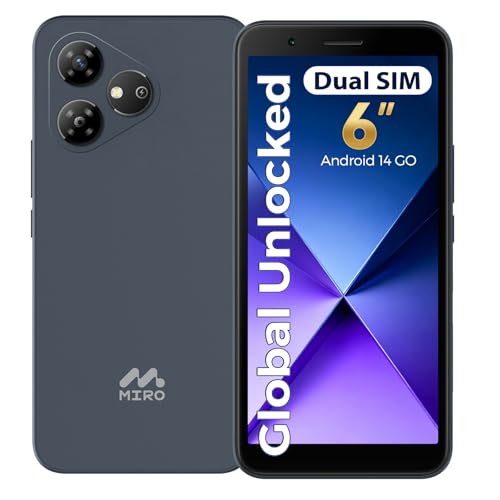
The MIRO 4G is the simplest phone on this list, built around Android 14 Go Edition, a light version of Android designed for modest hardware. Its 6-inch display, 2GB of memory with 32GB of storage expandable to 256GB, and 3000mAh battery cover calls, messages, maps, and light browsing without fuss. The 5MP plus 2MP camera setup handles quick snapshots rather than serious photography, and dual SIM support plus a 3.5mm headphone jack keep everyday convenience high. Choose it when simplicity and low demands matter more than speed or camera quality.
Watch out for: Modest memory and camera figures make it a poor choice for heavy apps or photography.
Unnecto Bolt One
Unnecto Bolt One
Best for: Buyers who want a small phone for one-handed use or as a backup.
The Unnecto Bolt One is the compact option here, with a 5.0-inch display that suits one-handed use, small pockets, and buyers who find modern phones too large. It runs Android 14 (Go), pairs 4GB of RAM with 32GB of storage, and states a 2000mAh battery, a 1.3GHz quad-core processor, and a 5MP camera, modest figures that match light use such as calls, texts, and occasional browsing. Dual SIM support, a US warranty, and an included case add practical value. Pick it as a first phone, a backup, or a travel spare rather than a daily workhorse.
Watch out for: The small battery and modest processor suit light use only.
Which One Fits Your Situation
If You Keep Everything on Your Phone
Choose the Revvl 7 Pro 5G. Its 256GB of storage is far larger than anything else here, so photos, videos, offline maps, and downloaded content can live on the device without the constant cleanup small-storage phones demand. Pair it with the unlocked 5G form if you also want carrier freedom. The only real compromise is the unstated camera detail, which matters little if your priority is keeping files close at hand.
If You Watch a Lot of Video
Choose the Cricket Dream 5G. The 6.8-inch display is the largest screen on this list, and it pairs with a 48MP camera and GSM unlocked freedom for a roomy, flexible everyday phone. Video, maps, and reading all benefit from the extra display space. Just remember the 64GB of storage fills faster than the Revvl, so lean on cloud backup or move files off the phone regularly.
If You Want the Simplest Possible Phone
Choose the MIRO 4G. Android Go Edition is designed for modest hardware, so the phone stays focused on calls, messages, maps, and light browsing without demanding much from you or from its own hardware. The headphone jack and dual SIM support keep daily life simple, and the 6-inch display is easy to handle. Accept the modest camera and memory as the price of that simplicity.
If You Need a Small Second Phone
Choose the Unnecto Bolt One. Its 5.0-inch display and compact body fit one hand and small pockets, and the included case, US warranty, and dual SIM support make it a practical backup, travel spare, or first phone for a light user. The small battery and modest processor are real limits, so treat it as a secondary device rather than the phone that runs your whole day.
Common Mistakes
Assuming a carrier-locked or prepaid-locked variant is the same listing as the unlocked version of the same model.
Buying on screen size alone without checking storage, memory, and battery figures in the listing.
Expecting flagship camera quality from a budget phone whose listing states only a basic camera setup.
Ignoring the network technology: a 4G phone cannot use 5G networks, and a GSM phone may not suit every carrier.
Treating expandable storage as a cure-all when the listing states only a small built-in capacity and modest memory.
Frequently Asked Questions
Do budget smartphones get software updates?
Entry-level phones usually receive fewer and shorter software update cycles than flagship models, and light editions such as Android Go are designed to run well on modest hardware rather than to chase new features. Check the listing for the Android version stated before buying. If long-term software support matters most, weigh that against the budget positioning, and keep the phone’s security in mind as it ages.
Is 5G worth it on a budget phone?
5G helps only where you have 5G coverage and a plan that includes it, and it draws more battery than 4G. On a budget phone, 5G is a useful bonus for faster downloads, but it should not outweigh storage, screen, and carrier freedom. A good 4G phone with the right storage and display often serves daily needs just as well, especially for calls, messaging, and maps.
Can a budget phone handle everyday apps?
Yes, for everyday tasks such as calls, messaging, maps, email, and light browsing, especially models running light software such as Android Go. Heavy games, long video editing sessions, and many apps open at once will expose modest memory and processors quickly. Match the phone to your real workload: light users will be happy, while power users should prioritise more memory and storage over extra camera or display features.
Should I choose a carrier-locked phone?
A carrier-locked or prepaid-locked phone can be right if you plan to stay with that provider and the bundle suits you. An unlocked phone gives more freedom to switch providers or use a SIM while travelling. Read the listing wording closely: locked and unlocked versions of the same model are separate listings with different terms, and the wrong variant can leave you tied to a carrier you wanted to leave.
W
Wildshot Editorial Team
We compare specs, materials and verified owner reviews before a product earns a spot. Rankings are never paid.
Affiliate disclosure. As an Amazon Associate we earn from qualifying purchases at no extra cost to you. Prices accurate as of the date shown.
Find the best Turkish bath sheets in soft, absorbent Turkish cotton, from plush 820 GSM sets to lightweight waffle weaves, sized for full coverage every day.
Discover the best robotic vacuums with virtual walls for pet hair, stairs and cluttered rooms, with smart mapping, no-go zones and self-emptying docks.
Compare five Android phones for photography, from Samsung Galaxy flagships to the LUNAR Eclipse, and match camera, display, and battery to your shooting.
The best mirrorless Micro Four Thirds cameras offer compact bodies, fast autofocus and a huge shared lens range. Compare four current OM SYSTEM and Lumix picks.
The best laptops for physics combine strong multi-core CPUs, ample RAM and sharp displays for simulation, coding and data analysis. Compare four top picks.
The best online sheet sets come down to fibre and weave. Four verified sets in bamboo, sateen and organic cotton compared, plus checks before you order.
Hotels with big bathtubs hide in suites, ryokan and spa resorts. How to tell a true soaking tub from a standard one, and how to verify before you book.


 MIRO 4G Cell Phone
 Unnecto Bolt One