We independently review everything we recommend. When you buy through our links, we may earn a commission. As an Amazon Associate we earn from qualifying purchases.
Best Gaming Headsets and Headphones for Every Setup
Compare the best gaming headsets and headphones for PC, PlayStation, and Xbox, with wireless and wired picks for sound, microphones, and comfort.
Compare the best gaming headsets and headphones for PC, PlayStation, and Xbox, with wireless and wired picks for sound, microphones, and comfort.
A good gaming headset does three jobs at once. It places sounds accurately so you hear footsteps before you see them, it carries your voice clearly to teammates, and it stays comfortable through a long session. Plenty of headsets do one of those jobs well. The ones worth buying do all three, without software headaches or a microphone that makes you sound like you are calling from another building.
The five picks below cover the sensible range: a flagship wireless model, two strong mid-range wireless options, a long-battery wireless headset, and a wired model for players who want zero charging and zero latency worries. All five are current models from the major gaming audio brands, and several double as console or phone headsets when the session moves off the desk.
As an Amazon Associate, we earn from qualifying purchases.
Quick Answer
The SteelSeries Arctis Nova Pro Omni leads overall with Hi-Res wireless audio, active noise cancellation, and hot-swappable batteries. For competitive shooters, the Razer BlackShark V2 HyperSpeed is the sharper pick thanks to its clear microphone and lightweight frame. The SteelSeries Arctis Nova 7 Gen 2 and Corsair HS80 MAX suit players who want long battery life, while the wired HyperX Cloud III suits anyone who prefers simple plug-and-play.
How to Choose
Start with your platform. A headset that works beautifully on PC may lose features on a console, and Xbox wireless support is the narrowest of the three major platforms. Check the compatibility list before anything else, because a headset that cannot connect to your console is useless no matter how good it sounds. Multi-platform headsets that support PC, PlayStation, and mobile through a mix of 2.4GHz wireless and Bluetooth give you the most flexibility if you play on more than one system.
Next, decide between wireless and wired. Wireless headsets free you from cables and let you step away from the desk without removing the headset, but they need charging and they cost more for the same sound quality. A 2.4GHz wireless connection is the right choice for gaming because it keeps latency low, while Bluetooth on its own can introduce noticeable delay. Wired headsets never need charging, never drop a connection, and usually deliver better sound for the money. If you play competitive shooters where every footstep matters, either a wired headset or a 2.4GHz wireless model is the safe choice.
Sound quality comes from the drivers and the tuning, not from a single specification. Larger drivers can deliver deeper bass, but a well-tuned smaller driver often sounds cleaner than a poorly tuned large one. Spatial audio support matters for competitive play because it helps you place sounds in three dimensions, telling you whether an enemy is above, below, or behind you.
The microphone deserves as much attention as the drivers if you play multiplayer games. A detachable or retractable boom microphone usually sounds clearer than a built-in microphone, and a flip-to-mute design lets you silence yourself quickly. Noise rejection matters if your room is not quiet, since a microphone that picks up keyboard clicks and background noise will annoy your teammates. Look for headsets that mention AI noise rejection or a cardioid pickup pattern, both of which help keep your voice clean.
Comfort decides whether a headset survives a three-hour session. Weight is the first thing to check, since a heavy headset presses down on the top of your head over time. Memory foam ear cushions and a padded headband help, as does a design that spreads clamping force evenly instead of squeezing at one point. Over-ear earcups suit most players better than on-ear designs because they enclose the ear fully and block more outside noise. If you wear glasses, look for softer ear cushions that do not press the arms of your glasses into your head.
Battery life only matters for wireless models, but it matters a lot. A headset that lasts a full weekend of gaming between charges is far more convenient than one that needs charging every night. Hot-swappable batteries are the best solution of all, since you can swap in a fresh battery in seconds and keep playing while the other one charges. Bluetooth-only battery figures are usually longer than 2.4GHz figures, so check which connection the headline number refers to.
Finally, think about software. Companion apps let you adjust the equalizer, tune the microphone, and set up game-specific audio profiles. If you prefer a headset that simply works, a wired model with no software requirement is the simplest path. Whatever you choose, make sure the headset fits your platform, your play style, and your tolerance for charging cables.
The SteelSeries Arctis Nova Pro Omni is the flagship pick in this guide, built for players who want one headset that handles PC, console, and mobile without compromise. Its Hi-Res certified wireless audio delivers detailed sound with clear highs and full bass, and the retractable ClearCast Pro microphone keeps your voice clear in team chat. Active noise cancellation cuts background noise during long sessions, and the base station makes switching between devices and adjusting volume feel effortless.
What sets this headset apart is its flexibility. OmniPlay support lets you connect up to five devices and switch between them, so the same headset can cover your PC, PlayStation, and phone. Hot-swappable batteries mean you never have to stop playing to charge: slide out a drained battery, slide in a charged one, and keep going while the other charges in the base station. Spatial audio support helps you place sounds precisely in competitive games, and the customizable equalizer lets you tune the sound to your taste.
Comfort is strong for long sessions, with a design that balances weight well and ear cushions that seal without pressing hard. The retractable microphone hides away when you are listening to music, so the headset doubles as normal headphones away from the desk.
The Razer BlackShark V2 HyperSpeed Wireless is the competitive pick in this guide, designed around clear communication and precise directional audio. Its TriForce Titanium 50mm drivers are tuned separately for highs, mids, and lows, which helps footsteps and reload sounds stand out from background noise. The HyperClear Super Wideband microphone captures a wider vocal range than a standard headset microphone, so your callouts come through clearly even in chaotic matches.
This is a lightweight headset built for long competitive sessions, with memory foam ear cushions and a frame that stays comfortable hour after hour. The detachable microphone is a practical touch: remove it when you are playing solo or listening to music, and clip it back on for team games. Spatial audio support adds directional awareness, and the companion software lets you fine-tune the equalizer for different games.
Connectivity covers 2.4GHz wireless for low-latency gaming and Bluetooth for phones, so the headset works well beyond the gaming desk. Battery life easily covers a full day of play between charges. If your priority is winning ranked matches rather than collecting features, this is the headset to beat in its class.
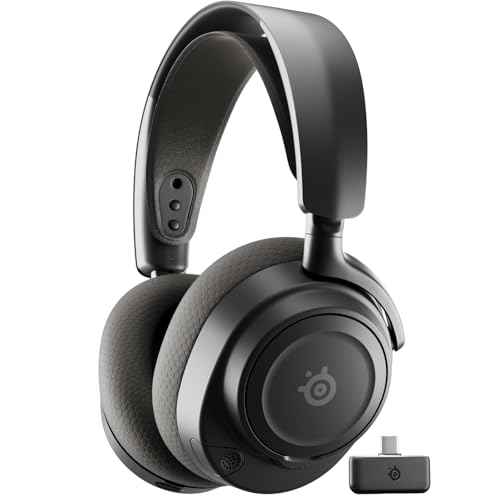
The SteelSeries Arctis Nova 7 Wireless Gen 2 is the value wireless pick, offering many flagship features at a more approachable level. Its headline feature is battery life: the second-generation model runs far longer than the original, so you can go days between charges even with heavy daily use. Fast charging over USB-C tops the battery up quickly when you do run low.
Simultaneous 2.4GHz and Bluetooth audio is the feature that makes this headset so practical. You can play a game on your PC while keeping a phone call or music stream open on Bluetooth, mixing the two sources without swapping headsets. The retractable microphone keeps the design clean when you are not in voice chat, and spatial audio support helps with directional awareness in shooters.
Sound quality is balanced and detailed, with a customizable equalizer in the companion software. Comfort is a strong point, with a lightweight frame and soft ear cushions that suit long sessions. Multi-platform compatibility covers PC, PlayStation, Switch, and mobile, making this a strong single-headset solution for players who game on several systems.
The Corsair HS80 MAX is the long-battery wireless pick, built for players who hate charging. Over a 2.4GHz connection it runs for days of play between charges, and over Bluetooth it lasts far longer still, so it is easy to forget the last time you plugged it in. That endurance makes it a natural fit for marathon sessions and for players who use one headset for gaming, work calls, and music.
Sound quality is detailed and well balanced, with Dolby Atmos support adding spacious surround sound on compatible platforms. The flip-up microphone is convenient: lift the boom to mute instantly, lower it to talk. The companion software provides equalizer controls for players who want to shape the sound.
Comfort comes from plush ear cushions and a padded headband that spreads weight evenly, while the wireless range reaches across a room so you can step away from the desk without losing audio. Multi-platform support covers PC, Mac, PlayStation, and mobile, and Bluetooth pairing makes it simple to switch to a phone. If battery life and everyday versatility matter more to you than flagship extras, this headset is hard to beat.
The HyperX Cloud III is the wired pick in this guide, for players who want great sound with no charging, no pairing, and no latency at all. Its angled 53mm drivers are tuned by HyperX audio engineers for clear game audio, with strong bass that gives explosions weight without drowning out dialogue or footsteps. DTS spatial audio support adds directional awareness for competitive play.
Comfort is where this headset has always stood out. Memory foam ear cushions and a padded headband make it easy to wear for hours, and the durable frame is built to survive daily use. The detachable microphone captures clear voice audio with noise cancellation, and you can remove it entirely when listening to music or watching videos.
Because it is wired, the Cloud III works with anything that has a standard headphone jack or USB port, covering PC, PlayStation, and Xbox without any setup. There is no software to install and no battery to manage: plug it in and play. For players who value simplicity, reliability, and strong sound over wireless convenience, it remains one of the best choices available.
Who Should Skip It
A dedicated gaming headset is not the right purchase for everyone. If you already own high-quality audiophile headphones and a separate desktop microphone, that combination will usually beat any gaming headset for music and voice quality. Competitive players who need the absolute lowest latency should also avoid Bluetooth-only headsets, since Bluetooth adds delay that can matter in fast shooters.
Players who mostly game on a single console should check compatibility carefully before buying a PC-first headset. Some headsets lose microphone features or surround sound on consoles, and Xbox wireless support in particular varies by model. If you only play on Xbox, a headset designed for Xbox wireless will serve you better than a general-purpose model.
Budget is another honest filter. A flagship wireless headset costs several times more than a good wired model, and the extra money buys convenience and features rather than a dramatic jump in sound quality. If you play casually a few hours a week, the wired HyperX Cloud III will cover your needs well, and the money saved can go toward games or other gear. Finally, players who dislike weight on their head or wear a headset for very long sessions should try before buying if possible, since comfort is personal and no specification can guarantee a perfect fit.
FAQ
Do I need a wireless gaming headset?
No. A wired headset delivers the same sound quality with no charging and no connection drops, and it usually costs less than a comparable wireless model. Wireless is worth it if you move around while playing or use the headset away from your desk. For competitive play, choose a 2.4GHz wireless model or a wired headset rather than Bluetooth alone, since Bluetooth can add noticeable delay.
What is the difference between a gaming headset and normal headphones?
A gaming headset includes a microphone designed for voice chat, while normal headphones usually do not. Gaming headsets also tend to emphasize directional sound and spatial audio, which helps you locate enemies and environmental sounds in games. Normal headphones can sound excellent for games too, but you will need a separate microphone for team chat, and they may lack the game-focused tuning and software features of a dedicated headset.
Are gaming headsets good for music and movies?
Yes, most modern gaming headsets sound good for music and movies, especially flagship models with Hi-Res audio support and wide frequency response. Wireless models with Bluetooth double as everyday headphones for commuting or calls. That said, a headset tuned for gaming may emphasize bass and footsteps over the neutral sound that music lovers prefer, so players who care mainly about music may prefer a wired model with a balanced tuning.
How long do wireless gaming headsets last on a charge?
Battery life varies widely by model and connection type. Most wireless gaming headsets in this guide run for at least a full day of heavy play over 2.4GHz, and many last several days between charges. Bluetooth connections usually stretch battery life further than 2.4GHz. Headsets with hot-swappable batteries effectively never need downtime, since you can swap in a fresh battery in seconds while the other one charges.
Final Verdict
The best gaming headset is the one that fits your platform, your play style, and your tolerance for charging. The SteelSeries Arctis Nova Pro Omni is the strongest all-around choice, combining Hi-Res wireless audio, active noise cancellation, and hot-swappable batteries in a package that works across PC, console, and mobile. Competitive players should choose the Razer BlackShark V2 HyperSpeed for its clear microphone and precise directional audio, while the Nova 7 Gen 2 and Corsair HS80 MAX offer the best balance of battery life, comfort, and multi-platform support for everyday players. If you prefer simplicity, the wired HyperX Cloud III delivers excellent sound with nothing to charge and nothing to configure.
Product and ASIN Reference
Product
ASIN
SteelSeries Arctis Nova Pro Omni
B0GS77JQLF
Razer BlackShark V2 HyperSpeed Wireless
B0CF3LHQSM
SteelSeries Arctis Nova 7 Wireless Gen 2
B0FRNR8Y11
Corsair HS80 MAX
B0D5Z1C5TB
HyperX Cloud III
B0C3BV19Q3
W
Wildshot Editorial Team
We compare specs, materials and verified owner reviews before a product earns a spot. Rankings are never paid.
Affiliate disclosure. As an Amazon Associate we earn from qualifying purchases at no extra cost to you. Prices accurate as of the date shown.
Find the best wire heat sets for clean wire splices and repairs. Compare heat shrink tubing kits by size, shrink ratio, seal, and piece count before you buy.
Find the best rear wheel bearing hub assembly for your car: rear-only picks for Honda, Acura, Ford Mustang, and Ford Focus with fitment and ABS details.
Find the best gaming desks for 3 monitors: the width, depth, weight capacity, and cable routing a triple-screen setup actually needs, plus a top pick built for three large screens.
Discover the best stationary bike workout setup: top indoor bikes, interval and endurance plans, and how to choose the right bike for home training today.

 SteelSeries Arctis Nova Pro Omni
 Razer BlackShark V2 HyperSpeed Wireless
 SteelSeries Arctis Nova 7 Wireless Gen 2
 Corsair HS80 MAX
 HyperX Cloud III