We independently review everything we recommend. When you buy through our links, we may earn a commission. As an Amazon Associate we earn from qualifying purchases.
4 Best 4 MOA Red Dot Sights for Fast Aiming (November 2026)
Four 4 MOA red dot sights compared by footprint, mount and battery: a 30 mm tube sight, a cantilever pick and two pistol reflex models with real specs.
Four 4 MOA red dot sights compared by footprint, mount and battery: a 30 mm tube sight, a cantilever pick and two pistol reflex models with real specs.
Choosing a 4 MOA red dot is really a decision about how much of the target the dot should cover and how the sight will attach to your gun. A 4 MOA dot spans roughly four inches at 100 yards and about one inch at 25 yards, so it stays easy to pick up at close range while still leaving most of a mid-range target visible. The harder part is that many models are sold in several dot sizes on one page, and footprints differ between brands, so the listing details matter more than the headline.
This roundup is for pistol shooters with optics-ready slides, rifle owners who want a mount included in the box, and anyone replacing a smaller dot that keeps getting lost against busy backgrounds. Every pick below was chosen because its Amazon listing names a 4 MOA dot in the title or product information, and the specifications quoted here come from those listings rather than from general product knowledge.
Quick Picks
As an Amazon Associate we earn from qualifying purchases.
Product
Best for
Key spec from title
Vortex StrikeFire II
Rifle shooters who want a red or green dot
4 MOA red/green dot, 30 mm tube
Ozark Armament Rhino
An absolute co-witness setup out of the box
4 MOA red/green dot, cantilever mount
Bushnell RXS-100
Optics-ready pistols with a DeltaPoint Pro cut
4 MOA dot, Weaver low mount included
UTG OP3 Micro
Slides milled for the RMR footprint
Red 4 MOA single dot, RMR footprint
How to Choose
Confirm the 4 MOA dot on the exact listing
Dot size is a variant, not a family trait. The same sight often appears in 2, 3, 4 and 6 MOA versions, and marketplace pages group those versions under one title with a style selector. Before ordering, check that the selected style and the product information table both state 4 MOA, because a product family name alone proves nothing. A true 4 MOA dot covers about 4.2 inches at 100 yards, 2.1 inches at 50 yards and roughly an inch at 25 yards, which is the coverage this whole category is built around.
Match the footprint or mount to your firearm
Micro reflex sights bolt straight to a slide cut, but the screw patterns are not interchangeable: RMR and DeltaPoint Pro footprints place their holes and recoil lugs differently, and an adapter plate adds height and another part that can loosen. Tube-style sights sidestep the question with a ring mount on a Picatinny rail, yet the mount height then decides your cheek weld and whether iron sights stay visible. Decide which mounting world your gun belongs to first, then compare dots inside that world instead of across both.
Read the battery type and runtime claim carefully
Listings quote runtime at a middle brightness setting, so a headline figure of 5,000 or 55,000 hours describes gentle use rather than a dot left on its brightest level. Battery format matters just as much: CR2032 cells are sold almost everywhere, while the CR2 used by some tube sights is less common in kitchen drawers. Loading direction is the third check. A cell that loads from the top or side can be swapped in seconds, while a bottom-loading cell means unbolting the optic and confirming zero again afterwards.
Count brightness settings and check the low end
Ten settings sound better than five until you learn how they are spaced. What decides daily usability is whether the lowest levels stay visible indoors without blooming and whether the top level holds up against bright sun on pale targets. Shooters who pair a sight with night-vision gear need the bottom one or two settings marked as compatible in the listing. Button size and placement also matter with gloves on, since tiny recessed controls that feel fine at a bench become fiddly on a cold range.
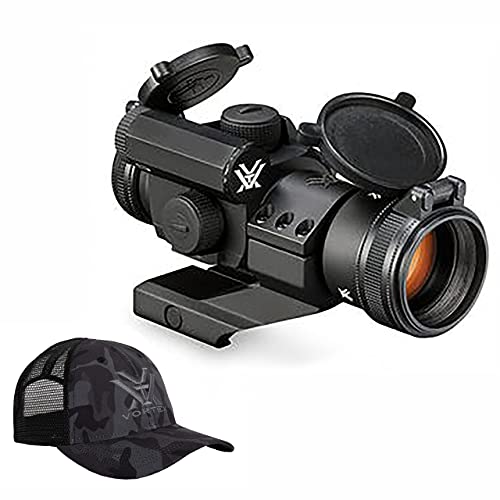
The StrikeFire II is the tube-style entry here, built around a 30 mm body and a selectable red or green 4 MOA dot, which gives shooters a genuine choice when one color washes out against grass or timber. Its cantilever ring mount comes in the box and sets the sight at a lower 1/3 co-witness height on flat-top rifles, so no separate mount purchase stands between delivery and the range. Ten brightness settings include two low levels suited to night-vision use, adjustments move in half-MOA clicks with generous travel, and the fully multi-coated lenses keep the window clear in flat light.
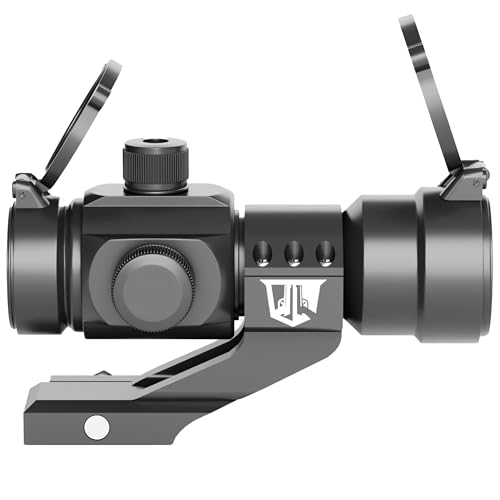
The Rhino takes the same cantilever idea and aims it at shooters who prefer an absolute co-witness, with the dot centered 1.41 inches above the rail so it lines up directly with standard iron sights. The 4 MOA dot switches between red and green, each color with five brightness levels, and the sealed, nitrogen-purged aluminum body shrugs off the weather that fogs lesser optics. Flip-up lens caps ride on the housing full time, the CR2032 cell is quoted at up to 3,000 hours on a medium setting, and at 9.7 ounces the whole unit stays reasonable on a lightweight build.
The RXS-100 is an open reflex sight shaped for optics-ready pistols, with a DeltaPoint Pro footprint that bolts directly to matching slide cuts and a Weaver-style low-rise mount in the box for railed guns. Its 4 MOA red dot runs through eight brightness settings, the top-loading CR2032 cell is credited with up to 5,000 hours at the middle setting, and a 12-hour automatic shutoff guards against a sight left glowing in a drawer. Clicks move in full MOA steps across a 100 MOA adjustment range, and at 1.3 ounces without its base the sight adds almost nothing to a carry gun.
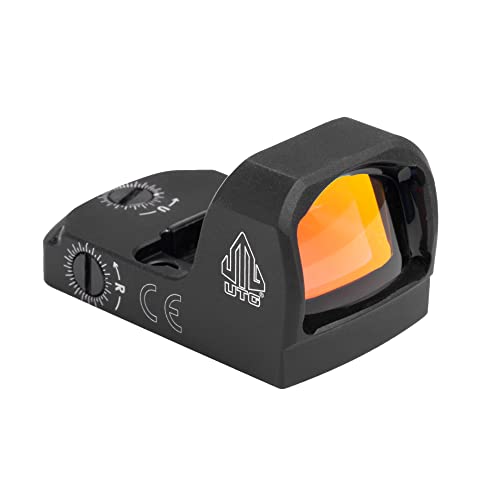
The OP3 Micro covers the other major slide cut: its base follows the RMR footprint, and a removable low-profile Picatinny mount is included for railed handguns and long guns. The red 4 MOA single dot comes with eight brightness settings, adjustments click in 1 MOA steps, and the housing is machined from 6061-T6 aluminum with a matte black anodized finish. Battery life is the headline figure here, with the CR2032 cell quoted beyond 55,000 hours at a middle brightness setting, helped by a magnetized compartment intended to keep the dot from flickering under recoil. The listing puts the sight itself at just 30 grams.
Which One Fits Your Situation
Your pistol slide is already milled for an optic
Start with the cut, not the brand. A DeltaPoint Pro pattern points to the Bushnell RXS-100, while an RMR pattern points to the UTG OP3 Micro, and choosing the matching footprint avoids adapter plates entirely. Both include a low rail mount as a fallback, so either sight can move to a carbine or a railed pistol later without extra parts.
You want a rifle sight that works the day it arrives
Pick one of the two cantilever models, since each ships with its mount fitted and needs only a rail and a zeroing session. The Vortex StrikeFire II suits lower 1/3 co-witness fans and anyone who wants red or green from one unit, while the Ozark Armament Rhino fits shooters who prefer the dot sitting exactly on the iron sight line.
Your gun spends months in a safe between outings
Runtime and shutoff behavior decide this one. The RXS-100 pairs a 5,000-hour middle-setting figure with a 12-hour automatic shutoff, so a forgotten sight wakes up still working. The OP3 Micro quotes far longer runtime but never switches itself off, which makes a habit of manual shutdown part of owning it. Tube sights with CR2 cells ask for a spare in the range bag instead.
You shoot in both dim barns and bright open fields
Brightness span matters more than the raw count of settings. The StrikeFire II spreads ten levels across the widest range here and adds a green dot that many shooters pick up faster against vegetation. The two pistol reflex sights stop at eight levels, still plenty for daylight, while the Rhino’s five levels per color are the simplest to cycle under time pressure.
Common Mistakes
Ordering from a grouped listing page without checking the style selector, then receiving the 2 MOA or 6 MOA version of the same model.
Assuming every micro reflex shares one footprint, when RMR and DeltaPoint Pro screw patterns and lug layouts are genuinely different.
Comparing battery figures across brands without noticing that every maker quotes runtime at a middle brightness setting.
Mounting a tube sight directly on a flat-top receiver with no riser or cantilever, leaving the dot too low for a natural cheek weld.
Ignoring total adjustment range, then running out of elevation travel on a canted base or an angled mounting surface.
Frequently Asked Questions
How much of the target does a 4 MOA dot actually cover?
Coverage grows in a straight line with distance: roughly one inch at 25 yards, two inches at 50 yards and just over four inches at 100 yards. That is why the size feels quick on close targets, where the dot sits inside the scoring area, yet still leaves most of a distant silhouette visible around its edges.
Is a 4 MOA dot too coarse for smaller targets at longer range?
It can be, depending on the target. On a small steel plate at 100 yards the dot may hide most of the plate, forcing you to hold by the dot’s edge rather than its center. Shooters who mostly engage small targets far away usually pick a finer dot, while mixed close and mid-range use is exactly where 4 MOA earns its place.
Can one of these pistol reflex sights also work on a rifle?
Yes, within limits. Both the RXS-100 and the OP3 Micro include a low Picatinny mount, so either can sit on a railed carbine, shotgun or rimfire rifle. Keep expectations matched to the design, though: open reflex windows gather dust and rain more readily than a sealed tube, and neither micro sight was built around heavy-recoiling long guns.
How long will the battery last if the sight stays switched on?
Manufacturers quote runtime at a middle brightness level, so real life depends on the setting you actually use. On those terms the figures here run from 3,000 hours for the Rhino to beyond 55,000 hours for the OP3 Micro. An automatic shutoff, fitted to the RXS-100, stretches a cell further by killing the dot after 12 idle hours.
W
Wildshot Editorial Team
We compare specs, materials and verified owner reviews before a product earns a spot. Rankings are never paid.
Affiliate disclosure. As an Amazon Associate we earn from qualifying purchases at no extra cost to you. Prices accurate as of the date shown.
The best mirrorless Micro Four Thirds cameras offer compact bodies, fast autofocus and a huge shared lens range. Compare four current OM SYSTEM and Lumix picks.
The best laptops for physics combine strong multi-core CPUs, ample RAM and sharp displays for simulation, coding and data analysis. Compare four top picks.
The best online sheet sets come down to fibre and weave. Four verified sets in bamboo, sateen and organic cotton compared, plus checks before you order.
Hotels with big bathtubs hide in suites, ryokan and spa resorts. How to tell a true soaking tub from a standard one, and how to verify before you book.
The best floor rugs for dogs are low-pile, non-slip and machine washable. Three verified picks compared by size, pile and backing for real dog households.
Looking for the best wireless cell phone chargers? Compare Qi2 15W magnetic pads, 3-in-1 stands and travel chargers for iPhone and Android before you buy.
Best Samsubg Galaxy S5 Battery Extenders compared: extended batteries and battery cases for the Galaxy S5, checked for capacity, bulk, fit and water resistance.
Find the best selling sound cards for gaming PC use, from budget PCIe 5.1 cards to high-resolution USB and premium internal models, with specs and fit guidance.


 UTG OP3 Micro Red Dot Sight