We independently review everything we recommend. When you buy through our links, we may earn a commission. As an Amazon Associate we earn from qualifying purchases.
Best Lighted Bike Helmet: Integrated LED Helmets for Safer Night Rides
The best lighted bike helmets: bicycle helmets with integrated front and rear LED lights, turn signals and certified protection, compared by listing specifications.
The best lighted bike helmets: bicycle helmets with integrated front and rear LED lights, turn signals and certified protection, compared by listing specifications.
As an Amazon Associate we earn from qualifying purchases.
Affiliate Disclosure: This article contains affiliate links to products on Amazon US. If you buy through those links, we may earn a commission from qualifying purchases at no additional cost to you. The helmets below were selected from manufacturer and retailer listing specifications — integrated lighting, certifications, battery life and fit — not from detailed research, and you should confirm the current specification and availability on the product page before buying.
A bike light on the handlebar points where the bike points. A light on your helmet points where you look — into the side street you are about to enter, at the driver waiting to turn across your path, at the pedestrian stepping off the kerb. That is the simple idea behind a lighted bike helmet, and it is why these helmets have become a serious option for commuters and night riders rather than a novelty.
There is a second advantage, and it matters just as much. A rear light on a helmet sits at the highest point of the rider, above the seat, above the rack bag, above the panniers that so often hide a seat-post light. Drivers behind you see it from further away, and they see it even when your bike’s own lights are partly blocked by luggage. Every helmet in this guide has integrated lighting — lights built into the helmet itself, front and rear — and none of them is a plain helmet with a clip-on light added as an afterthought. That distinction is the whole point of this guide: the lighting here is part of the helmet, charged with it, switched with it, and designed to be seen from every angle.
One warning belongs at the top. A lighted helmet is still a helmet first. No amount of LED brightness compensates for a helmet that does not fit, or for one whose safety certification you have not checked. Every pick below lists a recognised safety certification — CPSC in the United States, with European EN1078 and other standards also stated on several models — and you should check the certification label inside the helmet when it arrives, because a listing claim is not the same as the label in your hands.
What to Look For in a Lighted Helmet
Integrated lights, front and rear
The defining feature is built-in lighting at both ends: a white light at the front that helps you see and be seen, and a red light at the rear that marks you for following traffic. Some helmets add turn signals — amber lights at the rear that flash left or right when you press a button on a handlebar remote — and some add an automatic brake light that brightens when the helmet senses you slowing down. These are genuinely useful in traffic, because they let you signal without taking a hand off the bars, but they are extras, not essentials: the core requirement is a front and a rear light that you can switch on, leave on, and trust.
Battery life and charging
Integrated lights run on a rechargeable battery, and battery life decides whether the helmet is practical for your riding. The best helmets in this guide list up to ten hours of runtime, which covers a full working week of commuting on a single charge; cheaper models may not state a runtime at all, which means you should charge the helmet after every ride and treat the stated modes with caution. Charging is by USB cable on all the picks below, and a helmet that shares a charger with your phone is one less cable to carry. Watch for a practical detail: on some models the light is bright enough at full power that real-world runtime is shorter than the headline figure, so plan on charging more often than the listing suggests.
Certification and fit
A helmet’s job in a crash is to absorb impact, and certification is how you know it has been tested to do that. Look for CPSC certification for the United States market, and check the fit system: a dial adjuster at the back of the helmet, adjustable straps, and a size range that covers your head circumference. The picks below range from a single large size to multiple sizes with dial adjustment, and a helmet that is too loose is a helmet that will move in a crash, lights or no lights. Measure your head, compare it with the size the listing states, and try the helmet on with the lights switched on before your first ride — fit and function are both easier to judge at home than at a junction.
Weight and ventilation
Lights, batteries and electronics add weight, and a heavy helmet is a tiring helmet on a long ride. The picks below range from around 340 grams for the lightest smart helmet to just over 420 grams for the budget model with a visor — a difference you will feel on a long climb. Ventilation matters too: a helmet with too few vents will be hot in summer, and a helmet you leave at home because it is uncomfortable is a helmet that protects no one. The models here all list ventilation as part of their design, but the number and placement of vents varies, so read the listing carefully if you ride in hot weather.
The Picks
1. Lumos Ultra Smart Bike Helmet — the best all-round lighted helmet
Top Pick
1. Lumos Ultra Smart Bike Helmet — the best all-round lighted helmet
The Lumos Ultra is the pick for most riders because it does the whole job in one helmet. Its listing shows integrated front and rear LED lights, with a customizable front light and a rear panel of individual LEDs, plus turn signals operated by a wireless handlebar remote and automatic brake lights when paired with the separate Lumos Remote. The lights are controlled through the Lumos app, where you can adjust brightness and flashing patterns, and the helmet lists certification to CPSC, ASTM F1447 and CE EN1078 standards.
Battery life is listed at up to ten hours, which is the longest in this guide, and the helmet weighs around 340 grams according to maker descriptions — light for a helmet carrying this much electronics. The shell is a polycarbonate outer over EPS foam, and a MIPS liner is available on some versions of the Ultra, which is the slip-plane system designed to reduce rotational forces in certain impacts; check the exact version you order, because MIPS is not fitted to every Ultra variant. The trade-offs are real: the battery runs down faster at full brightness with frequent signalling, the app is part of the experience whether you want it or not, and the helmet costs more than a basic lighted helmet. For a commuter who rides in traffic every day and wants the most complete visibility system available, it is the strongest pick here.
2. Lumos Ultra E-Bike Smart Helmet — the pick for faster riding
Runner-Up
2. Lumos Ultra E-Bike Smart Helmet — the pick for faster riding
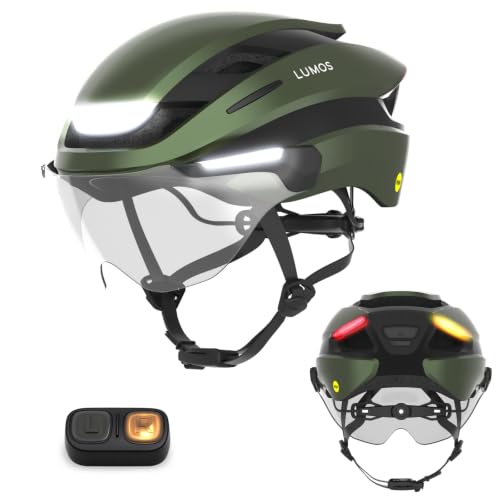
The Ultra E-Bike is the Ultra’s faster-riding sibling, and it is the pick if your rides are quicker — an electric bike, a fast commute, or a scooter. Its listing shows integrated front and rear LED lights, turn signals controlled by a wireless handlebar remote, a retractable face shield, and a battery life of up to ten hours, and it adds a certification the standard Ultra does not list: NTA 8776, the Dutch standard for electric bikes, alongside CPSC, ASTM F1447 and CE EN1078. That extra certification is the point of this model: it is designed and tested for the higher speeds and higher impact energies of e-bike riding.
The face shield is a practical addition for faster riding, keeping wind and debris out of your eyes without separate glasses, and the integrated lights give the same 360-degree visibility as the standard Ultra, with automatic brake lights when the helmet senses deceleration. The same trade-offs apply — charging, app setup, and a higher cost than a simple lighted helmet — and the e-bike certification only matters if you ride at e-bike speeds; on a slow pedal bike, the standard Ultra gives you the same lights for less. Choose the Ultra E-Bike if you ride an electric bike or a scooter, or if you simply want the broadest certification in this guide.
3. ILM E3-10L Adult Bike Helmet — the budget lighted helmet
3. ILM E3-10L Adult Bike Helmet — the budget lighted helmet
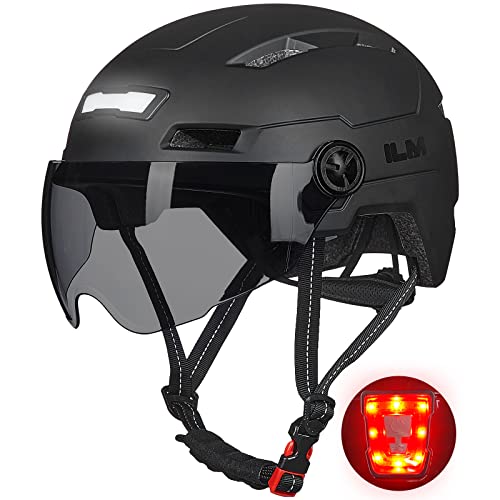
The ILM E3-10L is the pick for riders who want integrated front and rear lights without paying for turn signals, apps and smart features. Its listing shows USB-rechargeable front and rear lights with three lighting modes — steady, slow flash, and a running-light effect at the rear — plus a detachable tinted lens that blocks sun, dust and sand, and a washable mesh lining. The helmet lists certification to ASTM, CPSC, CE and EN1078, and its one-piece construction combines an EPS inner shell with a polycarbonate outer shell for shock absorption.
At a listed weight of 421 grams it is heavier than the Lumos helmets, and it gives up their turn signals and automatic brake lights entirely — this is a lighted helmet, not a smart helmet, and that is the honest trade. The listing also notes that the electronics cannot be guaranteed to work perfectly and asks buyers to contact the seller about any light problem, which is worth knowing before you buy. Battery runtime is not stated by ILM, so charge the helmet after every ride rather than guessing. The listed size is Large to Extra Large, so it is a focused choice for riders whose heads fit that range. Choose the E3-10L if your budget is tight, you want front and rear lights with a visor, and you do not need signalling features.
4. Anthsania Smart Bike Helmet — the customizable LED display
4. Anthsania Smart Bike Helmet — the customizable LED display
The Anthsania smart helmet is the pick for riders who want a lighted helmet with a difference: a customizable full-colour LED display at the rear, controlled by an app and a remote, that can show patterns and messages as well as plain light. Its listing shows integrated front and rear lighting with a personalized LED display, app and remote control, aimed at adult and teenage riders. For a commuter who rides in a group, or a rider who wants the brightest and most distinctive rear light in traffic, the display is a genuine visibility feature, not just decoration: a large, bright, moving pattern is harder for a driver to miss than a small steady dot.
The trade-off is the same as with any display helmet: the display is only as useful as its battery, and a helmet whose main feature is a screen will need charging more often than a helmet with simple steady lights. Fit and certification should be checked on the product page before buying, because the display is the headline and the safety details are the part that matters in a crash. Choose the Anthsania if you want the most visible rear light in this guide, you enjoy customizing your gear, and you are happy to charge the helmet regularly.
Side-by-Side Summary
Helmet
Lights
Turn signals
Certification listed
Battery listed
Lumos Ultra
Front and rear LEDs
Yes, handlebar remote
CPSC, ASTM F1447, CE EN1078
Up to 10 hours
Lumos Ultra E-Bike
Front and rear LEDs
Yes, handlebar remote
CPSC, NTA 8776, ASTM F1447, CE EN1078
Up to 10 hours
ILM E3-10L
Front and rear LEDs, 3 modes
No
ASTM, CPSC, CE, EN1078
Not stated
Anthsania Smart Helmet
Front and rear LEDs, customizable display
App and remote control
Check the product page
Check the product page
Using a Lighted Helmet Properly
A lighted helmet works best as part of a visibility system, not as a replacement for one. Keep your bike’s own front and rear lights fitted and switched on as well — two light sources at different heights are easier to judge in the dark than one, and a driver can tell your distance and speed more accurately from a pair of lights than from a single point. Use the flashing mode in daylight and at dusk, when a steady light can blend into shop signs and car headlights, and switch to steady at night, when a flashing light makes it harder for others to judge where you are. Charge the helmet after every ride if you use it daily: a helmet that runs out of power halfway home is worse than a plain helmet, because you trusted it and it let you down. And replace any helmet — lighted or not — after a crash, or after about five years of regular use, because the foam that absorbs an impact does its job once.
Frequently Asked Questions
Are lighted helmets legal to use on the road?
In most places, a lighted helmet is legal and welcome: it is an additional light, not a replacement for the lights your local law requires on the bike itself. Check your local rules for what the bike must carry — usually a white front light and a red rear light or reflector — and treat the helmet as an extra layer of visibility on top of that, not a substitute for it.
Do I still need lights on my bike if my helmet has lights?
Yes. A helmet light points where you look, which means it sweeps across the road when you turn your head, and a driver may read that movement as a signal to turn. Your bike’s lights point where the bike is going, steadily and predictably. Use both, and you are visible from more angles and easier to understand in traffic.
How do I choose between the Lumos Ultra and the Ultra E-Bike?
Choose by speed. The standard Ultra covers ordinary pedal commuting with front and rear lights, turn signals and the same ten-hour battery. The Ultra E-Bike adds NTA 8776 certification for electric bikes and a retractable face shield, and it is the right pick if you ride an electric bike, a scooter, or any ride where you regularly travel at e-bike speeds. On a slow pedal bike, the standard Ultra gives you the same lighting system.
What if the lights stop working?
On the ILM E3-10L, the listing itself notes that the electronics cannot be guaranteed to work perfectly and directs buyers to the seller for problems — a reminder that a lighted helmet has more to go wrong than a plain one. On any of these helmets, if a light fails, treat the helmet as a plain helmet and use your bike lights until the helmet is repaired or replaced. Never ride in the dark trusting a light you have not checked: switch the lights on before you leave, every time.
The Bottom Line
The best lighted bike helmet is the one that is certified, fits your head, and has lights you will actually switch on every ride. The Lumos Ultra is the strongest all-round pick here: front and rear LEDs, turn signals, a long battery and solid certification. The Lumos Ultra E-Bike is the pick for faster riding, with e-bike certification and a face shield. The ILM E3-10L is the budget way into integrated lighting, with front and rear lights and a visor and no smart features to pay for. The Anthsania smart helmet is the most distinctive rear light in the group, for riders who want a customizable display. Whichever you choose, check the certification label inside the helmet when it arrives, measure your head against the size the listing states, and confirm the current specification and availability on the product page before buying.
W
Wildshot Editorial Team
We compare specs, materials and verified owner reviews before a product earns a spot. Rankings are never paid.
Affiliate disclosure. As an Amazon Associate we earn from qualifying purchases at no extra cost to you. Prices accurate as of the date shown.
The best replacement batteries for the Canon 5D Mark III use the LP-E6 pack: the genuine Canon LP-E6 plus Wasabi Power, BM Premium, and STK options, with capacity, voltage, and third-party warnings explained.
A fit-first guide to the best bikes for a small lady: 24-inch and 20-inch wheel options, low step-through frames, low standover, and the height ranges each bike is made for.
The second guide in this series on beach riding: cruiser bikes with wide tyres, low step-through frames, and corrosion-aware care for sand, boardwalk, and packed beach paths.
The best bikes for a delivery job: sturdy hybrid and city bikes with cargo racks, wide gearing and durable frames for daily courier routes, compared by listing specifications.
Compare the best thermostat for boiler systems, from WiFi smart models with geofencing to a hydronic heating specialist, plus wiring and scheduling tips.
Compare the best light projectors for bedrooms and parties, from aurora and nebula star lamps to astronaut designs with speakers, timers and remotes here.
Looking for the best resin storage sheds? Compare compact 4x6 sheds, vertical cabinets and roomy 8x10 walk-ins for tools, bikes and mowers before you buy.
Five night shift watches with tritium tubes, LumiBrite, Indiglo and LED light. Compare dials built for dark wards, patrols, warehouses and night driving.


 2. Lumos Ultra E-Bike Smart Helmet — the pick for faster riding
 3. ILM E3-10L Adult Bike Helmet — the budget lighted helmet
 4. Anthsania Smart Bike Helmet — the customizable LED display