We independently review everything we recommend. When you buy through our links, we may earn a commission. As an Amazon Associate we earn from qualifying purchases.
Best Rechargeable OTC Hearing Aids for Workplace Conversations
Discover the best rechargeable OTC hearing aids for workplace conversations, with clear speech, noise reduction, battery life and Bluetooth calls for offices.
Discover the best rechargeable OTC hearing aids for workplace conversations, with clear speech, noise reduction, battery life and Bluetooth calls for offices.
The best rechargeable OTC hearing aids for workplace conversations are the devices that keep voices clear in meetings, on calls, and across an open office, without running out of power before the working day ends. Workplace listening is different from listening at home. You need to follow a colleague speaking softly across a desk, catch a question from the far end of a meeting room, and hear a video call over keyboard noise and air conditioning.
This guide focuses on rechargeable over-the-counter hearing aids sold on Amazon US that are suited to that kind of day. Every pick below is a rechargeable OTC hearing aid, not a prescription device and not a disposable-battery model. The quick answer is straightforward: start with the ELEHEAR Beyond Pro for its long per-charge run time, app control, and speech-focused sound. The Lexie B2 Plus Powered by Bose is a strong supported alternative, the ELEHEAR Beyond is a useful lower-cost companion in the same family, and the Jabra Enhance Select 300 suits people who want remote professional support.
Workplace conversations reward speech clarity more than sheer volume. Directional microphones, noise reduction, and feedback control help a voice stand out from office background sound. A comfortable, discreet fit matters because you may wear the aids for eight hours or more. Reliable Bluetooth helps with video calls, and a charging case that holds extra charges means you are not tied to a desk socket.
Before you buy, remember what OTC hearing aids are for. They are intended for adults who perceive mild to moderate hearing loss. They are not a substitute for a hearing assessment, and they are not intended for severe hearing loss or for sudden changes in hearing. If you have pain, discharge, dizziness, ringing that is new or one-sided, or a sudden change in hearing, speak to a hearing professional or a clinician before relying on an OTC device.
Look for at least 16 to 18 hours per charge, and treat 20 hours or more as a comfortable margin. A charging case that holds extra full charges adds resilience on travel days and long shifts. Check how the case charges, how long a quick top-up gives you, and whether the aids turn on automatically when you take them out. The picks in this guide range from up to 18 hours to over 24 hours per charge, so you can match the device to the length of your day.
Speech Clarity in Meetings and Group Discussions
Volume alone does not make a meeting easier to follow. Speech clarity depends on how the device separates voices from background sound, handles reverberation in a large room, and preserves the high-frequency detail that distinguishes similar consonants. Look for speech-focused processing, directional microphones, and modes for quiet and noisy settings. A small meeting room is very different from a large conference room, so the best workplace devices adapt between those settings, either automatically or through a simple app control.
Noise Reduction for Open Offices
Open offices combine keyboards, printers, ventilation, distant conversations, and footsteps. Good noise reduction should lower that steady background sound while keeping the voice in front of you clear, without making voices sound muffled or artificial. Look for noise reduction, environmental adaptation, and feedback control, and check whether the app lets you adjust how much background sound is reduced. No OTC hearing aid can remove all office noise. The goal is a clearer balance, so the speaker stands out while you still hear a fire alarm and a colleague calling your name.
Bluetooth for Calls and Video Meetings
With Bluetooth streaming, a phone call or video meeting can go directly to your ears, which often makes speech easier to follow than listening through a laptop speaker in a noisy room. Hands-free calling, where available, means you can take a call without holding a phone to your ear. Check compatibility with your phone, whether calls and media both stream, and whether the device supports the Bluetooth version your phone uses. Many rechargeable OTC aids use an app for volume, program changes, and a hearing check, which is an advantage if you like fine control and a drawback if you prefer simple physical controls.
Fit, Comfort, and Discretion
You may wear these devices for a full working day, so fit is not a minor detail. Receiver-in-canal designs sit behind the ear with a small wire to a speaker in the ear canal, and they are common here because they can be discreet and comfortable. Look for a range of dome sizes in the box, a lightweight design, and a fit that stays secure when you move, turn your head, or wear a headset. Discretion matters to many workplace users, but comfort matters more over a long day. Check the return and trial terms before you buy, and try different domes during your first week.
App Control and Self-Fitting
Self-fitting OTC hearing aids use an app-based hearing check or guided setup to tailor the sound to your hearing profile. That gives you a personal starting point without a clinic visit. Look for a clear setup process, easy volume and program controls, and the ability to save different settings for quiet and noisy environments. Some devices also offer support from hearing experts or remote audiology sessions. A powerful app is useful only if you will actually use it. If you prefer a simple device, choose one with clear on-device controls and a small number of programs.
Charging, Cases, and Everyday Practicality
Rechargeable convenience is one of the main reasons people choose OTC hearing aids for work. There are no small disposable batteries to change, and the charging case doubles as storage and protection. Check whether the case charges wirelessly or by cable, how many extra charges it holds, and how long a full charge takes. A case that is easy to carry in a bag is more useful than a bulky desktop charger if you move between meeting rooms. Also check what is included: domes, wax guards, a cleaning brush, and a charging cable.
The Best Rechargeable OTC Hearing Aids for Workplace Conversations Reviewed
The ELEHEAR Beyond Pro is the strongest all-round workplace pick here because it combines long battery life, speech-focused processing, and flexible Bluetooth and app control in a rechargeable receiver-in-canal design. It is an OTC hearing aid for adults with perceived mild to moderate hearing loss, with a maximum gain of up to 50 dB stated in the listing.
Battery life is up to 20 hours on a single charge, and the charging case provides four additional full charges. A 15-minute fast charge gives up to 6 hours of use, a practical fallback before an afternoon meeting. For workplace conversations, the headline feature is VocClear 2.0, ELEHEAR’s speech processing system, described as designed to deliver clearer speech with enhanced high-frequency detail up to 8500 Hz and ultra-low latency of 8 ms. Bluetooth 5.3 supports streaming from compatible iOS and Android devices, and the app allows program and volume adjustments. The device includes feedback reduction and noise cancellation, and the aids turn on and off automatically when taken out of or placed back into the case.
Partial fit to note: the Beyond Pro is an app-led device, so people who want the simplest possible controls may find the setup more involved than a one-button aid. The charging case is larger than a pocket-sized case, so it is best carried in a bag.
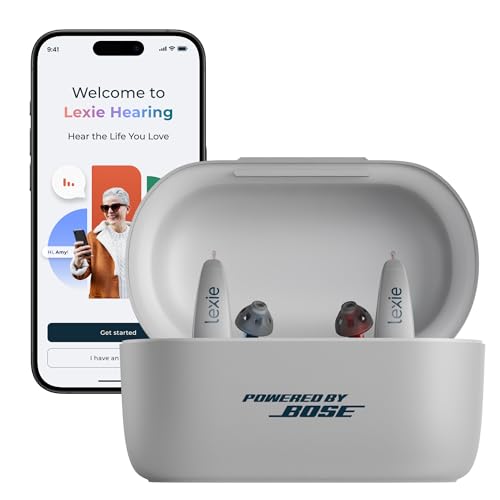
The Lexie B2 Plus Powered by Bose is a self-fitting rechargeable OTC hearing aid with Bose sound technology and an in-app hearing check that tailors settings to your hearing profile. It is designed for adults with perceived mild to moderate hearing loss, with on-demand support from Lexie Experts and a trial period stated on the listing.
Battery life is up to 18 hours per charge, with a wireless charging case that provides an additional charge for use on the go. That is slightly shorter than the ELEHEAR picks here, so it suits a standard working day with overnight charging. Charging the aids takes around 3 hours, and charging the case takes around 3 hours. The in-app hearing check analyses your hearing profile and recommends settings, and the app allows adjustments to volume, treble, bass, and environment settings. Noise reduction is included, and Bluetooth supports calls and streaming, so phone calls and video meetings can go directly to the aids.
Partial fit to note: Bluetooth streaming is focused on calls, and some descriptions note that streaming is primarily for iOS devices, so Android users should check the current listing for call and media streaming compatibility before buying. Battery life of up to 18 hours is shorter than the other picks, so people with long days should plan for a case top-up.
The ELEHEAR Beyond is the value pick in the ELEHEAR range, offering much of the same workplace logic as the Beyond Pro in a simpler package: rechargeable power, AI speech enhancement, Bluetooth 5.3, and app control. It is an OTC hearing aid for adults with perceived mild to moderate hearing loss, with a maximum gain of up to 50 dB and noise attenuation of 24 dB stated in the listing.
Battery life is up to 20 hours on a single charge, with up to 100 hours of total run time when the charging case is included. A 15-minute charge gives up to 6 hours of use. AI-powered speech enhancement is the central workplace feature, described as designed to improve speech clarity and support tinnitus masking, with connectivity to iOS and Android devices via Bluetooth 5.3. The app allows adjustments and program changes, so you can adapt the sound for a quiet desk, a meeting room, or a noisier shared space.
Partial fit to note: the Beyond is a step below the Beyond Pro in speech-processing detail, so it may be less suited to very challenging listening environments such as large, echoing meeting rooms. App control is still part of the experience, so people who prefer a device with no phone setup may find it less simple than a basic one-button aid.
The Jabra Enhance Select 300 is the most support-led pick in this guide. It is a rechargeable receiver-in-canal OTC hearing aid for adults with perceived mild to moderate hearing loss, built on Jabra Enhance technology with remote audiology support. That support is the main reason to choose it for work: instead of relying only on an app-based self-fit, you can access professional guidance to fine-tune the sound for the voices and rooms you find hardest.
Battery life is over 24 hours per charge, the longest per-charge figure in this guide. The portable charger carries three full charges, so total run time away from a socket is generous for travel and conferences. Bluetooth audio streaming works with compatible Apple and Android phones, supporting calls, music, and media. The device offers automatic sound adjustments, directional sound handling, and built-in noise reduction, including an environmental optimiser that adapts to different settings.
Partial fit to note: the Select 300 is a more involved purchase than a simple self-fit aid, because its full value depends on using the remote support and app together. People who want a quick, set-and-forget device may find the setup process longer. The portable charger is also larger than a basic case, so it is best carried in a bag.
Confirm that the product is described as a rechargeable OTC hearing aid, not a personal sound amplifier or a prescription device. Check the seller, the return and trial terms, and what is included in the box. Match the device to your working day and compare battery life per charge and case capacity. Check fit early by trying the different dome sizes, and check phone compatibility, because Bluetooth streaming and app control depend on your phone model. Start in quieter settings, then move to meetings as you become comfortable with volume and program controls. If hearing changes suddenly, or if you have pain or other symptoms, seek professional advice rather than increasing the volume.
FAQ
Are rechargeable OTC hearing aids suitable for workplace conversations?
Yes, for adults who perceive mild to moderate hearing loss. Many models are well suited to workplace conversations because they focus on speech clarity, noise reduction, and Bluetooth calls. They work best when the main challenge is following voices in meetings, on calls, and in open offices. They are not intended for severe hearing loss, and they do not replace a hearing assessment. If you are unsure whether your hearing loss is mild to moderate, a hearing professional can help you decide whether an OTC device is appropriate.
How long should the battery last on a working day?
Look for at least 16 to 18 hours per charge, with 20 hours or more giving a comfortable margin for a full working day plus a commute. The picks here range from up to 18 hours for the Lexie B2 Plus, to up to 20 hours for the ELEHEAR Beyond and Beyond Pro, to over 24 hours for the Jabra Enhance Select 300. A charging case that holds extra charges adds further margin, especially on travel days.
Do OTC hearing aids help in noisy open offices?
OTC hearing aids with noise reduction and directional microphones can help voices stand out from steady office background sound, such as ventilation, keyboards, and distant conversation. They reduce background sound while preserving speech, and allow you to adjust programs for quiet and noisy settings. They cannot remove all background sound, and they work best with practical steps such as sitting closer to the speaker and using Bluetooth for calls where possible.
Can I use Bluetooth hearing aids for video meetings and phone calls?
Yes, many rechargeable OTC hearing aids support Bluetooth streaming for calls and media from compatible phones, which can make video meetings easier to follow than listening through a speaker. Check the listing for your phone model, whether calls and media both stream, and whether hands-free calling is supported. The ELEHEAR models here use Bluetooth 5.3, the Lexie B2 Plus supports Bluetooth calls and streaming, and the Jabra Enhance Select 300 supports Bluetooth streaming for compatible Apple and Android devices.
What is the difference between an OTC hearing aid and a personal sound amplifier?
An OTC hearing aid is a regulated device intended for adults with perceived mild to moderate hearing loss, with self-fitting features and safety and labelling requirements. A personal sound amplifier is a different kind of product, intended to amplify environmental sound for people without hearing loss, and it is not a substitute for a hearing aid. When you shop on Amazon, check that the listing describes the product as an OTC hearing aid, not only as an amplifier, and confirm that it is rechargeable.
Bottom Line
The best rechargeable OTC hearing aids for workplace conversations last a full working day, keep speech clear in meetings, reduce office background sound, and make Bluetooth calls easy to follow. The ELEHEAR Beyond Pro is the best overall pick for its 20-hour battery life, four extra case charges, VocClear 2.0 speech processing, and Bluetooth 5.3 app control. The Lexie B2 Plus Powered by Bose is the best supported alternative, with Bose sound and up to 18 hours per charge. The ELEHEAR Beyond offers similar battery life at a simpler level, while the Jabra Enhance Select 300 offers over 24 hours per charge plus remote professional support. Choose based on your working day: prioritise battery life for long days, Bluetooth for video calls, and remote support if you want guidance while you adjust.
Disclosure: As an Amazon Associate, we may earn from qualifying purchases.
W
Wildshot Editorial Team
We compare specs, materials and verified owner reviews before a product earns a spot. Rankings are never paid.
Affiliate disclosure. As an Amazon Associate we earn from qualifying purchases at no extra cost to you. Prices accurate as of the date shown.
Compare the best narrow frame rollator walkers for tight doorways and small spaces, with widths, weight limits, seat sizes, wheels and folding compared.
Our eufy video doorbell s4 review 2026 covers the 3K panoramic camera, radar detection, OmniTrack AI tracking, local storage and wired setup in this guide.
Find the best bike tyre levers for road, gravel and mountain bikes. Compare plastic, steel-core and stainless sets, spoke hooks and rim-safe picks today.
Looking for the best 750 sports bike 2? Compare true 750cc sport motorcycles and close 650 to 776cc alternatives, with specs, fit and dealer buying advice.
Searching for the best 120mm full suspension bike 2? We compare three full-suspension mountain bikes on Amazon and flag where each one meets the 120mm mark.
Find the best SUV replacement battery for your vehicle. Compare group sizes, CCA, reserve capacity, and AGM vs flooded options in this guide before you buy.
Searching for the best battery operated RC truck? Compare five tough 4WD trucks on speed, runtime, scale, and durability to find the right one for you.
Best battery life vs best performance explained: how the tradeoff works, which mode fits your day, and how to pick the right device without any regret.


 ELEHEAR Beyond
 Jabra Enhance Select 300