We independently review everything we recommend. When you buy through our links, we may earn a commission. As an Amazon Associate we earn from qualifying purchases.
Best Window Fans for Homes
Find the best window fans for homes with reversible airflow, thermostats, and quiet twin-blade designs that cool bedrooms and living rooms well every day.
Find the best window fans for homes with reversible airflow, thermostats, and quiet twin-blade designs that cool bedrooms and living rooms well every day.
A good window fan can change how a home feels on a warm evening. Instead of pushing the same stale air around a room, it pulls cooler outdoor air inside or pushes hot, stuffy air outside. Used well, it can freshen a bedroom before sleep, clear cooking smells from a kitchen, and help a living room feel comfortable without running air conditioning all day. The best window fans for homes fit the window, move air in the direction you need, run quietly enough for a bedroom, and offer controls that are easy to reach.
OUR TOP PICK
Bionaire BW2300-N Twin Window Fan with Reversible Airflow
Choosing the right model starts with the window itself. A fan that is too wide will not seat properly, and one that is too narrow will leave gaps that let hot air leak back inside. Blade size, speed settings, reversible airflow, a thermostat, a remote, and expandable panels all matter in different ways depending on the room. This guide compares four window fans based on specifications, features, and user feedback.
Disclosure: As an Amazon Associate, we earn from qualifying purchases.
Measure the width and height of the window opening. Most twin fans here fit windows between about 23 and 37 inches wide, but the exact range varies by model. Check the minimum and maximum width before ordering, and allow for sash thickness and handles that stick out.
2. Choose reversible airflow
In intake mode, the fan draws cooler outdoor air inside. In exhaust mode, it pushes warm, stale air outside. In exchange mode, one blade draws air in while the other pushes air out. This helps most in the evening, when outdoor air cools down, and after cooking. Electronic reversing is more convenient than manual reversing.
3. Match blade size and speed settings to the room
Most home window fans use twin blades around 8.5 to 9 inches across, a size that suits bedrooms, kitchens, and living rooms. Three speeds give a useful range from a gentle breeze to a stronger flow. Look for a low speed quiet enough for sleep and a high speed that clears a room quickly.
4. Consider noise, especially for bedrooms
A fan that sounds fine in a living room can feel loud in a quiet bedroom. User feedback often notes whether a fan is quiet on low speed or noisy on high speed. A quiet low speed is worth seeking for a bedroom, and a fan seated firmly with gaps sealed tends to vibrate less.
5. Look for a thermostat
A programmable thermostat lets the fan turn on and off based on room temperature, without constant adjustment. This helps overnight, when temperatures fall, and during the day, when a room warms in the sun. A clear LED display makes the setting easy to see from across the room.
6. Check controls, remote, and installation
A remote allows speed, direction, and power changes without walking to the window. Simple dials are also easy to use, but they require reaching the fan. Look for a model that needs no assembly and includes feet or legs for tabletop use. Check whether the fan fits double-hung, vertical slider, casement, or sliding windows.
7. Think about sealing, screens, and weather
A window fan works best when air moves through the fan, not around it. Accordion panels and locking expanders help seal the opening. A removable bug screen keeps insects outside, and a fabric cover protects the fan when it is not in use. No standard window fan should be left running in heavy rain.
Top Picks
Bionaire BW2300-N Twin Window Fan with Reversible Airflow
Top Pick
Bionaire BW2300-N Twin Window Fan with Reversible Airflow
Best for: Bedrooms and living rooms where a thermostat, remote, and quiet operation matter most.
The Bionaire BW2300-N is built around convenience and temperature control. It uses two 8.5-inch blades with independent controls, three speeds, a programmable thermostat, an LED display with a dimmer, and a remote control. The listing states that it fits windows from 24 to 36 inches wide, suits double-hung, vertical slider, and casement windows, needs no assembly, and carries a 3-year limited warranty. The unit measures 4 inches deep by 24 inches wide by 12.8 inches high, with a listed noise level of 30 dB. User feedback highlights the remote, quiet operation on lower settings, and strong airflow for bedrooms and living rooms.
Pros:
– Programmable thermostat with LED display and dimmer
– Remote control plus button controls
– Reversible twin blades with independent controls
Cons:
– Temperature reading can differ from elsewhere in the room
– Display stays visible at night unless dimmed
– Only fits horizontally in larger windows
Comfort Zone CZ310R Twin Window Fan with Remote Control
Runner-Up
Comfort Zone CZ310R Twin Window Fan with Remote Control
Best for: Homes that want one fan to handle intake, exhaust, and circulation across several rooms.
The Comfort Zone CZ310R offers three airflow modes in one unit. It uses two 9-inch blades, three speeds, and a 3-in-1 design with cooling, exhaust, and circulate functions. Cooling brings fresh air inside, exhaust removes stale air, and circulate runs the blades in opposite directions. The listing states 70 watts at 120 volts, with airflow listed at 8.40 feet per second, and a remote that adjusts speed, function, direction, and power. The expanders adjust from 23.5 to 37 inches and lock to secure the fan. It installs horizontally or vertically, and includes feet for tabletop use, a removable bug screen, and a fabric cover. User feedback often praises the remote and flexible modes.
Pros:
– Three functions: cooling, exhaust, and circulate
– Remote control for speed, function, and power
– Wide fit from 23.5 to 37 inches
– Bug screen and fabric cover included
Cons:
– Accordion expanders can feel flimsy if handled roughly
– Noise increases noticeably on the highest speed
– Plastic construction feels lighter than metal-bodied fans
Genesis A1WINDOWFAN Twin Window Fan with Thermostat
Genesis A1WINDOWFAN Twin Window Fan with Thermostat
Best for: Living rooms and bedrooms that need strong air exchange and temperature-based control without a remote.
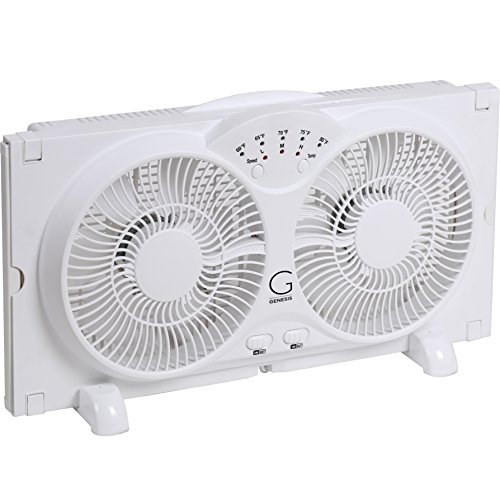
The Genesis A1WINDOWFAN focuses on strong airflow and simple temperature control. It uses two 9-inch fans, each with its own copper motor, with three speeds and reversible airflow. The adjustable thermostat works with Max Cool technology and LED lights, allowing a target between 60 and 80 degrees Fahrenheit in five-degree steps. The listing describes it as ETL certified, 12 by 4 by 24 inches, and 8.4 pounds. Expandable panels fit windows up to 37 inches wide, and removable legs allow freestanding use. Each head can be set to intake or exhaust on its own. Secondary listings give airflow of about 706 CFM and power of 30 watts. User feedback often mentions the strong breeze and clear LED indicators.
Pros:
– Two independent copper motors for intake and exhaust
– Adjustable thermostat, 60 to 80 degrees Fahrenheit, with Max Cool
– Three speeds with twin 9-inch blades
Cons:
– No remote control, so settings change at the fan
– Noise on higher speeds, and thermostat can read a few degrees warm
– No bug screen is listed
Amazon Basics WDF9-1 Twin Window Fan
Amazon Basics WDF9-1 Twin Window Fan
Best for: Smaller rooms and buyers who want a simple, manual twin window fan without extra controls.
The Amazon Basics WDF9-1 is a straightforward twin window fan for smaller rooms, with simple manual controls and no extra features to learn. It uses two 9-inch blades, three speeds, manual control, and reversible airflow with an exhaust mode. The listing describes a 63-watt unit with expandable panels that fit windows from 25 to 32 inches wide. The compact design moves easily between rooms, and the manual dial keeps operation simple: choose a speed, choose intake or exhaust, and let the fan run. It works well as a bedroom fan on a mild evening or a spare fan for a guest room or home office. User feedback often highlights ease of use and steady airflow for the size.
Pros:
– Simple manual controls with three speeds
– Twin 9-inch blades in a compact design
– Expandable panels fit windows from 25 to 32 inches
Cons:
– No remote control, thermostat, or digital display
– Narrower fit range than the other picks
– Manual reversing is less convenient than electronic reversing
Comparison Table
Feature
Bionaire BW2300-N
Comfort Zone CZ310R
Genesis A1WINDOWFAN
Amazon Basics WDF9-1
Blade size
Twin 8.5-inch
Twin 9-inch
Twin 9-inch
Twin 9-inch
Speeds
3
3
3
3
Reversible airflow
Yes, electronic
Yes, 3 functions
Yes, independent
Yes, manual
Thermostat
Programmable, LED display
Not listed
Adjustable, 60 to 80 degrees Fahrenheit
Not listed
Remote
Yes
Yes
No
No
Window fit
24 to 36 inches
23.5 to 37 inches
Up to 37 inches
25 to 32 inches
Power
Not stated here
70 watts, 120 volts
30 watts in secondary listings
63 watts
Extras
3-year warranty, no assembly
Bug screen, cover, feet
ETL certified, Max Cool, legs
Manual dial, panels
Buying Guide
Start with the room and the window, not with the feature list. A bedroom benefits from a quiet low speed, a dimmable display, and a remote or thermostat. A kitchen benefits from strong exhaust and a fan that can be removed and cleaned easily. A living room benefits from a wider fit and a circulate mode. A home office benefits from a fan quiet enough for calls.
Measure twice. Record the width and height of the opening, note the window type, and check for handles or locks that might interfere with the fan. Compare those numbers with the fit range on the listing. If the window is near the edge of a range, choose a model with more adjustment room. After installation, seal gaps with the included panels and, if needed, foam strips or weatherstripping.
Think about airflow through the whole home, not just one room. A window fan works best when air has a path in and a path out. Opening a window on the shaded side while running a fan in exhaust mode on the sunny side can create a cross-breeze. In the evening, intake mode brings cooler air inside. After cooking, exhaust mode clears heat and smells faster.
Avoid common mistakes. Do not choose a fan by blade size alone, because controls, fit, and noise matter just as much. Do not leave large gaps unsealed, run a fan in heavy rain, or expect it to replace air conditioning on the hottest days. Do not block the fan with curtains, furniture, or a closed interior door.
Maintenance is simple but worth doing. Clean the blades and grilles regularly, because dust can reduce airflow and increase noise. Check the panels and seals at the start of each warm season, and replace worn foam or weatherstripping. Store the fan with its cover on when it is not in use. If a fan develops a rattle, check that it is seated firmly and that the panels are locked.
Frequently Asked Questions
Are window fans good for homes without air conditioning?
Yes, window fans can help by bringing cooler outdoor air inside in the evening and pushing hot air outside during the day. They work best when outdoor air is cooler than indoor air and the fan is sealed well. On very hot days, a fan alone may not keep a room cool, but it can still improve ventilation.
Should a window fan blow air in or out?
It depends on the time of day. Intake mode is useful in the evening and early morning when outdoor air is cool. Exhaust mode is useful after cooking or when a room feels hot and stuffy. Exchange mode is useful when only one window is available.
What size window fan do I need?
Measure the width of the window opening and compare it with the fit range on the listing. Most twin fans here fit windows from about 23 to 37 inches wide. Blade size is usually 8.5 to 9 inches. A larger room may benefit from stronger airflow, while a smaller room may do well with a compact manual model.
Are twin window fans noisy?
Noise varies by model and speed. Many twin fans are quiet on low speed and louder on high speed. User feedback often notes whether a fan suits a bedroom. A low speed or dimmable display is a safer choice for light sleepers, and seating the fan firmly can reduce vibration.
Can I leave a window fan in the window all season?
Many homes leave a window fan installed through the warm season, especially if it has a cover and a bug screen. Keep the fan dry, and remove it during heavy rain if the window is exposed. At the end of the season, clean the fan and store it in a dry place.
Do window fans need a remote or thermostat?
No, a remote or thermostat is not required, but both add convenience. A remote allows changes from bed or across a living room. A thermostat turns the fan on and off based on temperature, which is useful overnight. A simple manual fan can work well in a smaller room.
Conclusion
The best window fans for homes balance fit, airflow direction, noise, and controls. For most homes, the Bionaire BW2300-N is a strong first choice, with a programmable thermostat, a remote, reversible twin blades, and a fit range that suits many bedrooms and living rooms. The Comfort Zone CZ310R is best for flexibility, with three functions, a remote, and a wide fit. The Genesis A1WINDOWFAN is best for strong air exchange, with independent copper motors and a thermostat. The Amazon Basics WDF9-1 is the best simple pick for smaller rooms.
Before ordering, measure the window and check the fit range. A fan that fits well, seals properly, and offers the right controls will do more for comfort than a larger or louder model that leaves gaps around the frame. Install it firmly, seal the edges, and use intake in the cool evening and exhaust after cooking.
W
Wildshot Editorial Team
We compare specs, materials and verified owner reviews before a product earns a spot. Rankings are never paid.
Affiliate disclosure. As an Amazon Associate we earn from qualifying purchases at no extra cost to you. Prices accurate as of the date shown.
Looking for the best vegan mattresses? Compare four Amazon-listed, wool-free mattresses by materials, firmness, thickness, trial, and warranty before you buy.
Find the best lightweight soft and absorbent bath towels for daily showers. Compare plush Turkish cotton sets that dry fast and stay soft wash after wash.
Searching for the best inexpensive garbage disposals? Compare five budget continuous-feed models on power, size, mounting, noise, and warranty before you buy.
Searching for the best blankets for Florida? Compare lightweight, breathable bamboo, cotton, and cooling blankets made for warm, humid nights all year round.
Four thorn proof gardening gloves compared on hide, gauntlet length and palm reinforcement, for pruning roses, clearing blackberries and handling cactus.
Discover the best floor keyboard rugs for classrooms, playrooms, and home offices, with expert tips on size, material, durability, and keyboard designs.
Discover the best butts humping pillows for laughs and cozy lounging, with soft novelty designs, sizes, covers, and tips for choosing a fun gag gift today.
Searching for the best alarm clocks Plutech fans ask about? Compare Plumeet and similar bedside clocks with dimmers, loud alarms, snooze, and USB charging.


 Amazon Basics WDF9-1 Twin Window Fan