Our Short List of 3

All 3 Picks at a Glance
| Product | Specs | Action |
|---|---|---|
 1. Honeywell Home RTH6360D — Best Balanced Value for Most Homes | Check price on Amazon | |
 2. Honeywell Home RTH221B — Best Simple Value, No C-Wire Needed | Check price on Amazon | |
| 4. Emerson Sensi Wi-Fi Smart Thermostat (1F87U-42WF) — Best Value for Scheduling Depth | Check price on Amazon |
Key takeaways
- Find the best value digital thermostat with programmable and smart picks compared on scheduling, HVAC compatibility, C-wire needs, and ease of use, explained in plain qualitative terms.
As an Amazon Associate we earn from qualifying purchases.
Affiliate Disclosure: This article contains affiliate links. If you buy through a link on this page, we may earn a commission at no additional cost to you. Product specifications are taken from the manufacturer and retailer listings cited for each pick, and we have not personally tested these thermostats.
Value in a thermostat is not about chasing the cheapest box on the shelf. A thermostat controls the single largest energy load in most homes, it is used every day, and a poor one wastes money twice: once in the energy it fails to save through weak scheduling, and again when it has to be replaced early because it never suited the house. A genuinely good value digital thermostat does the opposite. It matches your heating and cooling system correctly, it makes a sensible schedule easy to set and easy to keep, it reads temperature accurately, and it keeps working for years without demanding attention. This guide compares four digital thermostats that approach that value equation from different directions, from the simplest battery-powered programmable models to an app-controlled smart option, so you can pick the level of control your household will actually use.
Throughout this guide, value is described in qualitative terms: what you get for the class of thermostat you are choosing, how much complexity it adds, and how well its features line up with real heating and cooling bills. The most expensive thermostat is poor value in a small apartment with a simple furnace, and the simplest thermostat is poor value in a large house where nobody is home on a predictable weekday schedule. Matching the tool to the house is the whole exercise.
Quick Picks
- Best balanced value for most homes: Honeywell Home RTH6360D Programmable Thermostat
- Best simple value with no wiring complications: Honeywell Home RTH221B Programmable Thermostat
- Best smart value for Alexa households: Amazon Smart Thermostat
- Best value for app control with strong scheduling: Emerson Sensi Wi-Fi Smart Thermostat (1F87U-42WF)
What Makes a Digital Thermostat Good Value?
Four things decide whether a thermostat earns its place on the wall. The first is compatibility: a thermostat that cannot control your system correctly has no value at any level. The second is scheduling, because the energy a programmable thermostat saves comes almost entirely from setbacks, cooler while you sleep or are out in winter and warmer while you are away in summer, and a schedule that is tedious to program gets abandoned. The third is sensing and control quality, including whether it can learn how long your home takes to reach a target. The fourth is total ownership effort: batteries, wiring requirements, and app accounts.
The Picks
1. Honeywell Home RTH6360D — Best Balanced Value for Most Homes
The Honeywell Home RTH6360D, model RTH6360D1002, sits in the sweet spot of this roundup for a typical house with a conventional furnace and air conditioner or a heat pump. Its listing describes a programmable digital thermostat with a 5-2 day schedule format, a large backlit digital display, push-button controls, and Smart Response technology. The 5-2 format means one program for the five weekdays and a separate program for the two weekend days, which matches the rhythm of most working households without the tedium of programming seven individual days. The listing gives its dimensions as 5.36 inches wide, 3.86 inches high, and 1.08 inches deep, lists a 24-volt control application, and includes the thermostat with its mounting system and install guide in the box.
Smart Response is the feature that lifts this model above basic timers. Rather than simply switching the system on at the time on the schedule, it learns how long your home takes to heat or cool and starts recovery early, so the target temperature is reached at the scheduled time. In daily life that is the difference between waking to a house that is already warm and waking to a house that has only just begun to warm up, and it is achieved without any network connection, account, or subscription. The listing describes compatibility with conventional systems up to two stages of heat and two stages of cool, and heat pump systems up to two stages of heat and one stage of cool, which covers a large share of North American homes. It can also be run with a flexible schedule arrangement rather than a fixed 5-2 pattern, as described in its documentation.
The value case is straightforward. You get a capable schedule, recovery learning, a clear display that is easy to read across a hallway, and controls a guest or a less technical household member can operate without instructions, all in a non-connected device that asks for nothing after installation. Choose it if your system falls within its stated staging limits and you want set-and-forget programming. Skip it if you need remote control from a phone, if your system is a millivolt or line-voltage setup, or if your household schedule varies so much day by day that a 5-2 pattern will always be wrong; one of the app-based picks below fits that life better.
2. Honeywell Home RTH221B — Best Simple Value, No C-Wire Needed
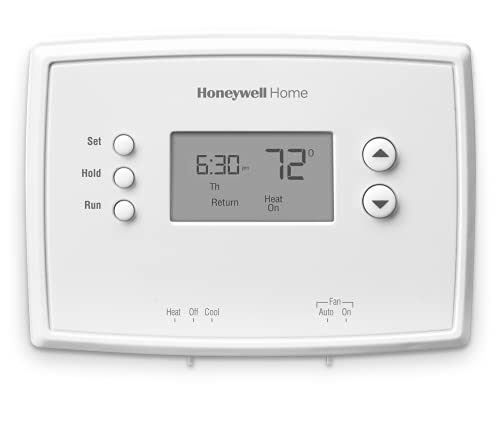
The Honeywell Home RTH221B, model RTH221B1039, is the simplest thermostat in this guide and, for the right home, the best value in it. It is a 1-week programmable digital thermostat: one schedule, with four periods a day commonly described as wake, leave, return, and sleep, repeated every day of the week. It runs on batteries rather than on power from the heating system, which means it does not need a common wire, and that single fact removes the most common obstacle in thermostat replacement. The documentation describes it for standard low-voltage systems, including single-stage heating and cooling and single-stage heat pumps without auxiliary heat, and its display shows the setpoint and room temperature in a simple digital format.
That simplicity is a feature, not a compromise. Where the same people keep the same routine every day, a 1-week program captures nearly all of the available setback savings. In a rental property or small home, a battery-powered thermostat that any occupant can understand in a minute has lasting value, and it suits anyone who does not want a connected device on the wall: no Wi-Fi, no app, no account, and nothing to reconfigure when a router changes.
Choose the RTH221B if your system is a straightforward single-stage setup, your routine is consistent across the week, and you value an installation that is essentially a like-for-like swap. Skip it if your weekdays and weekends differ sharply, if you have a multistage system or a heat pump with auxiliary heat that needs a thermostat designed to manage it, or if adjusting the temperature from elsewhere in the house or away from home is something you know you will use. Value here means paying only for control you will genuinely exercise, and for many homes this model defines that line well.
3. Amazon Smart Thermostat — Best Smart Value for Alexa Households
ASIN: B09F1RH8C5
The Amazon Smart Thermostat, model S6ED3R, brings app control and voice control into this comparison at the value end of the smart category. It is a Wi-Fi programmable thermostat built with Honeywell Home thermostat technology, according to Amazon, and it is ENERGY STAR certified. Its published dimensions are 3.56 inches square and 0.84 inches deep, with a clean digital display showing the temperature in a large format, touch controls for raising and lowering the setpoint and changing mode on the device itself, and full scheduling through the Alexa app, where up to four time periods per day can be configured for each day of the week. Amazon describes it as compatible with most 24-volt HVAC systems, including forced air, heat pumps, and radiant boiler systems, and not compatible with line-voltage systems such as electric baseboard heating.
Its distinctive value feature is automation through Alexa. Routines can tie temperature changes to times, to other devices, and to household patterns, and the Hunches feature can adjust the thermostat automatically when Alexa infers that everyone is asleep or that nobody is home. For a household already using Alexa, that integration costs no extra effort and can recover setback savings that a manual schedule loses whenever plans change. Control through the Ring app is also described by Amazon alongside the Alexa app.
The trade-offs are equally clear. This thermostat requires a C-wire to power it, and where no C-wire exists a separate power adapter kit is the described solution, so check your existing wiring before you order. It works within the Alexa ecosystem rather than across every smart home platform, and it does not support remote room sensors of its own, so a house with one badly placed thermostat location will not gain the multi-room sensing that some premium systems offer. Choose it if you already live in the Alexa ecosystem, have or can add a C-wire, and want scheduling, remote control, and automatic adjustments without moving into premium smart thermostat territory. Skip it if your home uses a different voice platform as its center, if your wiring cannot support it, or if you prefer a thermostat that keeps working entirely on its own when the internet does not.
4. Emerson Sensi Wi-Fi Smart Thermostat (1F87U-42WF) — Best Value for Scheduling Depth
The Emerson Sensi, model 1F87U-42WF in its pro version listing, is the pick for a household that wants smart control with an emphasis on scheduling and broad platform support rather than on a single ecosystem. The listing describes a Wi-Fi smart thermostat with a digital display and button controls, ENERGY STAR certification, a seven-day flexible schedule, remote control through the free Sensi app, and features including geofencing, which adjusts temperature based on the location of a phone so the house can begin returning to comfort as someone heads home. The listing describes compatibility with Amazon Alexa, Apple HomeKit with a C-wire, and other smart home platforms of its period, which makes it a flexible choice in a mixed-device household.
The Sensi design philosophy is part of its value. The unit looks and operates like a conventional thermostat on the wall, with physical controls that remain intuitive for anyone in the house, while the app carries the deeper scheduling and reporting. It can be used at three levels, simple on-device adjustment, a programmed schedule, or full app and voice control, and each level works without forcing the others. The listing describes guided installation through the app with step-by-step instructions.
Choose the Sensi if you want seven-day scheduling, geofencing, and app control without committing your home to one voice assistant, and if your system and wiring match the listing’s requirements, including a C-wire where the listing specifies one. Skip it if a basic programmable model already covers your routine, because unused smart features are not value, or if your household would rather have the deeper Alexa routine integration of the Amazon model above. As with every smart pick, confirm the current app and platform support described on the listing at the time you buy, since smart home integrations evolve over a product’s life.
Compatibility: Check This Before You Compare Features
More thermostat returns are caused by wiring and system mismatches than by any dislike of features, so work through these checks before choosing a pick. First, identify your system: conventional furnace with air conditioning, heat pump with or without auxiliary heat, boiler, or something less common such as millivolt wall heating or line-voltage electric baseboards. None of the thermostats in this guide is intended for line-voltage baseboard systems, and those homes need a thermostat designed specifically for that duty.
Second, count your stages. A single-stage system is either fully on or fully off, while multistage systems run at more than one output level. The RTH221B is described for single-stage applications, the RTH6360D covers a broader range of conventional and heat pump staging, and the smart models publish their own compatibility lists. Match the thermostat to the staging you actually have.
Third, look at your wires. Remove the old thermostat’s cover, with power to the system switched off, and photograph the wire labels before disconnecting anything. The presence or absence of a wire on the C terminal decides whether a smart thermostat can be installed directly or needs an adapter kit, and it is far better to learn that from a photograph than from a half-finished installation. If your system has no usable wire labels, or the wiring does not match the diagrams in the new thermostat’s guide, that is the point to call an HVAC technician rather than to experiment; control wiring mistakes can damage equipment that costs far more than any thermostat.
How Scheduling Turns Into Savings
A programmable thermostat saves energy only when its schedule reflects real life, so set it up honestly. In heating season, the classic pattern is a comfortable temperature for the morning and evening hours at home, a setback while the house is empty during the day, and a deeper setback overnight. Cooling season mirrors it: let the house drift warmer while empty and overnight within a range your household tolerates, and recover in time for waking and returning. The exact temperatures are a household decision, but the structure matters more than any single degree: long, consistent setback periods save more than short, aggressive ones that the system must immediately undo.
Heat pump owners should be more conservative with setbacks. Many heat pump systems call on auxiliary electric heat to recover quickly from a deep setback, and that auxiliary heat is an expensive way to warm a house, which can erase the saving the setback created. A thermostat with a recovery feature that ramps temperature gradually, or modest setbacks held for long periods, usually serves a heat pump better than dramatic overnight drops. Check whether your chosen thermostat and your heat pump’s control settings handle recovery in a way that limits auxiliary heat use.
Finally, review the schedule twice a year, at the change between heating and cooling seasons, because schedules drift out of date as jobs, school terms, and household members change.
Installation Notes
For the battery-powered and conventional programmable models, installation is typically a matter of switching off power to the HVAC system, labeling and moving the wires to the matching terminals on the new base, mounting the new unit level on the wall, and walking through the system-type settings in the installer setup menu. That last step is the one people rush and the one that matters most: telling a thermostat it controls a heat pump when it actually controls a conventional furnace, or the reverse, produces exactly the strange behavior that gives programmable thermostats a bad name. Enter the system type, staging, and fan settings exactly as the guide directs for your equipment.
For the smart models, add the network steps: install the manufacturer’s app, connect the thermostat to your home Wi-Fi, and confirm remote control works before you consider the job finished. If the old thermostat contains a mercury switch, recycle it through a proper collection program rather than household trash.
Frequently Asked Questions
Do I need a C-wire for a digital thermostat?
Not always. Battery-powered programmable models such as the RTH221B run without one, and the RTH6360D is likewise designed around battery and system power arrangements described in its documentation. Wi-Fi smart thermostats generally do need a C-wire or an adapter kit, because their radios and displays draw continuous power. Check the specific requirement on the listing for the model you choose.
What is the difference between 5-2, 5-1-1, and 7-day programming?
A 5-2 thermostat uses one program for weekdays and one for the weekend. A 5-1-1 design separates Saturday and Sunday. A 7-day thermostat allows a different program for every day. More flexibility is only valuable if your routine actually varies that much; a consistent household gains nothing from 7-day programming over a 5-2 schedule.
Can one of these thermostats control electric baseboard heaters?
No. Baseboard systems are line-voltage applications and need thermostats rated and listed for that use. None of the picks in this guide should be installed on a line-voltage system.
Conclusion
The best value digital thermostat is the one whose schedule you will keep, on the system you actually have, with the least ongoing effort. For most homes that is the Honeywell Home RTH6360D, whose 5-2 programming and Smart Response recovery cover the daily pattern of a working household without any network dependency. For the simplest single-stage homes, the battery-powered Honeywell Home RTH221B delivers genuine setback savings with the easiest installation in this guide. Households invested in Alexa can step up to the Amazon Smart Thermostat for app control, routines, and automatic adjustments, while the Emerson Sensi suits those who want seven-day scheduling, geofencing, and wider platform support. Check your system type, staging, and C-wire situation first, verify the current listing details when you order, and any of these four can be a durable, worthwhile upgrade over a manual thermostat.