Key takeaways
- The best men's road bike saddle relieves perineal pressure and matches your sit-bone width. Two verified picks compared for road position and long miles.
Ask a room of male road riders about saddles and the same complaint surfaces within a minute: numbness. Not soreness, which is a fitness problem that solves itself, but the dead, pins-and-needles feeling that arrives forty minutes into a ride and the worry that follows it home. The cause is anatomical. When a rider rolls forward into a road position, weight shifts off the sit bones and onto the perineum, the soft tissue between them, and a saddle that supports that tissue badly compresses nerves and blood flow. The modern men’s road bike saddle exists to solve exactly this, with cut-outs, channels and widths matched to male anatomy, and the good news is that the shapes work at accessible prices as well as at the premium end.

This guide explains how men’s saddle design works, how to measure yourself before buying, and compares two verified saddles, a padded channel design and an oversized comfort platform for upright road positions, then explains how to shop the third approach, the full cut-out, without being caught by a shifting listing.
Disclosure: As an Amazon Associate, this site may earn from qualifying purchases made through links in this article, at no additional cost to you.
Why men’s saddles are shaped the way they are
Three design tools do the work. The first is the relief channel, a groove down the saddle’s centre that reduces pressure on soft tissue while keeping the shell’s structure. The second is the full cut-out, which removes the centre entirely and suits riders whose numbness persists with a channel. The third is width: the rear of the saddle must be wide enough that your sit bones, not the tissue between them, carry your weight when you sit upright, while the nose stays narrow enough not to chafe your thighs when you rotate forward.
Padding philosophy splits the market. Firm saddles hold you on top of the shell and suit experienced riders with strong positions. Soft, deep padding feels kind in the shop and on short rides, and suits newer riders and upright positions, though very powerful riders sometimes find it vague under hard efforts. Neither is wrong; matching the padding to your position and mileage is the skill.
Measure before you buy. Sit on foil or corrugated cardboard placed on a carpeted step, feet raised slightly to mimic your riding posture, then measure centre to centre between the two impressions. That is your sit-bone width. For an aggressive road position choose a saddle a little wider than the measurement; for an endurance or upright position, wider still. Most men land between roughly 110 and 140 mm of sit-bone width, which is why road saddles cluster between 130 and 155 mm of shell width, with comfort designs going beyond.
The cut-out answer to numbness: how to shop it
The full cut-out attacks the most common male complaint directly. Its defining feature is a central opening through the shell, which removes material from exactly the zone that compresses the perineum in a forward road position, supported by a shaped, firmer foam platform that keeps your sit bones located rather than sinking. For riders whose current saddle leaves them numb at the hour mark, this is the design language to try first. No single model is carried as the pick for this slot here, deliberately: listings in this niche revise variants and specifications under one page more often than the premium brands do, so a named pick would age badly. Shop the design, not a name, using the checks in this section and the fit section below.
The firmer platform also changes how the saddle behaves under power. Where deep gel saddles can feel like they absorb your effort on climbs, a structured cut-out shell gives a planted base to push against, which suits riders doing intervals, group rides and longer endurance days on drop-bar bikes. The trade is adaptation: a cut-out saddle concentrates load on the sit bones by design, and the first week can feel like sitting on a railing if your position is off. Set it level, resist the urge to tilt it nose-down, which slides you forward onto your hands, and judge it after three rides, not one.
As with every saddle at this end of the market, confirm the live listing shows the cut-out variant and the width you measured for, because sellers in this segment revise specifications under a single listing more often than the premium brands do.
Bikeroo saddle: padded channel comfort
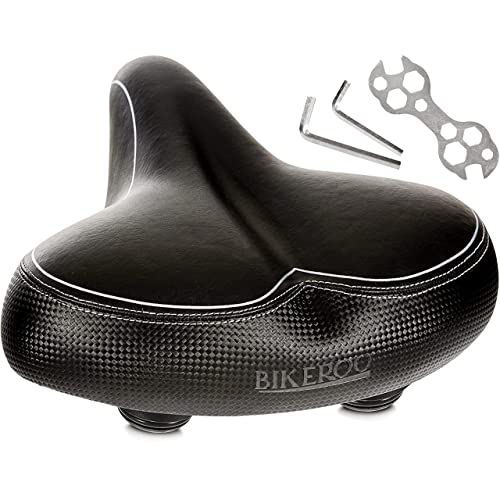
The Bikeroo saddle (ASIN B07B646ZZY) is the channel counterpart to a full cut-out. It keeps a continuous shell but carves a deep relief channel along its centre, then adds the two things newer and heavier riders tend to ask for: thick padding across a wide rear platform, and spring or elastomer suspension elements under the back of the saddle that take the edge off rough road surfaces.
For men whose problem is sit-bone soreness and general discomfort rather than numbness, this is usually the better first move. The channel still unloads the centre, the padding forgives imperfect shorts and imperfect roads, and the wide rear genuinely supports an endurance position where you sit more upright than a racer. Bikeroo’s shape has become a default recommendation in this class because it asks so little of the rider: fit it level, ride, and the complaints mostly stop.
Its limits are the mirror of its strengths. The wide nose can brush the inner thigh during high-cadence efforts, the padding adds weight, and riders who spend long periods in a low, aggressive tuck will find the platform behind them rather than under them. Match it to endurance, fitness and commuting road bikes and it is in its element.
CDYWD oversized saddle: when upright is the position
The CDYWD oversized saddle (ASIN B0BFXMW9Z5) serves the growing share of men’s road riding that happens sitting up: flat-bar road bikes, endurance builds with raised bars, e-road bikes and riders returning to cycling with backs that vote against the drops. Its rear platform is the widest here, its padding the deepest, and the short overall profile keeps the nose out of the way of a seated, spinning style.
The honest caveat for this category, stated plainly: on a traditional drop-bar bike ridden low and forward, a saddle this broad can crowd the back of the pedal stroke and feel like it is in the way when you stand. In its intended upright role it does the opposite, spreading load so broadly that sit-bone pressure stops being the story of the ride. Verify the exact variant, width and spring configuration on the live listing before ordering, as oversized saddle pages commonly group several versions together.
Fit checks that save you a second purchase
Most saddle misery is setup, not product. Work through this order before blaming any saddle. Height: a saddle set too high rocks your pelvis and loads one side, then the other; set it so the knee keeps a soft bend with the pedal at its lowest. Tilt: start level; a degree of nose-down tilt can relieve perineal pressure for some men, but more than a touch dumps weight onto your hands and wrists. Setback: your sit bones should rest on the wide rear of the saddle with your hands on the hoods, not hover over the middle. If you are perching on the nose, move the saddle forward on its rails.
Then give the combination time. Sit bones adapt over two to three weeks of regular riding. Soreness that shrinks ride by ride is adaptation; numbness that arrives earlier each ride, or any numbness that lingers off the bike, is a fit problem to solve promptly with position changes, a different saddle shape, or a professional fit, in that order.
Shorts, contact points and the saddle as a system
A saddle is one of three contact points, and men troubleshooting discomfort should audit the other two before spending twice. Padded shorts do real work in this system: a quality chamois positions its padding over the sit bones and reduces friction, and it pairs best with saddles at the firmer end of this guide. Riders on the deep-padded Bikeroo or CDYWD often find a thinner liner short more comfortable than a thick touring short, because two deep layers of foam can shift against each other. One combination at a time, tested over a full-length ride, tells you more than any chart.
Gloves and bars matter more than riders expect. Weight that should rest on your sit bones migrates forward when your reach is too long or your bars too low, and it arrives at the perineum and the hands simultaneously, which is why numb hands and a numb saddle region so often arrive together. If both complain, suspect position before product: a shorter stem, a few degrees of bar rotation, or spacers under the stem can return your weight to the wide part of the saddle where every design in this guide intends it to be.
When to step past this class
These saddles cover the great majority of men’s road riding, but three signals say the answer lies elsewhere. Persistent numbness after a cut-out saddle, a level setup and three weeks of adaptation deserves a professional bike fit and, if it continues, a medical conversation; saddles are not the tool for every problem. Riders chasing racing positions with large saddle-to-bar drop need the long, narrow, firm shells of the performance market, where width is chosen for a rotated pelvis rather than an upright one. And riders logging very high weekly mileage will simply wear this class out, covers and foam first, on a timescale that makes the mid-range’s better materials the cheaper long-term purchase. None of that diminishes the picks here. For endurance, fitness and commuting miles, they solve the problem most men actually have, which is a stock saddle shaped for a photograph rather than a pelvis.
Finally, keep records. A phone photograph of your saddle’s tilt and rail position, plus a note of the setup that worked, turns every future saddle swap, rental bike or workshop visit into a five-minute job instead of a fresh experiment. Fit knowledge compounds like fitness does, and the riders who suffer least are rarely the ones with the most expensive saddles; they are the ones who know their numbers.
Verdict
Men whose headline problem is numbness should start with a full cut-out design, shopped with the checks above. Men whose problem is soreness and general comfort on endurance miles should start with the padded, channelled Bikeroo. Men riding upright road positions who want maximum width should choose the CDYWD oversized saddle and confirm its variant carefully. All three are verified listings at the accessible end of the market, and all three will outperform the narrow, unpadded seat most road bikes ship with, provided you measure your sit bones first and set the saddle up level.