We independently review everything we recommend. When you buy through our links, we may earn a commission. As an Amazon Associate we earn from qualifying purchases.
3 Best Walk Behind Blowers for Yards (November 2026)
Compare the best walk behind leaf blowers for big lawns and driveways, covering airflow, wheels, aiming controls, and what arrives in the box.
Compare the best walk behind leaf blowers for big lawns and driveways, covering airflow, wheels, aiming controls, and what arrives in the box.
The real decision with a walk behind blower is not whether it moves leaves, because any wheeled machine in this class moves far more air than a handheld unit. The decision is whether its airflow, wheel sizes, and aiming controls match the ground you actually clear, week after week, without turning every turn at a bed edge into a wrestling match.
OUR TOP PICK
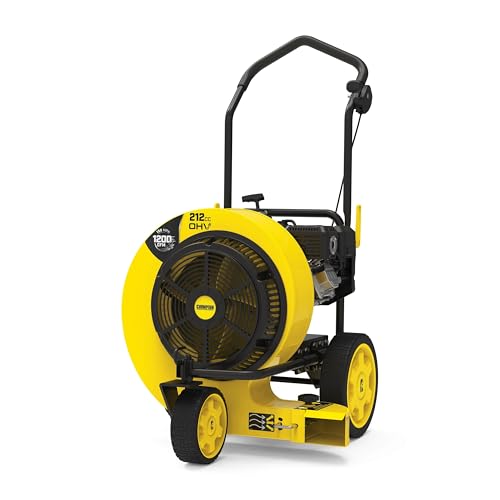
Champion Power Equipment 212cc Walk-Behind Leaf Blower
This guide serves owners of large lawns, long driveways, and small commercial lots who are done carrying that power on their arms or back, and who clear the same open ground often enough that setup, storage, and refuelling routines matter too. Every pick below is a wheeled, push-style blower chosen from the names, engine sizes, and specifications printed on its Amazon product page, with no handheld or backpack models mixed in.
Quick Picks
As an Amazon Associate we earn from qualifying purchases
Product
Best for
Key spec from title
Champion Power Equipment 212cc Walk-Behind Leaf Blower
Straight, long driveway and lawn runs
1200 CFM
Landworks Leaf Blower Wheeled Walk Behind Jet Sweep
Buyers who want a stated metal impeller
150 MPH / 1270 CFM at 3600RPM
SuperHandy Walk Behind Leaf Blower
Large rear wheels for open, uneven turf
150 MPH / 1270 CFM at 3600RPM
How to Choose
Air volume and air speed, read together
Air volume, measured in CFM, is what rolls an established pile of leaves forward across open ground, while air speed, measured in MPH, is what breaks a damp mat loose from wet grass in the first place. A listing that shouts one figure and hides the other leaves you guessing about half the job. The three machines here cluster closely, stating between 1200 and 1270 CFM alongside 150 MPH in their titles, so the honest comparison is not a huge power gap. Instead, look at how each machine aims and sustains that air, because control, rather than a small spec difference, decides how many passes a big lawn needs.
How the air stream is aimed
A walk behind blower earns its keep when you can change the direction and angle of the blast without stopping, bending down, and wrestling a chute by hand. Side discharge suits long passes along a lawn, pushing leaves into a windrow ahead of you. Forward discharge helps when you reach the end of a driveway and need to push the pile onward instead of sideways into a bed. Look for a vane or flow control with clear positions, and check whether the adjustment lives at the handle or down at the housing, because that placement changes how often you will actually bother to use it during a long cleanup.
Wheels, weight, and the ground you cross
These are heavy machines that you push, so wheel sizes matter more than they first appear to. Larger rear wheels roll more easily over turf, acorns, and the lip where a driveway meets the lawn, while a smaller swivel front wheel makes the machine nimble but can dig in on soft ground. A front wheel that can lock straight is genuinely useful on long, flat runs, where a free caster tends to wander. Also plan for the weight off the lawn: loading a machine of this size into a truck bed or up a shed ramp is usually a two-person job, so measure your storage route before ordering.
What arrives in the box and what does not
Small print decides whether a new blower starts on the first weekend or waits in the garage. Some listings include engine oil and a funnel, while others state plainly that oil is not included and must be added before the first start. Fuel type matters too: these four-stroke engines run on straight unleaded gasoline, so there is no oil-and-fuel mixing, but the tank size sets how often you stop on a large property. Finally, read the warranty line on the listing itself rather than assuming dealer support, because walk behind blowers are often sold through channels where the listing, not a local shop, is your first point of contact.
The 3 Best Options
Champion Power Equipment 212cc Walk-Behind Leaf Blower
Top Pick
Champion Power Equipment 212cc Walk-Behind Leaf Blower
Best for: Long, straight driveway and lawn runs where a lockable front wheel keeps the machine tracking true.
Long, straight driveway and lawn runs where a lockable front wheel keeps the machine tracking true.
Watch out for
Its stated air volume is the lowest of the three picks, and no impeller size or material is stated on the listing, so confirm both points matter less than wheel control for your ground.
The Champion suits owners whose clearing is mostly long, straight work: a driveway that runs to the road, a parking apron, or a broad lawn cleared in parallel passes. Its front wheel can swivel for turning or lock facing forward, which keeps the machine tracking straight instead of drifting on those runs. A three-position wind vane and a forward flow attachment let you switch between side and front discharge, and the handle adjusts for height, then folds over the engine for storage. Among these picks, it is the most deliberately set up for paved surfaces and tidy, repeated routes.
Watch out for: Its stated air volume is the lowest of the three picks, and no impeller size or material is stated on the listing, so confirm both points matter less than wheel control for your ground.
Landworks Leaf Blower Wheeled Walk Behind Jet Sweep
Runner-Up
Landworks Leaf Blower Wheeled Walk Behind Jet Sweep
Best for: Detail-focused buyers who want a stated metal impeller and a stated power output figure.
Detail-focused buyers who want a stated metal impeller and a stated power output figure.
Watch out for
Engine oil is not included and must be added before the first start, and the listing gives a wider airflow range in its feature bullets than in its title, so check which figures the seller confirms.
The Landworks Jet Sweep fits buyers who read the mechanical details closely and want them stated rather than implied. It is the only pick here whose listing names a metal impeller and gives a maximum power output figure, which appeals if sticks and grit regularly pass through the housing along with the leaves. Its flow angle adjusts through a wide range, so you can lift the stream over a pile or drive it down into a matted layer. The trade-off is rolling gear: its rear wheels are the smallest in this group, so it asks a little more of you on rough or rutted turf.
Watch out for: Engine oil is not included and must be added before the first start, and the listing gives a wider airflow range in its feature bullets than in its title, so check which figures the seller confirms.
SuperHandy Walk Behind Leaf Blower
SuperHandy Walk Behind Leaf Blower
Best for: Open, uneven lawns where big rear wheels and handle-mounted controls reduce stopping and stooping.
Open, uneven lawns where big rear wheels and handle-mounted controls reduce stopping and stooping.
Watch out for
This listing does not state an impeller size or material, so if debris heavier than leaves is routine on your property, weigh that gap against the Landworks before choosing.
The SuperHandy is aimed at homeowners clearing open, uneven ground who would rather keep both hands on the grips than stop to adjust the machine. Its listing highlights handle-mounted controls for changing speed and airflow while you walk, paired with the joint-largest rear wheels here, which help it roll across turf that is less than perfectly smooth. The housing sits on a steel frame, and the flow angle adjusts so the stream can be angled at a pile rather than blasted straight over it. For a half-acre or more of mixed lawn and driveway, it is the most convenience-led take on the same basic formula.
Watch out for: This listing does not state an impeller size or material, so if debris heavier than leaves is routine on your property, weigh that gap against the Landworks before choosing.
Which One Fits Your Situation
You clear a long driveway and paved apron every week
Choose the Champion Power Equipment 212cc model. Paved work rewards tracking and aiming more than raw volume, and its front wheel locks straight for the run to the road, then frees up for the turn at the end. The forward flow attachment handles the final push off the apron without walking around the pile, and the folding handle keeps a garage corner free between sessions.
Your lawn is large, uneven, and scattered with sticks
Look first at the Landworks Jet Sweep. A stated metal impeller is the detail that matters when twigs and grit go through the housing, and its wide flow adjustment helps work a matted layer loose in sections. Accept the smaller rear wheels as the compromise, slow down on rutted patches, and keep the machine on the firmer routes across the yard where it rolls most happily.
You want the fewest stops while you are walking
The SuperHandy fits this pattern best. Controls at the handle mean airflow changes happen mid-pass instead of at a standstill, and the large rear wheels keep momentum over bumpy turf. If your cleanup is one long circuit of lawn, drive, and paths, that continuity is worth more than a spec-sheet edge, because every stop costs you the pile you were building.
You are replacing a handheld blower on a growing property
Start by matching the machine to the open ground, not the beds. Any of the three will transform the lawn and driveway work, but none of them replaces a handheld unit around shrubs, steps, and gutters, where wheels cannot go. Budget and storage should assume both tools stay in the shed, with the walk behind blower doing the heavy, repetitive passes it was built for.
Common Mistakes
Buying on air speed alone and ignoring air volume, when volume is what carries a large pile across open ground once it is moving.
Assuming every listing includes engine oil, then discovering on assembly day that the machine cannot be started until oil is bought and added.
Choosing the smallest rear wheels for rough, soft turf, where larger wheels roll over ruts and debris instead of ploughing into them.
Expecting a wheeled blower to clean beds, steps, and gutters, when its housing and turning circle are designed for open, passable ground.
Storing the machine without checking the handle fold and doorway width, even though these units are wide, heavy, and awkward to manoeuvre indoors.
Frequently Asked Questions
How big does a yard need to be before a walk behind blower makes sense?
As a working guide, the format starts paying off around half an acre of actual leaf fall, where handheld clearing becomes an afternoon of arm fatigue. Below that, a backpack or handheld unit stores smaller and handles beds more easily. Above that threshold, the wheeled machine turns the open ground into steady passes, and the time saved grows with every long driveway and broad lawn section added.
Can a walk behind blower move wet leaves?
Yes, within limits, and technique matters more than throttle. A wide, low air stream lifts the edge of a wet mat better than a narrow jet, especially when the flow control angles the blast downward. Work in narrower passes than you would with dry leaves, slow your walking pace, and expect the last layer on saturated grass to need a second pass once the surface has dried a little.
Do these blowers need fuel mixed with oil?
No. These engines are four-stroke designs that run on straight unleaded gasoline, with engine oil held separately in the crankcase. That removes the mixing step, but adds a duty: the oil level must be checked, and on some models oil must be added before the first start because the machine ships without it. Your listing and manual are the authority here.
Push or self-propelled: which should a homeowner choose?
For most homeowners, push is the sensible default, because the in-stock homeowner machines in this class are push designs that handle flat lawns and gentle slopes well. Self-propelled and larger commercial units exist, but are commonly sold through dealers rather than stocked as homeowner listings. If your ground is steep, shop that dealer channel deliberately instead of forcing a push model onto unsuitable terrain.
W
Wildshot Editorial Team
We compare specs, materials and verified owner reviews before a product earns a spot. Rankings are never paid.
Affiliate disclosure. As an Amazon Associate we earn from qualifying purchases at no extra cost to you. Prices accurate as of the date shown.
Looking for the best vegan mattresses? Compare four Amazon-listed, wool-free mattresses by materials, firmness, thickness, trial, and warranty before you buy.
Find the best lightweight soft and absorbent bath towels for daily showers. Compare plush Turkish cotton sets that dry fast and stay soft wash after wash.
Searching for the best inexpensive garbage disposals? Compare five budget continuous-feed models on power, size, mounting, noise, and warranty before you buy.
Searching for the best blankets for Florida? Compare lightweight, breathable bamboo, cotton, and cooling blankets made for warm, humid nights all year round.
Four thorn proof gardening gloves compared on hide, gauntlet length and palm reinforcement, for pruning roses, clearing blackberries and handling cactus.
Find the best window fans for homes with reversible airflow, thermostats, and quiet twin-blade designs that cool bedrooms and living rooms well every day.
Discover the best floor keyboard rugs for classrooms, playrooms, and home offices, with expert tips on size, material, durability, and keyboard designs.
Discover the best butts humping pillows for laughs and cozy lounging, with soft novelty designs, sizes, covers, and tips for choosing a fun gag gift today.