Key takeaways
- Pellet and granular carbon beds hold far more odor media than thin carbon sheets. Compare three listing-verified purifiers for stubborn pet odor control.
Pet odor is a gas problem, not a dust problem, and that fact drives the whole purchase. Dander and hair are particles that any decent HEPA stage can trap, but the smell from litter boxes, wet coats and accidents travels as vapor, and vapor only stops when it lands on enough activated carbon. A carbon sheet on a prefilter holds a dusting of media and gives up quickly, so the decision is how deep a bed of loose pellet or granular carbon you are willing to house, power and replace.
This roundup serves multi-pet households whose rooms never lose the animal smell, owners living with a persistent litter corner, and anyone whose earlier purifier handled dust yet left odor untouched. Every model below was chosen from its Amazon product page; only machines whose listings describe a substantial loose carbon stage made the cut. Two listings quantify that stage by volume or cartridge design rather than weight, and the notes say so instead of converting figures the seller never published.
Quick Picks
As an Amazon Associate we earn from qualifying purchases.
| Product | Best for | Key spec from title |
|---|---|---|
| Austin Air HealthMate (Model B400) | Large open rooms with constant multi-pet odor | Over 780 cubic inches of activated carbon and zeolite |
| Austin Air HealthMate Plus (Model B450) | Pet homes that also battle litter and household chemical smells | Carbon stage adds potassium iodide impregnated carbon |
| IQAir HealthPro Plus | Allergy-led homes needing odor control plus ultrafine particle capture | V5-Cell granular activated carbon cartridge |
How to Choose
Judge the carbon by mass or volume, never by the word carbon alone
Nearly every purifier claims an activated carbon filter, yet that phrase covers everything from a gram-scale coating on a foam sheet to a canister holding many pounds of loose pellets. For pet odor, only the second design keeps working month after month, because capacity scales with the amount of media the air must cross. Read the listing until you find a number: a bed volume in cubic inches, a cartridge weight, or a stated depth in inches. The Austin Air listings, for example, spec the carbon stage at over 780 cubic inches of activated carbon and zeolite. If a listing offers no quantity at all, treat its odor claims as light-duty no matter how the headline reads.
Match the carbon blend to the smells you actually have
Plain granular carbon handles a broad range of everyday vapors, but some blends are built for harder targets. The HealthMate Plus listing describes a stage combining activated carbon, potassium iodide impregnated carbon and zeolite, and names formaldehyde and benzenes among the gases it addresses, which suits homes where litter odor mixes with cleaning-product fumes or new furniture off-gassing. IQAir takes a different route: its V5-Cell cartridge pairs granular activated carbon with impregnated alumina, a chemisorbent partner meant to lock onto gases that plain carbon holds weakly. Decide which smell profile matches your rooms before comparing anything else, because the right blend in a smaller bed can outlast the wrong blend in a bigger one.
Check what the listing promises for particles, and notice what it omits
Odor may be the reason for buying, but dander still has to go somewhere. The Austin Air listings describe 60 square feet of true medical grade HEPA, rated on the page at 99.97 percent of particles larger than 0.3 microns. The IQAir listing instead leads with HyperHEPA filtration, stating capture of at least 99.5 percent of particles down to 0.003 microns. What none of these deep-bed listings leads with is a CADR figure; Austin Air publishes none for the HealthMate, and IQAir lists air delivery per fan speed instead. Compare coverage and airflow claims on their own terms rather than hunting for a number the seller never supplied.
Plan the ownership pattern before the first filter ever saturates
A deep carbon bed is a consumable on a long fuse, and each brand schedules it differently. The IQAir listing gives separate lives for each stage, putting the V5-Cell cartridge at two years and the HyperHEPA filter at four years and two months, so replacements arrive staggered rather than all at once. Austin Air wraps its carbon, zeolite and HEPA into one combined filter assembly, which simplifies changes but makes it one large part. Also weigh the cabinet: these are heavy floor-standing units, and the IQAir listing puts its weight at 35 pounds. Measure the corner you intend to fill, and confirm the machine can live beside the litter area rather than across the house from it.
The 3 Best Options
Austin Air HealthMate (Model B400)

The standard HealthMate is the direct answer for a big room where several animals live and the smell never clears between cleanings. Its listing describes a four-stage filter built around more than 780 cubic inches of activated carbon and zeolite, a loose deep bed vapors cross slowly, followed by a true HEPA stage for dander riding along with the odor. Austin Air states coverage of up to 1,500 square feet, and the cabinet is a plain perforated steel box with a manual dial, so there is no app or sensor to fail. Note: the listing quantifies the carbon by volume, not by weight, so compare it on that stated figure.
Specs
- Filtration: 4-stage, with large and medium particle pre-filters ahead of the carbon stage
- Carbon stage: Over 780 cubic inches of activated carbon and zeolite, per the listing
- Particle stage: 60 sq. ft. of True Medical Grade HEPA
- Listing efficiency claim: 99.97 percent of particles larger than 0.3 microns
- Coverage: Up to 1,500 sq. ft., per the listing
- Dimensions: 14.5 x 14.5 x 23 inches
- Model: B400 (this ASIN is the Black finish)
Best for: Open-plan living spaces where multiple pets keep odor levels constantly topped up.
Watch out for: The listing snapshot behind these fields is not recent, so confirm a live offer on this exact ASIN and that the finish shown is the Black B400 before ordering.
ASIN: B0007Y830I
Austin Air HealthMate Plus (Model B450)

Choose the Plus when pet odor is half the complaint and the same rooms also carry litter-box sharpness, cleaning sprays or furniture off-gassing. Its listing keeps the standard model’s deep-bed layout but changes the recipe inside the carbon stage, adding potassium iodide impregnated carbon alongside the activated carbon and zeolite, and names formaldehyde and benzenes among its targets. The HEPA stage, cabinet dimensions and stated coverage carry over from the standard unit, so the upgrade decision is purely about gas chemistry rather than size or airflow. As with its sibling, the listing gives the carbon stage as a volume figure; no weight is published on the page.
Specs
- Filtration: 4-stage, per the listing
- Carbon stage: Over 780 cubic inches of activated carbon, potassium iodide impregnated carbon and zeolite
- Listing target gases: VOCs, formaldehyde, benzenes, chemicals, gases and odors
- Particle stage: 60 sq. ft. of True Medical Grade HEPA
- Listing efficiency claim: 99.97 percent of particles larger than 0.3 microns
- Dimensions: 14.5 x 14.5 x 23 inches
- Model number: B450A1 (this ASIN is the Sandstone finish)
Best for: Homes where litter and pet smells mingle with household chemical odors.
Watch out for: Other colour listings of the Plus have shown no available offer in past snapshots, so confirm a live offer on this Sandstone ASIN rather than switching finishes at checkout.
ASIN: B00GFZIFPQ
IQAir HealthPro Plus
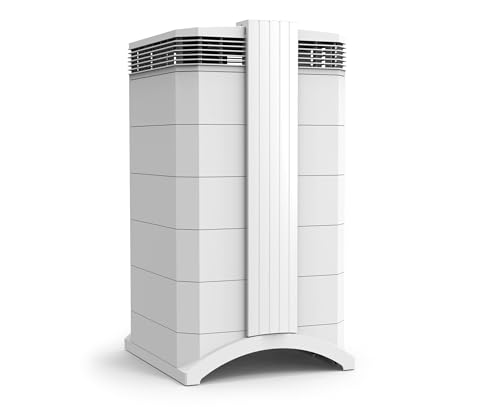
The HealthPro Plus suits households where allergy symptoms matter as much as smell, pairing the carbon stage with the strongest particle claim in this group. Air passes a pre-filter, then the V5-Cell cartridge, whose filter listing describes granular activated carbon blended with impregnated alumina, then a HyperHEPA stage rated on the listing at 99.5 percent capture down to 0.003 microns. The listing states coverage of up to 1,125 square feet and gives air delivery for each of six fan speeds, topping out at 300 cfm. The unit listing never publishes a carbon weight for the cartridge, so judge odor capacity on the cartridge design and stated two-year life.
Specs
- Filtration: PreMax pre-filter, V5-Cell gas and odor cartridge, HyperHEPA H12/13 filter
- Carbon stage: V5-Cell cartridge with granular activated carbon and impregnated alumina, per the filter listing
- Particle claim: At least 99.5 percent of particles down to 0.003 microns, per the listing
- Maximum coverage: Up to 1,125 sq. ft.
- Air delivery: Up to 300 cfm on the highest of six speeds, per the listing table
- Filter lives stated on the listing: V5-Cell 2 years; HyperHEPA 4 years and 2 months
- Dimensions and weight: 28 x 15 x 16 inches; 35 pounds
- Wattage: 160 watts
Best for: Allergy-sensitive homes that need litter and pet odor control in the same machine.
Watch out for: This long-running listing has presented different versions of the model over time, so confirm a live offer and check whether the page shows the standard HealthPro Plus or a newer variant before ordering.
ASIN: B002VXDCHW
Which One Fits Your Situation
Your living room hosts several animals around the clock
Go with the standard HealthMate. Its deep carbon and zeolite bed is the largest odor reservoir in this group by the figures the listings publish, and the stated coverage of up to 1,500 square feet matches an open room where dogs and cats circulate all day. The manual controls also suit a machine that simply runs continuously in one spot.
The litter corner shares air with a freshly renovated room
Pick the HealthMate Plus. The potassium iodide impregnated carbon in its listing is aimed at formaldehyde and similar gases, so the same bed that absorbs litter vapor also addresses the chemical background from new flooring, paint or furniture. You give up nothing on the particle side, since the HEPA stage matches the standard model.
Someone in the house reacts to dander, not just to smell
The HealthPro Plus is the fit here. Its listing leads with ultrafine particle capture down to 0.003 microns, far finer than the threshold quoted for the Austin Air units, while the V5-Cell cartridge still gives pet gases a genuine granular carbon bed to land on. It is the balanced choice when breathing symptoms outrank pure odor volume.
You want the fewest, most predictable filter changes
Both brands publish their schedules, but they differ in shape. The HealthMate folds everything into one combined filter, so a change is a single event separated by long intervals. The IQAir listing staggers its stages, with the carbon cartridge due first and the HyperHEPA filter lasting roughly twice as long, which spreads the work across separate, smaller swaps.
Common Mistakes
- Buying a purifier whose carbon stage is a thin coated sheet, then concluding that carbon does not work on pet odor when the smell returns within weeks.
- Comparing these deep-bed units on CADR alone, when their listings publish coverage, bed volume or air delivery instead and the gas stage is the actual point.
- Placing the machine in a hallway or spare room while the litter box sits two rooms away, then blaming the carbon for odors it never gets to process.
- Ignoring the finish and variant on the listing page, since each Austin Air colour and each IQAir version carries its own ASIN and its own availability.
- Waiting for a breakthrough smell before replacing the carbon stage; a saturated bed gives little warning, so the listing’s stated filter life is the schedule to follow.
Frequently Asked Questions
Why does pellet or granular carbon beat a carbon sheet for pet odor?
Odor molecules are gases, and trapping them is a contact game: the more carbon surface the air crosses, and the longer it lingers there, the more vapor gets adsorbed. A loose bed measured in pounds or hundreds of cubic inches offers vastly more surface than a coating on a sheet, so it keeps absorbing long after a thin filter has saturated.
Can one of these machines handle both dander and smell?
Yes, because the two problems are handled by two different stages in the same cabinet. The HEPA stages in these listings trap dander, hair fragments and dust, while the carbon bed behind or ahead of them adsorbs the gases that carry odor. Check that the listing you choose states real figures for both stages, as the three above do.
How will I know when the carbon stage is finished?
Carbon rarely announces its own end. The practical signal is odor creeping back despite the fan running and the pre-filter being clean, but the safer method is the calendar: each listing states a filter life for its carbon stage, and heavy pet loads argue for changing on the early side of that window rather than stretching it.
Should I run a deep-bed purifier all day or only when the room smells?
Continuous low-speed running suits these machines better than occasional blasts. Pet odor is produced around the clock, and a steady pass through the carbon bed keeps vapor levels from building up in soft furnishings, where they linger and re-release. Intermittent use lets smells settle into fabrics between sessions, which makes the room seem resistant even when the filter is working.