We independently review everything we recommend. When you buy through our links, we may earn a commission. As an Amazon Associate we earn from qualifying purchases.
Best Battery Operated RC Truck: 5 Tough 4WD Picks for Every Driver
Searching for the best battery operated RC truck? Compare five tough 4WD trucks on speed, runtime, scale, and durability to find the right one for you.
Searching for the best battery operated RC truck? Compare five tough 4WD trucks on speed, runtime, scale, and durability to find the right one for you.
The best battery operated RC truck for most drivers is the DEERC 9309E, a 1:16 scale 4WD monster truck with a metal drivetrain, a waterproof speed controller, and two included battery packs for up to 40 minutes of combined driving. It balances speed, toughness, and ready-to-run convenience better than anything else in its class, and it works just as well on grass and gravel as it does on pavement.
That said, the right truck depends on where you drive and who is holding the remote. A beginner needs a slower, tougher truck with an adjustable speed limit. A hobbyist chasing top speed needs a brushless motor and a larger scale. Someone who drives near ponds and puddles needs sealed electronics and an amphibious design. This guide compares five battery-operated RC trucks that cover those needs, explains how to read the specs that actually matter, and flags the trade-offs of each pick so you can buy once and drive happy.
Scale tells you how big the truck is relative to a full-size vehicle, and it shapes almost everything else about the driving experience. A 1:18 truck is compact enough to carry in a backpack and drive indoors, while a 1:10 truck has real presence on a trail and rolls over obstacles that would stop a smaller model. Larger trucks are generally more stable at speed and handle rough ground better, but they need more storage space and a bigger area to run in. For backyard driving, 1:16 and 1:12 scales hit a practical middle ground: big enough to handle grass and gravel, small enough to transport easily. Think about where the truck will live between runs before you fall in love with the biggest model on the page.
Brushed vs Brushless Motors
The motor is the single biggest divider in this category. Brushed motors are cheaper and perfectly fun for casual driving, but their internal brushes rub as they spin, so they run slower, waste more energy as heat, and wear down over time. Brushless motors have no brushes to grind away, so they run cooler, use the battery more efficiently, and last far longer. Most battery-operated RC trucks at entry-level prices use brushed motors, and that is fine for a first truck or a gift. If you plan to drive hard several times a week, or you want the highest top speeds, a brushless truck is worth the step up. All five trucks in this guide run on rechargeable batteries, and none of them uses nitro fuel or a gas engine.
Battery Type and Runtime
Every truck here ships with rechargeable battery packs, and most include two of them. Runtime claims usually describe combined driving time across both packs, not a single continuous run, so read the fine print. A 7.4V lithium pack is the common standard in this class, and higher milliamp-hour ratings generally mean longer sessions. Two packs matter more than one big pack, because you can swap in a fresh one while the other charges. Check whether the truck uses a standard connector and whether spare packs are easy to find, since a truck with a dead proprietary battery is a paperweight. Also note charge times: a truck that runs 20 minutes and takes two hours to charge needs that second pack far more than a truck with a fast charger.
Drivetrain and Terrain
Four-wheel drive is the feature that matters most for off-road use. A 4WD truck sends power to all four wheels, which keeps it moving through grass, loose dirt, gravel, and mud where a two-wheel-drive truck would spin and stall. All five picks in this guide are 4WD. Beyond the drivetrain, look at ground clearance, tire tread, and suspension. Big knobby tires grip loose surfaces, independent suspension keeps the wheels planted over bumps, and oil-filled shocks absorb hard landings better than simple spring shocks. If your driving is mostly smooth pavement and indoor floors, these features matter less. If your truck will see dirt, sand, and uneven lawns, they matter more than top speed.
Durability and Water Resistance
RC trucks crash. They hit curbs, flip on jumps, and roll down hills, so build quality decides how long the fun lasts. Metal parts in the drivetrain, such as the differential, drive shaft, and shocks, survive impacts that bend or snap plastic parts. A reinforced chassis and a protective bumper or roll cage add another layer of insurance, especially for new drivers who are still learning throttle control. Water resistance matters too: an IPX4-rated speed controller can handle puddles, wet grass, and light rain without shorting out. Fully waterproof trucks can drive through shallow water. If you drive near sprinklers, streams, or muddy trails, sealed electronics are worth paying for.
Control Range and Ease of Use
A 2.4GHz radio system is the modern standard, and it lets several trucks run side by side without interference. Control range varies from around 50 metres on small models to 100 metres or more on larger ones. Longer range matters in open fields; in a backyard, even a modest range is plenty. Ease of use matters just as much, especially for younger drivers. Look for a trigger-style controller with proportional steering and throttle, which gives finer control than simple on-off buttons. An adjustable top-speed setting is one of the most useful features a beginner truck can have, because a parent can cap the speed while a new driver learns, then raise it as skills improve.
Ready-to-Run vs Hobby Grade
Ready-to-run trucks arrive with everything in the box: the truck, the remote, batteries, and a charger. You open the box, charge the packs, and drive. Hobby-grade trucks may need a battery and charger bought separately, and they often accept upgrades and replacement parts. Toy-grade trucks are sealed and disposable when something breaks. Ready-to-run is the right choice for a first truck or a gift. Hobby grade suits drivers who already own batteries and a charger and want a platform they can repair and upgrade over time. Know which kind you are buying before you check out, so a missing battery does not turn delivery day into a disappointment.
The DEERC 9309E is the best all-round battery-operated RC truck in this guide, and it earns that spot with a balanced spec sheet rather than one headline number. Its 380 brushed motor is rated for speeds up to 42 km/h, which is quick enough to thrill an adult driver without being unmanageable for a teenager. The drivetrain is the real story: a metal differential, metal drive shaft, and oil-filled shocks hold up to repeated off-road abuse on dirt, grass, and gravel, where plastic drivetrains wear out fast.
Two 7.4V 1500mAh battery packs are included, extending combined runtime to roughly 40 minutes before a recharge is needed. An IPX4-rated waterproof speed controller lets the truck keep running through puddles, wet grass, and light rain. A rear wheelie bar and shock-absorbing suspension keep hard launches and rough landings in check, while bright LED headlights make it usable after dark. The radio control range tapers off past about 100 feet, so it suits backyards and parks more than wide-open fields. Only one charger is included, so both battery packs cannot top off at once. For most drivers, the 9309E is the truck to buy first.
The HAIBOXING 18859E is the budget-friendly way into 4WD off-road driving, and it has stayed popular for years because the formula works. This 1:18 scale truck pairs a brushed 380 motor with a 4WD drivetrain and a waterproof shell, and it is rated for speeds up to 36 km/h. That is quick enough to be fun on dirt trails and grass without being so fast that a new driver destroys it on the first run.
Two rechargeable batteries are included, so a session does not end the moment the first pack runs down. The reinforced chassis and independent suspension handle rocks and mud with more composure than most trucks at this size, and the compact 1:18 scale makes it easy to carry and store. The trade-offs are the ones you would expect at this level: a brushed motor that will not match brushless trucks for speed or longevity, and a plastic body that shows wear after hard crashes. For a first truck, a gift, or a second truck to run alongside a friend, the 18859E is a sensible pick that keeps the entry cost low while still delivering real off-road capability.
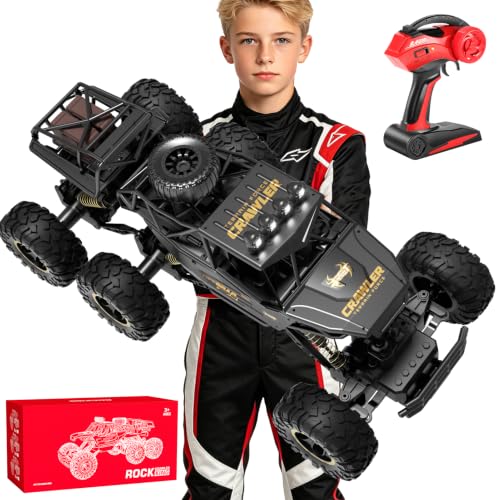
The Eoyeskido is the most imposing truck in this guide, and it stands apart with a six-wheel layout that none of the other picks can match. At 46 cm long, this 1:10 scale monster truck has real presence on a trail, and its deep-grip tires, 4WD system, and independent suspension are built for uneven ground. The extra pair of wheels spreads the load and adds traction on loose surfaces, which helps on climbs and rough terrain where a four-wheel truck might bog down.
Two included batteries provide up to 70 minutes of stated total runtime, the longest figure in this lineup, which means longer sessions between charges. The size is both the appeal and the compromise: at nearly half a metre long, it needs more storage and transport space than the compact trucks here, and it is best suited to open outdoor areas rather than tight indoor spaces. For drivers who want the biggest, most eye-catching truck in the group and have the room to run it, the Eoyeskido delivers a driving experience that feels a class above its size rivals.
The JONEALA is the specialist of this group, built for drivers who want to take their truck through water as well as over land. This 1:12 scale 4WD truck uses dual motors and a fully waterproof design, so it can drive through puddles, streams, and mud without worrying about the electronics. Independent shock absorbers soften impacts on rough ground, and rubber tires grip well on wet and dry surfaces alike.
Two included batteries extend playtime to about 60 minutes of stated total runtime, which is generous for a truck in this class. The 1:12 scale gives it a realistic presence without the bulk of a 1:10 model. As a partial fit for a general best-of list, it is worth noting that the amphibious design is the reason to buy this truck: if you never drive near water, a standard off-road truck offers similar land performance with a simpler setup. But if your driving includes ponds, puddles, and muddy trails, no conventional truck in this guide matches what the JONEALA can do.
The Jiakora is the most beginner-friendly truck in this guide, and it is the pick for younger drivers or anyone buying their first RC truck. Its ABS chassis and aluminium alloy frame withstand bumps and drops, while the 4×4 drivetrain and 45-degree climb ability tackle rough terrain with confidence. Non-slip silicone tires keep it moving on dirt, grass, or gravel, and independent suspension and shock absorbers smooth out the bumps.
Top speed is capped at 20 km/h, which is modest next to the faster trucks here, but that restraint is a feature for a first driver: it is quick enough to be fun and slow enough to survive the learning curve. Two rechargeable batteries extend playtime, and 2.4GHz non-jamming technology lets multiple trucks run together without interference. The trade-off is pace. Experienced drivers will outgrow the 20 km/h ceiling quickly, and the plastic body parts can scratch or scuff over time. For a first truck, though, the Jiakora gets the balance right.
What to Check Before You Buy
Before you order, confirm the listing matches the truck you researched: scale, motor type, battery count, and included accessories can vary between listings of similar-looking models. Check that the box includes the batteries and charger, since some hobby-grade trucks sell them separately. Read the stated runtime carefully and remember that combined runtime across two packs is not the same as a single continuous run. Look at the recommended age range and match the top speed to the driver, not just to your own enthusiasm. Finally, check that spare parts and extra battery packs are available for the model you choose, because a truck you can repair and keep running is worth more than a slightly faster truck you cannot fix. A few minutes of checking before you buy saves weeks of frustration after delivery.
FAQ
Are battery-operated RC trucks better than nitro RC trucks?
For most drivers, yes. Battery-operated trucks are quieter, cleaner, and simpler to run: you charge the packs and drive. Nitro trucks need fuel, tuning, and regular engine maintenance, and they are louder and messier. Nitro models can offer longer continuous run times and a different driving feel, but battery trucks have become fast and capable enough that most buyers never miss the engine. Battery power is also the better choice for neighbourhoods, parks, and indoor use.
How long does the battery last in an RC truck?
Most trucks in this guide run 20 to 40 minutes on a single pack, and all five include two packs, so combined runtime ranges from about 40 to 70 minutes depending on the model. Actual runtime varies with terrain, throttle use, and temperature: hard driving on grass drains a pack faster than gentle cruising on pavement. Swapping in a charged second pack is the simplest way to extend a session.
What scale RC truck should I buy?
For a first truck or a younger driver, 1:18 or 1:16 scale is a good starting point: compact, affordable, and easy to handle. For an older driver or someone who drives mostly outdoors, 1:12 or 1:10 scale offers more stability, better obstacle clearance, and a more realistic feel. Larger scales cost more and need more space, so match the scale to where the truck will actually be driven.
Do I need a brushless motor?
Not for casual driving. Brushed motors power most entry-level trucks and deliver plenty of fun at a lower cost. A brushless motor becomes worth it when you drive often, want higher top speeds, or want a motor that lasts longer without wearing out. If you are buying a first truck and are unsure how much you will use it, start brushed and upgrade later.
Can RC trucks drive in water?
Only if they are designed for it. Trucks with a waterproof speed controller and sealed electronics, like the DEERC 9309E, can handle puddles and wet grass. A fully waterproof amphibious truck like the JONEALA can drive through shallow water. A standard truck without water protection should stay out of puddles, because water can short the electronics and end the truck’s life in seconds.
Bottom Line
The best battery operated RC truck is the one that matches your terrain, your driver, and your patience for maintenance. The DEERC 9309E is the strongest all-round choice, with a metal drivetrain, waterproof electronics, and two batteries in the box. The HAIBOXING 18859E is the smart budget pick for a first truck. The Eoyeskido six-wheel monster truck brings the most presence and the longest stated runtime. The JONEALA is the only pick here that truly belongs in the water, and the Jiakora is the safest first truck for a younger driver. Whichever you choose, buy the truck with two batteries, a 4WD drivetrain, and sealed electronics, and you will spend your time driving instead of waiting on a charger.
Disclosure: As an Amazon Associate, we may earn from qualifying purchases.
W
Wildshot Editorial Team
We compare specs, materials and verified owner reviews before a product earns a spot. Rankings are never paid.
Affiliate disclosure. As an Amazon Associate we earn from qualifying purchases at no extra cost to you. Prices accurate as of the date shown.
Find the best SUV replacement battery for your vehicle. Compare group sizes, CCA, reserve capacity, and AGM vs flooded options in this guide before you buy.
Best battery life vs best performance explained: how the tradeoff works, which mode fits your day, and how to pick the right device without any regret.
Find the best AIO CPU coolers for quiet, high-performance builds. Compare 360mm liquid coolers by radiator size, fans, socket support, and fit before you buy.
Only three cylindrical purifiers on Amazon pair a particle prefilter with real carbon. Compare an 18 lb carbon bed, a Vocarb canister and a smart tower.
Compare electric start generators by running watts on each fuel, outlet type, tank size and start backup, with four Amazon listings that name electric start.


 Eoyeskido 1:10 Scale 6-Wheel 4WD RC Monster Truck
 JONEALA 4×4 Amphibious RC Truck
 Jiakora 1:12 Off-Road RC Truck